
DSSSB - 29 August 2019 (Shift-2)
Reasoning
Medium
Which of the following cubes in the answer figure CANNOT be made based on the unfolded cube in the question figure?
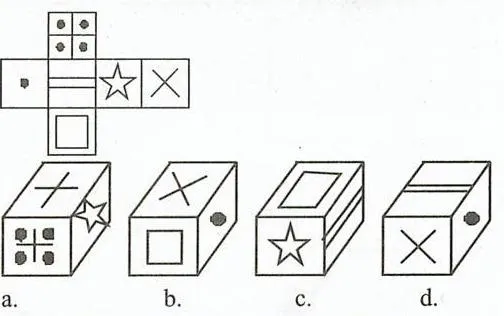
Appeared in: DSSSB - 29 August 2019 (Shift-2)
Explanation
- The core principle is that faces opposite each other on an unfolded net cannot be adjacent on the folded cube.
- From the net, the face with 'Two Lines' and the face with the 'Cross (X)' are identified as an opposite pair.
- Cube D depicts the 'Two Lines' face and the 'Cross' face sharing an edge, which is a geometric impossibility.
- Therefore, Cube D is the configuration that cannot be formed from the given net.
Why Other Options Were Wrong
- Option A: Cube A is a valid construction. It shows the 'Cross', 'Star', and 'Four Dots' faces. None of these are opposite pairs, and their orientation is consistent with the folded net.
- Option B: Cube B is a valid construction. It displays the 'Cross', 'Inner Square', and 'One Dot' faces. These faces are not opposite each other, and they can be arranged this way when the net is folded.
- Option C: Cube C is a valid construction. It shows the 'Two Lines', 'Star', and 'Inner Square' faces. No opposite pairs are shown, and this arrangement is a possible result of folding the net.
Related Visual

Clinical Relevance
- Nursing practice connection: This is primarily an exam-oriented knowledge point with limited direct bedside application, so retain Spatial reasoning and visualization of 3D objects from 2D nets as background academic context rather than a clinical decision trigger.
- While not a clinical question, spatial reasoning is a component of general intelligence and problem-solving skills, which are crucial for nurses.
- Nurses use spatial skills for tasks like understanding anatomical relationships, correctly placing equipment, and navigating complex clinical environments.
- What if? - If the question asked which cube can be formed, there could be multiple correct answers (A, B, and C are all possible). The negative framing ('CANNOT') is key to finding the single incorrect option.
How to Approach the Question
- First, carefully examine the unfolded net to identify the six distinct faces.
- The most effective strategy is to determine the pairs of opposite faces. In most nets, faces separated by one intervening face are opposite.
- List the three pairs of opposite faces. For this net, they are: (Four Dots vs. Inner Square), (One Dot vs. Star), and (Two Lines vs. Cross).
- Review each of the folded cube options (A, B, C, D).
- For each option, check if it shows any of the identified opposite pairs as adjacent (sharing an edge).
- The cube that depicts an opposite pair as adjacent is the one that cannot be formed and is the correct answer.
Concept Tested & Keywords
- Concept Tested: Spatial reasoning and visualization of 3D objects from 2D nets.
- Stem keywords: unfolded cube, cannot be made, answer figure, question figure
- Lead-in keywords: Which, CANNOT
- Negative lead-in flag: CANNOT
Question ID
QK-9t6rQeHi_EYO3_IZ1--
Practise the full DSSSB - 29 August 2019 (Shift-2)
Attempt every question from this paper in a timed mock, then review the full solution for each one.
More Cube & cuboid Questions
- Which of the following cubes in the answer figures CANNOT be made based on the unfold cube in the question figure?
- Which of the following cubes in the answer figure CANNOT be made based on the unfolded cube in the question figure?
- Which of the following cubes in the answer figure CANNOT be made based on the unfolded cube in the question figure?
More DSSSB - 29 August 2019 (Shift-2) Questions
- A person walks 5 km towards north and then turns towards east and walks 8 km. He then turns right and walks 10 km and again turns right and walk 6 km…
- Which two signs should be interchanged to make the below equation mathematically correct? 15 + 3 - 4 x 5 ./.3 \= 18
- Out of the given options three are similar in a certain manner. However one option is NOT like the other three. Select the option which is different…
- Out of the given options, three are similar in a certain manner. However, one option is NOT like the other three. Select the option which is differen…
- Some letters are numbered as 1, 2, 3, 4, 5 and 6. In the options, four possible arrangements of these numbers are given. Choose the option so that th…
- Read the given statement and conclusions carefully. Assuming that the information in the statement is true, even if they appear to be in variance wit…
- From the given answer figures, select the one in which the question figure is hidden/embedded? Question Figure: Answer Figures:
- Which of the following Venn diagrams best represents the relationship between horses, herbivores and domestic animals?
- Five friends were comparing their marks. Ranjan's marks was greater than Manish's mark but less than Geeta's. Ashish's marks was greater than Sonali'…
- Which answer figure will complete the pattern in the question figure?