
DSSSB -28 August 2019 (Shift-2)
Reasoning
Medium
Which of the following cubes in the answer figure CANNOT be made based on the unfolded cube in the question figure?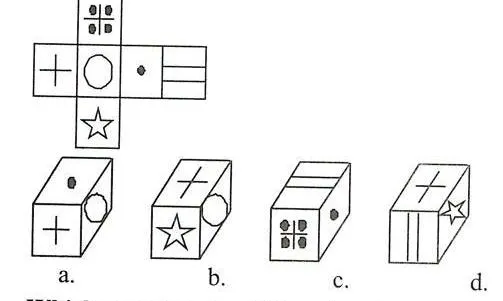
Appeared in: DSSSB -28 August 2019 (Shift-2)
Explanation
- The core principle for solving cube net problems is that faces opposite each other on the 2D net cannot be adjacent (share an edge) on the 3D folded cube.
- In the given net, the face with the 'plus' (+) symbol and the face with the 'dot' (.) symbol are in alternate positions in a straight line, making them opposite faces.
- The cube in Image A incorrectly shows the 'plus' face and the 'dot' face adjacent to each other.
- This arrangement is physically impossible when folding the given net, as opposite faces can never touch.
Why Other Options Were Wrong
- Option B: The cube in Image B is a valid construction. It shows the 'plus' (+), 'star' (☆), and 'circle' (O) faces. None of these are opposite to each other.
- Option C: The cube in Image C is a valid construction. It shows the 'three lines' (=), 'four dots', and 'dot' (.) faces. None of these are opposite to each other.
- Option D: The cube in Image D is a valid construction. It shows the 'plus' (+), 'three lines' (=), and 'star' (☆) faces. None of these are opposite to each other.
Related Visual

Clinical Relevance
- Nursing practice connection: This is primarily an exam-oriented knowledge point with limited direct bedside application, so retain Spatial Reasoning as background academic context rather than a clinical decision trigger.
- While not a clinical question, this type of logical reasoning problem assesses spatial awareness and problem-solving skills.
- Nurses utilize these cognitive skills daily for tasks such as organizing equipment in a sterile field, navigating complex hospital layouts, and interpreting spatial information from medical imaging.
- Strong problem-solving abilities are crucial for critical thinking and making sound clinical judgments under pressure.
How to Approach the Question
- First, carefully examine the unfolded 2D net of the cube provided in the question.
- Identify the pairs of opposite faces. A simple rule is that in a straight strip of faces, alternate faces are opposite. The two faces on the flaps are also opposite each other.
- Systematically analyze each of the four answer options (the folded 3D cubes).
- For each option, check if any of the visible adjacent faces correspond to a pair you identified as opposite.
- The cube that shows two opposite faces touching each other is the one that cannot be formed and is the correct answer.
- Remember the question asks which cube CANNOT be made, so you are looking for the impossible configuration.
Concept Tested & Keywords
- Concept Tested: Spatial Reasoning
- Stem keywords: unfolded cube, answer figure, CANNOT be made
- Lead-in keywords: CANNOT
- Negative lead-in flag: Question asks which option CANNOT be formed.
Question ID
Qoupcfq4M-bk7aYy726jVs
Practise the full DSSSB -28 August 2019 (Shift-2)
Attempt every question from this paper in a timed mock, then review the full solution for each one.
More Cube & cuboid Questions
- Which of the following cubes in the answer figures CANNOT be made based on the unfold cube in the question figure?
- Which of the following cubes in the answer figure CANNOT be made based on the unfolded cube in the question figure?
- Which of the following cubes in the answer figure CANNOT be made based on the unfolded cube in the question figure?
More DSSSB -28 August 2019 (Shift-2) Questions
- Read the given statement and conclusions carefully. Assuming that the information in the statement is true, even if they appear to be at variance wit…
- Out of the given options, three are similar in a certain manner. However, one option is NOT like the other three. Select the option which is differen…
- Five girls took part in a race. Rashi finished before Manisha but behind Garima. Ankita finished before Sakshi but behind Manisha. Who won the race?
- If a mirror is placed on the line MN, then which of the answer figures will be the right mirror image of the given figure?
- Out of the given options, three are similar in a certain manner. However, one option is NOT like the other three. Select the option which is differen…
- Which of the following answer figures completes the series of the question figure?
- Out of the given options, three are similar in a certain manner. However, one option is NOT like the other three. Select the option which is differen…
- Which two signs should be interchanged to make the below equation mathematically correct? (56+6) 8 × 3 + 3 \= 18
- Two men Kashish and Yash start from the same point. Kashish walks 0.3 km west, then turns north and walks 0.45 m, then turns to his right and walks 0…
- If 12$3 \= 51, 14$2 \= 43, 16$4 \= 79, then what is the value of 17$3?