
RRB Staff Nurse Jaipur-6th June 2018
Applied Anatomy
Easy
The spinal cord is made up of
Appeared in: RRB Staff Nurse Jaipur-6th June 2018
Explanation
- The spinal cord is a major component of the Central Nervous System (CNS) and functions as the primary pathway for information connecting the brain and the peripheral nervous system.
- It is composed of nervous tissue, which includes neurons (nerve cells) and neuroglia (supporting cells).
- This nervous tissue is organized into grey matter (containing cell bodies) and white matter (containing myelinated nerve fibers or axons).
- Neurons are responsible for transmitting electrical impulses, while neuroglia provide support, protection, and insulation.
Why Other Options Were Wrong
- Option B: Cardiac muscle is a specialized type of muscle tissue found exclusively in the walls of the heart. Its function is to pump blood, and it is not a component of the nervous system.
- Option C: Smooth muscle is found in the walls of hollow visceral organs like the intestines, bladder, and blood vessels. It controls involuntary movements like peristalsis. It is innervated by the nervous system but is not part of the spinal cord's structure.
- Option D: Striated muscle, also known as skeletal muscle, is attached to bones and is under voluntary control, enabling body movement. The spinal cord sends signals to these muscles but is not made of them.
Related Visual
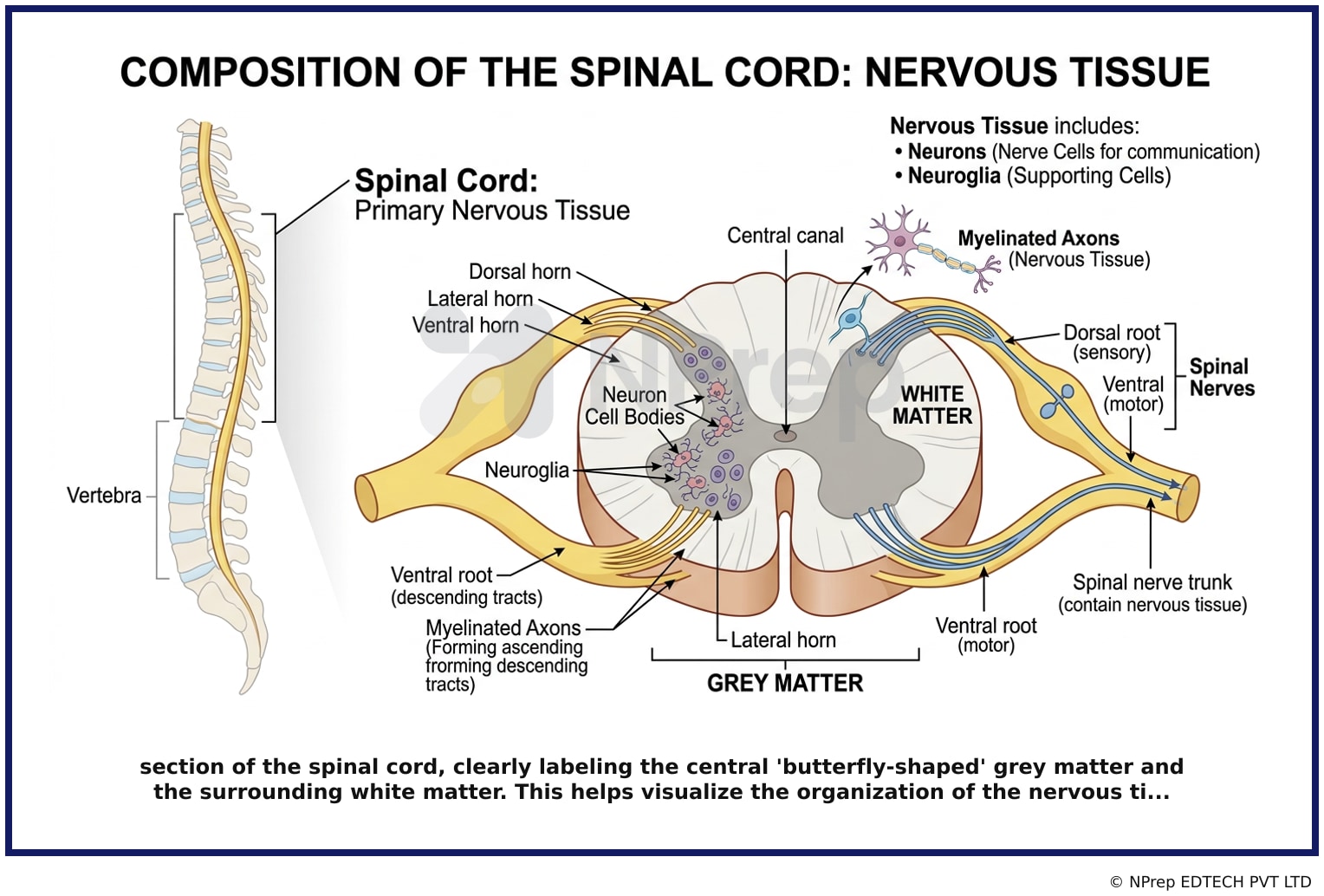
- Visual 1: Diagram - A cross-section of the spinal cord, clearly labeling the central 'butterfly-shaped' grey matter and the surrounding white matter. This helps visualize the organization of the nervous tissue.
- Visual 2: Table - A comparison of the four basic tissue types in the body (nervous, muscle, epithelial, connective), highlighting their key features and functions to provide broader context.
Clinical Relevance
- Nursing practice connection: This is primarily an exam-oriented knowledge point with limited direct bedside application, so retain Composition of the Spinal Cord as background academic context rather than a clinical decision trigger.
- Understanding that the spinal cord is made of nervous tissue is fundamental to comprehending the effects of spinal cord injury (SCI). Damage to this tissue can disrupt the flow of information, leading to paralysis, loss of sensation, and autonomic dysfunction below the level of injury.
- Nursing care for patients with SCI focuses on preventing further damage, managing symptoms, and supporting rehabilitation, all of which are based on the fragile and complex nature of nervous tissue.
- What if the question was about peripheral nerves instead of the spinal cord? The answer would still be nervous tissue, as peripheral nerves are bundles of axons (from neurons) and associated connective tissue that extend from the CNS to the rest of the body.
How to Approach the Question
- First, identify the key subject of the question, which is the 'spinal cord'.
- Recall the basic biological classification of tissues in the body: nervous, muscle, epithelial, and connective.
- Categorize the spinal cord's function. It's the main communication link between the brain and body, which points to it being part of the nervous system.
- Evaluate the given options. 'Nervous tissue' directly aligns with the function of the spinal cord.
- Recognize that 'cardiac', 'smooth', and 'striated' are all sub-types of muscle tissue, which has a primary function of contraction and movement, not information processing. This allows for their elimination as incorrect answers.
Concept Tested & Keywords
- Concept Tested: Composition of the Spinal Cord
- Stem keywords: spinal cord, made up of
- Lead-in keywords: BEST, MOST RELEVANT CLUE
Question ID
QEvxo-EQIsCh6qLkWaeJjO
Practise the full RRB Staff Nurse Jaipur-6th June 2018
Attempt every question from this paper in a timed mock, then review the full solution for each one.
More Nervous System Questions
- Which one of the following is the third cranial nerve?
- Identify the procedure done by the health care professional in the image below:
- Connection between right and left hemisphere is known as?
- A young adult who was hit by a car was fortunate because the level of his injury did not interrupt his respiratory function. The cord segment involve…
- Auditory area located in which lobe of the brain?
- A patient is unable to see downward and lateral movement of the eyes. Which of the following cranial nerve primarily would be affected?
- Pressure by the upper end of a crutch may cause injury to the?
- Which of the following is the largest cranial nerve?
- How many cervical nerves are there in the spinal cord?
- An injury to the upper brachial plexus results in?
More RRB Staff Nurse Jaipur-6th June 2018 Questions
- Complete the analogy Pearl : Necklace :: Flower : ?
- Find compound interest on Rs. 5000 at 12% p.a. for 1 year, compounded half-yearly.
- Chronic diarrhea is caused by
- Directions: In the following question, insert proper mathematical signs between the figures in the sum: If $\times$ means 'Minus'; $\div$ means 'Mult…
- If MEN is coded as MIN and WOMAN as WUMIN, then CHILD will be coded as
- The ligaments join
- On your way to take an examination, you suddenly get an attack of diarrhoea. If you stop at a nearby drug store for an over the counter opioid with a…
- Penicillin was discovered by
- Movements of the baby felt by the pregnant mother are known as
- The average of 25 results is 18. The average of first 12 of them is 14 and that of last 12 results is 17. Find the 13th result.