
Combined AIIMS - 2020 (Jodhpur, Bhopal, Patna, Raipur)
Nursing Foundation
Easy
The contraindications of the procedure shown in the following image is:
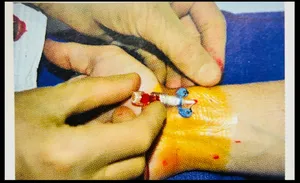
Appeared in: Combined AIIMS - 2020 (Jodhpur, Bhopal, Patna, Raipur)
Explanation
- The procedure shown is radial artery cannulation for an arterial line.
- A negative (abnormal) Allen's test is a major contraindication for this procedure.
- It signifies that the collateral blood supply to the hand from the ulnar artery is insufficient.
- Proceeding with cannulation despite a negative test creates a significant risk of ischemic injury to the hand if the radial artery becomes occluded.
Why Other Options Were Wrong
- Option A: Pulse pressure variation (PPV) is a measure of fluid responsiveness, and monitoring it is a key reason to place an arterial line, not a reason to avoid it.
- Option B: Hyperkalemia is an electrolyte disturbance that needs to be managed, but it does not directly affect the safety or feasibility of placing an arterial line in the wrist.
- Option D: Mechanically ventilated patients are often critically ill and are prime candidates for arterial lines. The line allows for continuous blood pressure monitoring and easy access for frequent arterial blood gas (ABG) sampling.
Related Visual

Clinical Relevance
- Nursing practice connection: This is primarily an exam-oriented knowledge point with limited direct bedside application, so retain Contraindications for Arterial Line Placement as background academic context rather than a clinical decision trigger.
- Patient safety is paramount. Always perform and correctly interpret the Allen's test before radial artery cannulation to prevent devastating complications like hand ischemia, necrosis, or loss of function.
- Documentation is key. The result of the Allen's test (positive or negative) must be documented in the patient's chart before the procedure is attempted.
- What if? If the Allen's test is negative on one wrist, the nurse or provider should assess the other wrist. If both are negative, an alternative site for arterial cannulation, such as the femoral or brachial artery, must be considered.
How to Approach the Question
- First, identify the procedure shown in the image. The location (wrist) and equipment (arterial catheter) point to radial artery cannulation.
- Next, understand the question. It asks for a contraindication, meaning a reason not to perform the procedure.
- Recall the specific safety checks required for radial artery cannulation. The most critical pre-procedure check is assessing collateral circulation.
- Evaluate each option: 'Pulse pressure variation' and 'Ventilated patients' are common reasons to perform the procedure (indications). 'Hyperkalemia' is an unrelated medical condition.
- This leaves 'Negative Allen's test'. A negative (abnormal) Allen's test directly indicates poor collateral circulation, which is the primary contraindication to prevent hand ischemia. Therefore, this is the correct answer.
Concept Tested & Keywords
- Concept Tested: Contraindications for Arterial Line Placement
- Stem keywords: contraindications, procedure, image
- Lead-in keywords: is
- Clinical cues: Image shows cannulation of the radial artery at the wrist.
Question ID
Qj_Tk-Lz1BORrpqkD3cgVe
Reference Book
E6 Anatomy Grays 43e Vol 2 Part 2 p. 73-75
E6 Medicine Harrison 22e Part 1 p. 1903-1905
Practise the full Combined AIIMS - 2020 (Jodhpur, Bhopal, Patna, Raipur)
Attempt every question from this paper in a timed mock, then review the full solution for each one.
More Nursing Care & Specific Procedures Questions
- Identify the procedure done in the given image:
- Match the following:
- Look at the image and tell which of the following is incorrect combination:
- Identify the airway used in emergency in the following image:
- According to hospital's protocol during emergency situation "code pink" is used for which condition?
- Which is the appropriate nursing action by nursing officer after taking ABG sample from radial artery?
- The common veins used for placement of central line are all; EXCEPT:
- Who discovered Catgut suture?
- The sutures used to close deep, multi-layer lacerations are:
- You are preparing to suction a patient who is intubated with a 4.5 mm endotracheal tube (ETT). What size suction catheter would you choose to minimiz…
More Combined AIIMS - 2020 (Jodhpur, Bhopal, Patna, Raipur) Questions
- The position used for most of the gynecological procedures?
- Thyroid eye disease (TED) is also known as:
- How many items are included in the WHO surgical safety checklist: SITOSO?
- In iron deficiency anemia, the fingernails become spoon shaped, this condition is referred to as:
- Which of the following code is associated with cardiac arrest during medical emergency?
- How is blood loss measured in Post-partum hemorrhage?
- The traction used for cervical spine injury:
- In operation theater during cauterization, the electric current passing from a single electrode is called:
- Tracheostomy is done in which tracheal ring?
- The instrument used for measuring fetal heart rate (FHR):