
UPPSC 2023
Medical Surgical Nursing
Easy
The commonest cause of brain stroke is -
Appeared in: UPPSC 2023
Explanation
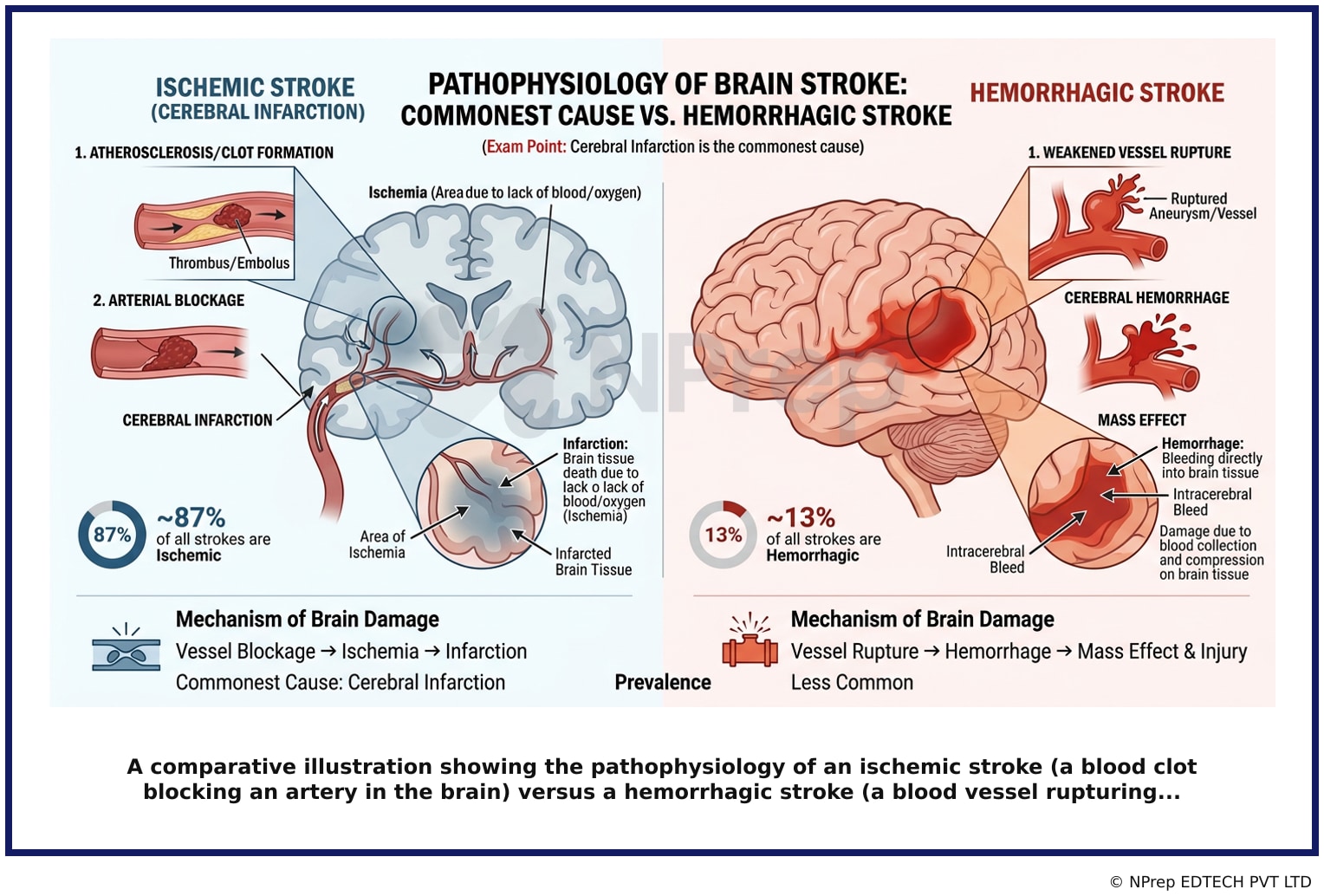
- Cerebral infarction is a type of ischemic stroke, which is the most prevalent form of cerebrovascular disease.
- It occurs due to the blockage of a blood vessel supplying the brain, most commonly by an embolus or a thrombus.
- This blockage leads to ischemia (lack of blood flow) and subsequent death (infarction) of brain tissue.
- Ischemic strokes account for approximately 87% of all stroke cases, making cerebral infarction the most common cause.
Why Other Options Were Wrong
- Option A: A tuberculoma is a space-occupying lesion resulting from a tuberculosis infection in the brain. While it causes neurological symptoms, it is an infectious granuloma, not a primary vascular event like a stroke.
- Option B: Neurocysticercosis is a parasitic infection of the brain caused by the larvae of the pork tapeworm. It is a leading cause of adult-onset seizures worldwide, not the most common cause of stroke.
- Option C: A stroke is, by definition, a non-traumatic cerebrovascular event. Head injury causes traumatic brain injury (TBI), which is a distinct pathological process involving external mechanical forces.
Related Visual
Clinical Relevance
- Nursing practice connection: This is primarily an exam-oriented knowledge point with limited direct bedside application, so retain Etiology and Types of Stroke as background academic context rather than a clinical decision trigger.
- Recognizing the signs of stroke is critical for nurses. The FAST acronym (Face drooping, Arm weakness, Speech difficulty, Time to call emergency services) is a key tool for rapid assessment and patient education.
- For ischemic stroke (cerebral infarction), time is brain. There is a narrow therapeutic window (typically 3 to 4.5 hours) for administering thrombolytic therapy (like tPA), which can dissolve the clot and restore blood flow.
- Nurses play a vital role in the acute stroke team, including monitoring vital signs, performing frequent neurological assessments, and preparing the patient for diagnostic imaging (CT scan) to differentiate between ischemic and hemorrhagic stroke.
How to Approach the Question
- First, identify the core of the question: it asks for the 'commonest cause' of a 'brain stroke'.
- Recall the major categories of stroke: ischemic and hemorrhagic.
- Access your knowledge about the prevalence of these types. Remember that ischemic strokes are far more common than hemorrhagic strokes.
- Evaluate the options. 'Cerebral infarction' is the medical term for tissue death caused by ischemia.
- Analyze the other options: Tuberculoma and Neurocysticercosis are infectious/parasitic conditions, and Head Injury is traumatic. These are different categories of neurological disease and not the primary definition or most common cause of a stroke.
- Conclude that cerebral infarction, being the outcome of the most common type of stroke (ischemic), is the correct answer.
Concept Tested & Keywords
- Concept Tested: Etiology and Types of Stroke
- Stem keywords: commonest cause, brain stroke
- Lead-in keywords: commonest
Question ID
Q5T3KpbnDI_zOHDvW5L-Y4
Reference Book
E6 Pathology- ROBBINS & COTRAN PATHOLOGIC BASIS OF DISEASE 10TH Ed p. 1251-1253
E6 Ghai Essential Pediatrics(pp 26-904 of 913) pp. 587-589, 591-593
Practise the full UPPSC 2023
Attempt every question from this paper in a timed mock, then review the full solution for each one.
More Nervous system Questions
- A patient presents to the OPD with the complaint of back pain and weakness in both lower limbs. Which of the following findings would suggest compres…
- What is the early sign of increased ICP (Intracranial pressure)?
- A 28 year old patient admitted in the hospital for suspected brain tumour. While assessing the patient the alzon nurse would keep in mind that the mo…
- In Myasthenia Gravis, why does repetitive nerve stimulation show a decremental response?
- Which of the following "device/instrument" is used in Cervical spinal cord injuries?
- Doctor has advised the nurse to prepare the room for a patient with a spinal cord injury (at C7 level). Which one of the following is most essential…
- Mr. Santos, 18 year old student, is admitted to the ward with a diagnosis of epilepsy. He tells the nurse that he is experiencing a generalized tingl…
- A client with C4 spinal cord injury is at greatest risk for?
- What is the minimum possible score of Glasgow Coma Scale?
- Patient with increased ICP is receiving Inj. Mannitol. The nurse's understanding about the reason for administration of this drug is?
More UPPSC 2023 Questions
- Which of the following is not an antonym pair?
- Select the correct option for synonymous words from the following –
- Match List-I with List-II and select the correct answer from the code given below – List-I (A) Kanh (B) Ghar (C) Ada (D) Aath List-II (1) Asht (2) Aa…
- Match the adjectives in List-I with their nouns in List-II and select the correct answer from the code given below – List-I (Adjective) (A) Poisonous…
- The correct word for the phrase 'a student who lives near or with the teacher' is –
- Words that have come from Sanskrit in a distorted form are called –
- For which sentence or phrase is the word 'Paaragat' (expert/mastered) used?
- There are two statements about the adjective given below. Select the correct option from the assertion-based code – Assertion – (1) An adjective desc…
- Match List-I with List-II and select the correct answer using the code given below – List-I (Word) (A) Indra (B) Kamal (Lotus) (C) Ganga (D) Stri (Wo…
- Match List-I with List-II and select the correct answer using the code given below – List-I (Word) (A) Pravritti (Tendency) (B) Niramish (Vegetarian)…