
AIIMS Delhi NO - 2017
Medical & Surgical Nursing
Easy
See the following image and identify this?
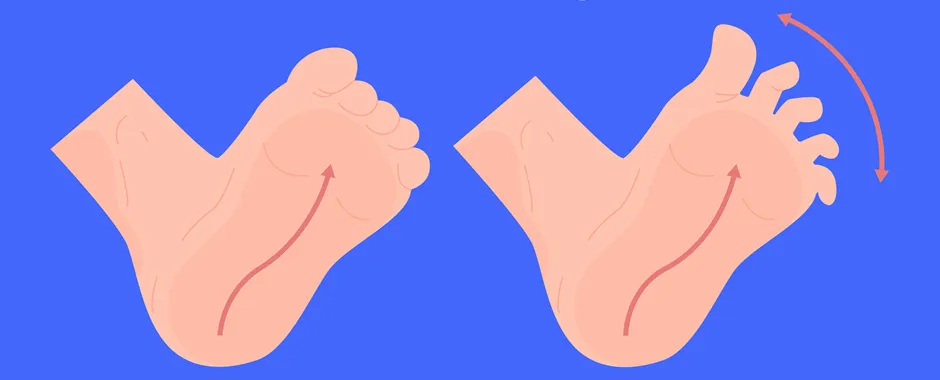
Appeared in: AIIMS Delhi NO - 2017
Explanation
- The image displays the classic signs of a positive Babinski reflex, which is an abnormal plantar response in adults.
- The stimulus involves stroking the lateral sole of the foot, leading to the response of dorsiflexion (upward movement) of the great toe and fanning (abduction) of the other toes.
- This specific response is named the 'Positive Babinski reflex' and is a more precise description than simply 'Abnormal plantar reflex'.
- In adults, this sign indicates a lesion in the upper motor neurons, specifically the corticospinal tract.
Why Other Options Were Wrong
- Option A: A normal plantar reflex in an adult involves the toes curling downward (plantar flexion), which is the opposite of what is shown in the image.
- Option B: While a positive Babinski reflex is indeed an abnormal plantar reflex, 'Positive Babinski reflex' is the more specific and clinically precise term for the signs depicted. In medical questions, the most specific correct answer is preferred.
- Option D: A negative Babinski reflex is the term for a normal plantar response, where the toes curl downward. The image clearly shows an upward-going toe.
Related Visual

Clinical Relevance
- Nursing practice connection: This is primarily an exam-oriented knowledge point with limited direct bedside application, so retain The concept tested is the identification and interpretation of the plantar reflex, specifically the Babinski sign, as part of a neurological assessment as background academic context rather than a clinical decision trigger.
- Nurses perform neurological assessments to detect changes in a patient's condition. Identifying a new-onset positive Babinski sign is a critical finding that must be reported to the physician immediately as it can indicate acute neurological deterioration, such as from a stroke.
- This reflex helps differentiate between upper motor neuron (UMN) and lower motor neuron (LMN) diseases. It is present in UMN lesions but absent in LMN lesions.
- What if? If the patient in the image was a 6-month-old infant, a positive Babinski reflex would be a completely normal finding, as the nervous system is still maturing. It only becomes pathological after about 2 years of age.
How to Approach the Question
- First, carefully analyze the image provided. Identify the action being performed (stimulus) and the resulting reaction (response).
- In this image, the stimulus is stroking the sole of the foot. The response is the big toe moving up and the other toes fanning out.
- Recall your knowledge of neurological reflexes. This specific sign is known as the Babinski reflex or sign.
- Evaluate the options based on your identification. A 'positive' Babinski sign is exactly what is shown.
- Differentiate between the options. 'Normal plantar reflex' and 'Negative Babinski reflex' describe the opposite (normal) response. 'Abnormal plantar reflex' is correct but general. 'Positive Babinski reflex' is the most specific and accurate term.
- Select the most precise and correct medical term that describes the visual evidence.
Concept Tested & Keywords
- Concept Tested: The concept tested is the identification and interpretation of the plantar reflex, specifically the Babinski sign, as part of a neurological assessment.
- Stem keywords: image, identify, reflex
- Lead-in keywords: identify
- Clinical cues: The visual cue of the great toe extending upward and other toes fanning out is the classic sign of a positive Babinski reflex.
Question ID
QgmcDSFEwW-aFidddrZMi-
Reference Book
E6 Medicine Harrison 22e Part 2 p. 1285-1287
E6 Physiology Essentials Sembulingam 10e Part 3 p. 69-71
E6 Nursing Brunner Adult Health 3SA Vol 2 Part 2 p. 12-14
Practise the full AIIMS Delhi NO - 2017
Attempt every question from this paper in a timed mock, then review the full solution for each one.
More Neurologic Function Questions
- Which of the following is a differentiating test between mucus and cerebrospinal fluid (CSF) from a nasal discharge?
- The nurse is posted in ED and patient comes with seizure. The priority management of seizure patient is:
- In the following picture, little finger under jaw is used because for:
- Parkinson's disease is characterized by deficiency of neurotransmitter.
- All of the following are complications of spinal cord injury (SCI); EXCEPT:
- A Patient with Parkinson's syndrome receives continuous levodopa to prevent what complication?
- During RTA, a person has a stroke, then his pupils are?
- A 28 year old patient was admitted to the hospital for a suspected brain tumor. While assessing the patient, the nurse would keep in mind that the mo…
- A patient develops an acute confusion (delirium) state. What would be the priority nursing Intervention?
- Pain at lower back and legs when flexed of knee flexes is known as?
More AIIMS Delhi NO - 2017 Questions
- Which is a live attenuated vaccine?
- The injection haloperidol is given intramuscularly by which technique?
- One of the most initial things that should be done by a nurse while going to a home visit?
- Most common type of shock in a trauma patient?
- Most common cause of hypotension in trauma patients?
- CSF draining from the nose and ear occurs in which type of skull fracture?
- Allen test should be performed before?
- Identify the appropriate action based on the Vaccine Vial Monitor (VVM) shown in the image.
- Identify the following image?
- Pentavalent vaccination site in infant?