
AIIMS Delhi NO- 2019
Medical & Surgical Nursing
Easy
In the following picture, little finger under jaw is used because for:
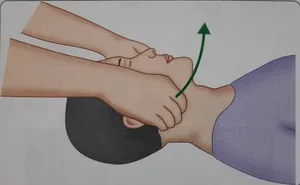
Appeared in: AIIMS Delhi NO- 2019
Explanation
- The image shows the jaw-thrust maneuver, an essential first-aid technique.
- In this maneuver, the rescuer's fingers are placed at the angle of the mandible (lower jaw).
- The purpose of this hand placement is to apply force to physically lift the mandible upward and forward.
- This action pulls the tongue away from the back of the throat (posterior pharynx), thereby opening the airway.
Why Other Options Were Wrong
- Option B: While the jaw-thrust maneuver is specifically chosen for patients with suspected cervical spine (C-spine) injuries to AVOID moving the neck, the act of lifting the jaw itself does not stabilize the spine. Stabilization is achieved by the rescuer's overall body and hand positioning, keeping the head in a neutral line.
- Option C: The term 'extend the jaw' is anatomically imprecise. The maneuver involves protruding or thrusting the jaw forward, not extending it in the way a joint is typically extended. 'Lifting the mandible' is a more accurate description of the action.
- Option D: This is incorrect because option A accurately describes the primary purpose of the finger placement in the jaw-thrust maneuver.
Related Visual

Clinical Relevance
- Nursing practice connection: This is primarily an exam-oriented knowledge point with limited direct bedside application, so retain Airway Management Techniques as background academic context rather than a clinical decision trigger.
- The jaw-thrust is the primary airway opening technique for unconscious trauma patients, as it minimizes movement of the cervical spine.
- Nurses and first responders must be proficient in this skill as part of Basic Life Support (BLS) and Advanced Cardiac Life Support (ACLS) protocols.
- What if? If the patient is unconscious but has no signs of trauma (e.g., a simple faint), the head-tilt, chin-lift maneuver is the preferred method because it is often quicker and easier to perform.
How to Approach the Question
- First, identify the procedure shown in the image. Recognize the hand placement on the jaw as the jaw-thrust maneuver.
- Second, recall the primary purpose of this maneuver, which is to open the airway.
- Third, analyze the specific action of the fingers. The fingers are positioned at the angle of the jaw to provide the lifting force.
- Evaluate the options based on this understanding. 'To lift mandible angle' is the most direct and accurate description of this action.
- Eliminate other options by considering the nuances. The maneuver is safe for C-spine injuries but doesn't cause stabilization. 'Extend' is an imprecise term for the jaw movement.
Concept Tested & Keywords
- Concept Tested: Airway Management Techniques
- Stem keywords: jaw-thrust maneuver, airway management, mandible
- Lead-in keywords: used because for
- Clinical cues: Image depicts a hands-on medical procedure on the head and neck.
Question ID
QaURO_2FGRY61HcWd8vrr2
Reference Book
E6 Anatomy Applied Ashalatha 4e p. 96-98
E6 Anatomy Grays 43e Vol 2 Part 1 pp. 21-23, 115-117
Practise the full AIIMS Delhi NO- 2019
Attempt every question from this paper in a timed mock, then review the full solution for each one.
More Neurologic Function Questions
- Which of the following is a differentiating test between mucus and cerebrospinal fluid (CSF) from a nasal discharge?
- The nurse is posted in ED and patient comes with seizure. The priority management of seizure patient is:
- Parkinson's disease is characterized by deficiency of neurotransmitter.
- All of the following are complications of spinal cord injury (SCI); EXCEPT:
- A Patient with Parkinson's syndrome receives continuous levodopa to prevent what complication?
- During RTA, a person has a stroke, then his pupils are?
- A 28 year old patient was admitted to the hospital for a suspected brain tumor. While assessing the patient, the nurse would keep in mind that the mo…
- A patient develops an acute confusion (delirium) state. What would be the priority nursing Intervention?
- Pain at lower back and legs when flexed of knee flexes is known as?
- Haemato-tympanum and otorrhoea are associated with which of the following head injuries?
More AIIMS Delhi NO- 2019 Questions
- A nurse is preparing to give bath to admitted patient with perineal problem. Which of the following will help the patient?
- In the absence of nurse from floor, patient falls from bed. This type of injury belongs to:
- Patient's Medical record with all essential information is responsibility of:
- Post-partum women having bleeding within 24 hrs after delivery is called:
- In which condition, distal pulse is preferred rather than apical pulse?
- A pre-eclampsia woman's baby is lying with her mother. Neonate is born in 37 weeks. After 57 hours, when nurse is monitoring vital signs of baby, tem…
- A woman with 3rd day postpartum has complaint of engorgement in both breasts. What is cut off temperature for fever in postpartum women?
- Universal blood donor?
- WHO hand wash time with soap?
- Why it is necessary to remove dark coloured nail paint before surgery?