
Bihar NHM CHO-2025
Reasoning
Medium
Read the given statements and conclusions carefully. Assuming that the information given in the statements is true, even if it appears to be at variance with commonly known facts, decide which of the given conclusions logically follow(s) from the statements.
Statements:
All biscuits are cookies.
Some biscuits are wafers.
Conclusions:
(I) Some cookies are wafers.
(II) Some wafers are not biscuits.
Appeared in: Bihar NHM CHO-2025
Explanation
- The core logic rests on the combination of a universal statement ('All A are B') and a particular statement ('Some A are C').
- Since 'All biscuits are cookies', any biscuit that has another property (like being a wafer) automatically transfers that property to the 'cookie' category.
- Statement 2 confirms 'Some biscuits are wafers'. Because these biscuits are also cookies (from Statement 1), it logically necessitates that 'Some cookies are wafers'.
Why Other Options Were Wrong
- Option A: This option incorrectly assumes Conclusion (II) is valid. The statements do not provide enough information to definitively conclude that some wafers are not biscuits. This is a possibility, but not a logical certainty.
- Option B: This option incorrectly validates Conclusion (II) while ignoring the valid Conclusion (I). Conclusion (I) is a direct and certain deduction from the premises.
- Option C: This option incorrectly dismisses Conclusion (I), which is a logically sound deduction based on the given statements.
Related Visual
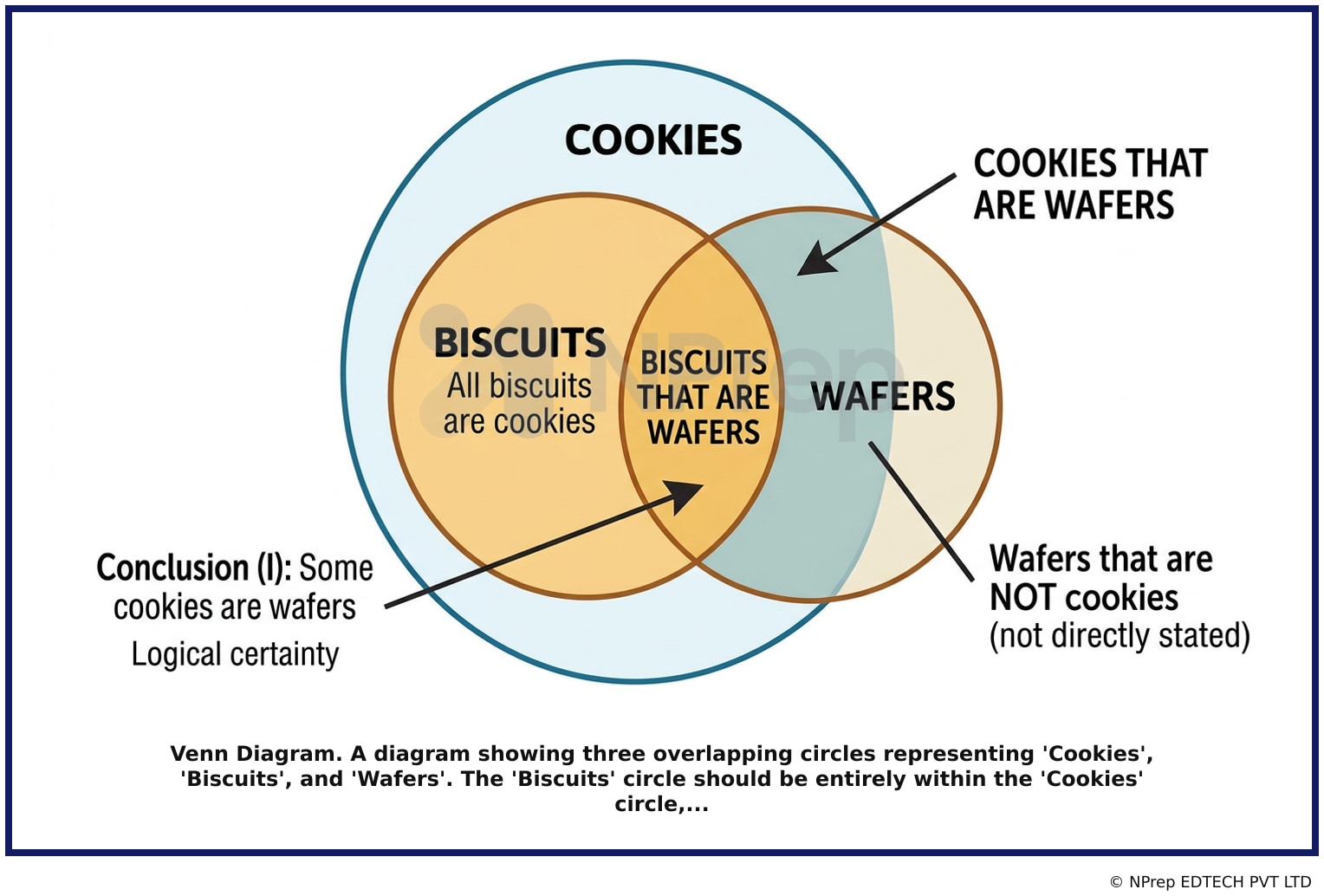
- Visual 1: Venn Diagram. A diagram showing three overlapping circles representing 'Cookies', 'Biscuits', and 'Wafers'. The 'Biscuits' circle should be entirely within the 'Cookies' circle, and the 'Wafers' circle should overlap with the 'Biscuits' circle. This visually demonstrates that the intersection of Biscuits and Wafers must also be an intersection of Cookies and Wafers.
Clinical Relevance
- Nursing practice connection: This is primarily an exam-oriented knowledge point with limited direct bedside application, so retain Syllogism and Logical Deduction as background academic context rather than a clinical decision trigger.
- This question type is not directly related to clinical nursing but tests analytical and logical reasoning skills.
- These skills are crucial for nurses in clinical decision-making, interpreting patient data, and following complex protocols where understanding logical relationships (e.g., if-then scenarios) is essential for patient safety.
- What if? If Statement 2 was 'No biscuits are wafers', then the conclusion 'No cookies that are biscuits are wafers' would follow, but we couldn't conclude anything about the relationship between cookies in general and wafers.
How to Approach the Question
- First, identify the type of statements (universal 'All' or particular 'Some').
- Translate the statements into a visual representation, like a Venn diagram. This is the most reliable method.
- Draw a large circle for the universal category ('Cookies'). Place the subject of the 'All' statement ('Biscuits') completely inside it.
- Now, draw the circle for the third item ('Wafers') to satisfy the second statement ('Some biscuits are wafers') by making it overlap with the 'Biscuits' circle.
- Examine each conclusion one by one and check if it MUST be true based on your diagram. If a conclusion is only possibly true, it is not a logical deduction.
- Select the option that reflects your analysis of the conclusions.
Concept Tested & Keywords
- Concept Tested: Syllogism and Logical Deduction
- Stem keywords: All biscuits are cookies, Some biscuits are wafers, Statements, Conclusions
- Lead-in keywords: logically follow(s)
- Negative lead-in flag: false
Question ID
QiB98Yy3yoTOj_fn0tWsUR
Practise the full Bihar NHM CHO-2025
Attempt every question from this paper in a timed mock, then review the full solution for each one.
More Statement-Based Reasoning Questions
- Read the below statements taking them as true even if they seem to be at variance from the commonly known facts. Then choose the option that represen…
- Statement : Malware infections can be prevented by using antivirus software, antimalware, regular software upgrades and avoid downloading attachments…
- Statement: A large number of people die every year due to drinking polluted water during the summer course of action I - The government should make a…
- Read the given statement and conclusions carefully. Assuming that the information in the statement is true, even if they appear to be in variance wit…
- In each question below is given a statement followed by two conclusions numbered I and II. You have to assume everything in the statement to be true,…
- In this question below are given two statements followed by two conclusions numbered I and II. You have to take the given two statements to be true e…
- Read the given statement and conclusions carefully. Assuming that the information in the statement is true, even if they appear to be at variance wit…
- Read the given statement and conclusions carefully. Assuming that the information in the statement is true, even if they appear to be in variance wit…
- All women are good, but some women are not bad. Therefore \ \ \ \ \ \ \ \ :
- Read the given statements and conclusions carefully. Assuming that the information given in the statements is true, even if they appear to be at vari…
More Bihar NHM CHO-2025 Questions
- Why is prime agricultural land typically excluded from energy project developments in India?
- The Schedule of the Constitution contains provisions regarding the recognition of official languages.
- Which major policy change regarding Foreign Direct Investment (FDI) in India's insurance sector was proposed in the 2025 Union Budget?
- Which phenomenon causes the deflection of southwest monsoon winds after they cross the equator and approach India?
- Which pH indicator acts as a Bronsted-Lowry base, accepting protons in acidic solutions and changing colour from yellow to red?
- Who among the following founded the Arya Samaj in 1875 in Bombay (now Mumbai)?
- Solar panels, which are responsible for generating electricity, are made of a special layer of which element?
- As per the 2025 Census, which Indian state now hosts 891 Asiatic lions, marking a 32% increase from 2020 numbers?
- What is the purpose of the Quantum Valley Tech Park, established in Amaravati, Andhra Pradesh in 2025?
- Which intellectual founded the Tattvabodhini Sabha to promote Vedantism and oppose Christianity?