
AIIMS Nagpur NO- 2020
Biochemistry & Nutrition
Hard
Ketone bodies are found in urine of patients with uncontrolled diabetes due to:
Appeared in: AIIMS Nagpur NO- 2020
Explanation
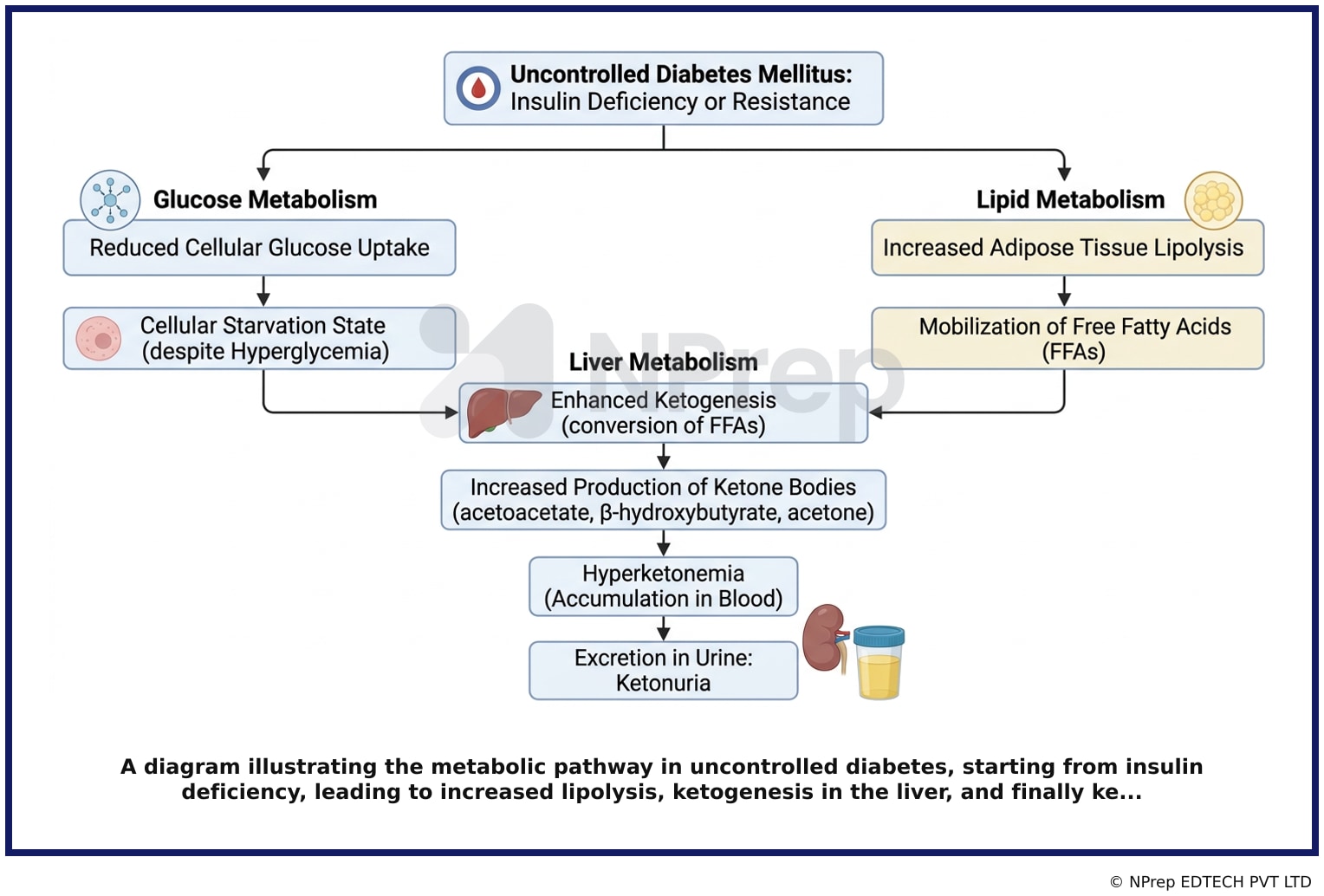
- In uncontrolled diabetes, insulin deficiency or resistance prevents cells from utilizing glucose for energy, creating a state of cellular starvation despite high blood sugar.
- To compensate, the body dramatically increases the breakdown of fat stores (lipolysis) into free fatty acids.
- The liver metabolizes these fatty acids through a process called ketogenesis, which produces ketone bodies (acetoacetate, β-hydroxybutyrate, and acetone) as byproducts.
- When ketone production exceeds the body's ability to use them for energy, they accumulate in the blood (ketonemia) and are excreted in the urine (ketonuria).
Why Other Options Were Wrong
- Option A: The primary metabolic byproduct of protein catabolism is urea, not ketone bodies. While some amino acids are ketogenic, fat is the main source of ketones in diabetic ketoacidosis.
- Option C: Impaired kidney function is a potential consequence of the dehydration and acidosis associated with diabetic ketoacidosis (DKA), not the cause of ketone production. Ketones are produced in the liver.
- Option D: Glucose does not decompose into ketones. The core problem is the body's inability to metabolize glucose, which triggers the switch to fat metabolism. High blood sugar is the problem, not the source of ketones.
Related Visual
Clinical Relevance
- Nursing practice connection: This is primarily an exam-oriented knowledge point with limited direct bedside application, so retain Pathophysiology of ketonuria in diabetes mellitus as background academic context rather than a clinical decision trigger.
- Urine ketone testing is a critical nursing intervention for patients with Type 1 diabetes, especially during illness, stress, or when blood glucose is consistently high (e.g., greater than 250 mg/dL).
- The presence of moderate to large ketones in the urine is a red flag for impending or existing Diabetic Ketoacidosis (DKA), a life-threatening medical emergency requiring immediate intervention with insulin and fluids.
- Patient education should emphasize when and how to test for ketones and to seek medical help promptly if ketones are present, as this indicates a severe lack of insulin.
How to Approach the Question
- First, identify the core clinical condition presented: 'uncontrolled diabetes'. This immediately signals a problem with insulin and glucose metabolism.
- Analyze the question's core 'ask': It wants the reason ('due to') for the presence of 'ketone bodies in urine'.
- Recall the primary function of insulin: it acts like a key to let glucose into cells for energy.
- Deduce the consequence of 'uncontrolled diabetes': without effective insulin, glucose stays in the blood, and cells starve.
- Consider the body's backup fuel plan. When glucose is unavailable, the body turns to its fat reserves.
- Connect this backup plan to the question's keyword. The breakdown of fat (fat metabolism) produces ketone bodies as a byproduct. This directly links the cause (fat breakdown) to the effect (ketones).
Concept Tested & Keywords
- Concept Tested: Pathophysiology of ketonuria in diabetes mellitus
- Stem keywords: Ketone bodies, urine, uncontrolled diabetes
- Lead-in keywords: due to
- Negative lead-in flag: false
Question ID
Q83ZupsQvY09zHXw3zvZRQ
Reference Book
E6 Biochemistry U Satyanarayana— Part 1 (pp 26-420 of 840) p. 287-289
E6 Textbook of Biochemistry for medical StudentsDM Vasudevan Part 1 (pp 26-370 of 370) p. 226-228
E6 Pathology- ROBBINS & COTRAN PATHOLOGIC BASIS OF DISEASE 10TH Ed p. 1105-1107
Practise the full AIIMS Nagpur NO- 2020
Attempt every question from this paper in a timed mock, then review the full solution for each one.
More Lipids Questions
- Lipid profile does not include?
- Emulsification of lipids in the small intestine requires?
- Which of the following enzymes converts fats into fatty acids and glycerol?
- Identify an enzyme that is useful for digestion of fat?
- Ketone bodies are synthesized from?
- Transportation of triglycerides from liver to adipose tissues is the function of which of the following lipoproteins?
- Fatty acids linked to sugar molecules are called:
- Which of the following is considered an essential fatty acid?
- Ketone bodies appear in the blood and urine when fats are being oxidized in great amounts. The condition is associated with?
- In a person on hunger strike from past three days which of the following urinary tests would give a positive reaction?
More AIIMS Nagpur NO- 2020 Questions
- An order for prednisolone reads 10 mg four times a day. The dose for the child is 2 mg/kg/day. How many pounds does the child weigh?
- Which type of leadership theories consider people inherit certain qualities that make them better suited to leadership?
- An acid-fast bacillus which is pathogenic:
- Which of the following helps prevent water loss through skin?
- What is the major nursing responsibility when administering sulfonamide preparation?
- Based on the knowledge of electroconvulsive treatment, the nurse explains to the student nurses that atropine is given before the treatment primarily…
- These agents decreases intestinal muscle tone to slow passage of feces:
- Assessing the laboratory findings which results would the nurse most likely to expect to find in a client with chronic renal failure?
- Epidemic dropsy is due to:
- The ability of a person to readily recover from stressful situations is called: