
NORCET-11 Mains
Child Health Nursing (Pediatrics)
Easy
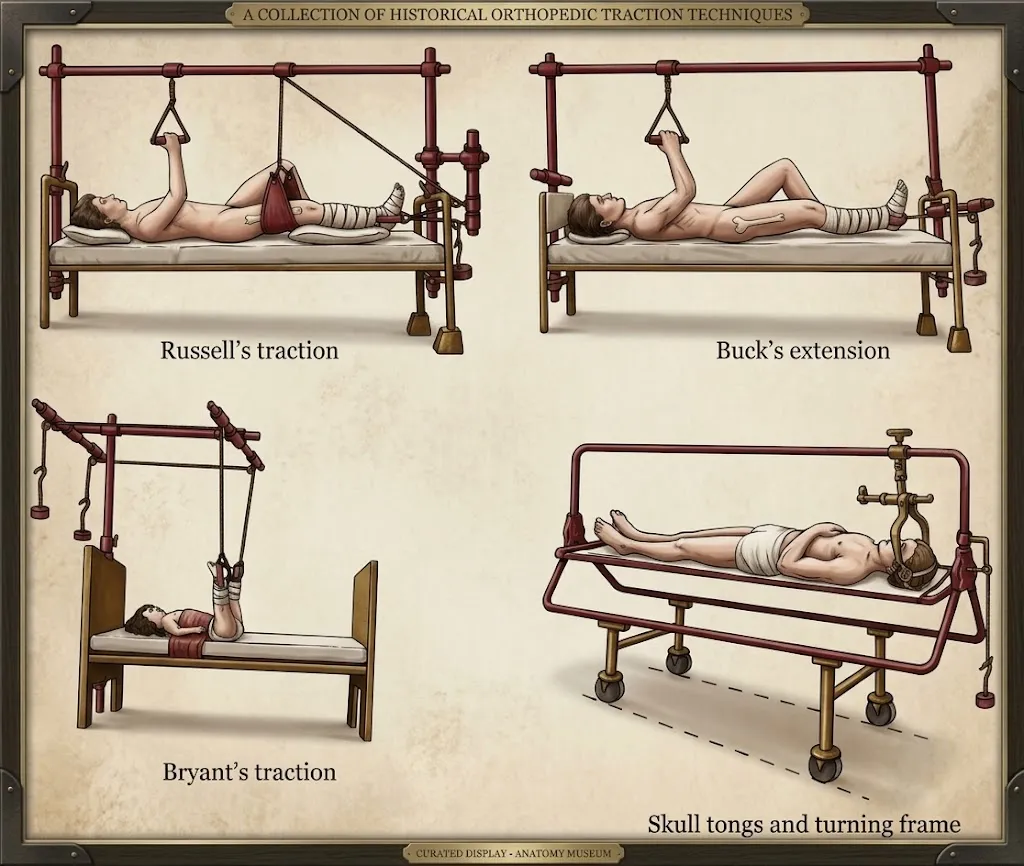
Identify the traction shown, used for a femur fracture in a child under 2 years.

Appeared in: NORCET-11 Mains
Explanation
- The image shows a child with both legs suspended vertically at a 90-degree angle to the hips, which is characteristic of Gallows or Bryant traction.
- This type of traction is specifically indicated for the treatment of femoral shaft fractures in children under the age of 2 or those weighing less than 15 kg (35 lbs).
- The traction uses the child's body weight for counter-traction, effectively aligning the fractured bone segments for healing.
- The key visual cue is the vertical suspension of both legs, with the buttocks slightly lifted off the bed.
Why Other Options Were Wrong
- Option A: Hamilton-Russell traction involves a different setup, typically using a sling under the knee and a system of pulleys to create both upward and longitudinal pull. It is not the vertical suspension shown in the image.
- Option B: Russell extension traction is similar to Hamilton-Russell traction. It uses a knee sling and a pulley system to apply a balanced pull, but it does not involve suspending both legs straight up in the air as seen with Bryant traction.
- Option D: Buck traction is a form of skin traction where the pulling force is applied horizontally along the length of the leg. The leg is not suspended vertically.
Clinical Relevance
- Nursing practice connection: This is primarily an exam-oriented knowledge point with limited direct bedside application, so retain Pediatric Orthopedic Traction as background academic context rather than a clinical decision trigger.
- The primary nursing responsibility for a child in Bryant's traction is frequent and meticulous neurovascular assessment due to the high risk of compromised blood flow to the lower legs, which can lead to Volkmann's ischemia, a devastating complication.
- Nurses must ensure the traction is effective by maintaining proper body alignment, ensuring weights hang freely, and checking that the child's buttocks are just slightly elevated off the mattress.
- What if? If the child in the image was 5 years old, Bryant's traction would be contraindicated due to the increased risk of vascular compromise. A different method, such as traction with a spica cast or flexible intramedullary nailing, would be considered.
How to Approach the Question
- First, carefully analyze the image. Note the key features: an infant, both legs suspended straight up (vertically), and the buttocks slightly off the bed.
- Next, read the question stem carefully. It specifies the injury (femur fracture) and the patient's age group (child under 2 years).
- Correlate the visual information with the clinical context. The combination of vertical leg suspension in an infant for a femur fracture is a classic presentation.
- Evaluate the options. Compare the definition of each traction type with your visual analysis.
- Eliminate options that do not match the visual evidence. Buck's and Russell's tractions do not involve bilateral vertical suspension.
- Select the option that perfectly matches both the image and the clinical indication provided in the question.
Concept Tested & Keywords
- Concept Tested: Pediatric Orthopedic Traction
- Stem keywords: traction, femur fracture, child under 2 years
- Lead-in keywords: Identify
- Clinical cues: Image shows bilateral vertical leg suspension in an infant.
- Clinical cues: Patient is a child under 2 years old.
Question ID
Q9S83SEERZHGPzmRxin6BE
Reference Book
E6 Nursing Brunner Adult Health 3SA Vol 1 Part 4 p. 125-127
E6 Nelson Textbook of Pediatrics(2024) — Volume 2 p. 2092-2094
Practise the full NORCET-11 Mains
Attempt every question from this paper in a timed mock, then review the full solution for each one.
More Orthopedic disorders Questions
- What is the meaning of Talipes equinus?
- The 12-year-old boy has fractured his arm. After the injury is casted, the nurse has to perform all of the following assessments, except?
- Which is a form of orthopaedic traction primarily used to treat femoral shaft fractures and developmental dysplasia of the hip in children under four…
- The most frequent incomplete fracture in children, in which the bone is twisted, is called \ \ \ \ \ \ .
- A positive Ortolani Sign indicates?
- Common type of fracture in children?
- The most severe complication after fracture reduction in children is?
- Ortolani's Sign is the main symptom of which disease?
- Gallow's traction is used for?
- The common type of fracture among children is?
More NORCET-11 Mains Questions
- A 42-year-old client presents with acute chest pain. Which type of myocardial infarction is shown on the ECG?& x20;
- A postoperative day 1 client after coronary artery bypass grafting has a sudden decrease in drain output from 50 mL to 0 mL, hypotension, and distend…
- A client with atrial fibrillation suddenly develops a heart rate of 175 to 195 per minute, blood pressure of 80/50 mmHg, chest pain, dizziness, and o…
- A patient underwent femoral artery catheterization. After the procedure, the affected leg becomes numb and pale, with decreased circulation and a wea…
- A client is on postoperative day 5 after coronary artery bypass grafting. Vital signs are temperature 39 degrees Celsius, heart rate 130 per minute i…
- A patient on a mechanical ventilator has a low-pressure alarm. Oxygen saturation is falling and respiratory rate support is not being maintained. Ini…
- A polytrauma client on mechanical ventilation develops a high-pressure alarm, airway secretions, and oxygen saturation falls to 82 percent. What is t…
- A client is brought unconscious with pinpoint pupils and a respiratory rate of 8 per minute. What is the first priority?
- A known diabetic client comes to the emergency department with a random blood sugar of 400 mg/dL, Kussmaul respirations, and a serum potassium of 5.8…
- A client with diabetic ketoacidosis has a serum potassium of 3.0 mEq/L. The physician prescribes an insulin infusion and IV potassium. What should th…