
RUHS, Jaipur, M.Sc Nursing Entrance Exam-2015
Obstetrics and Midwifery Nursing
Easy
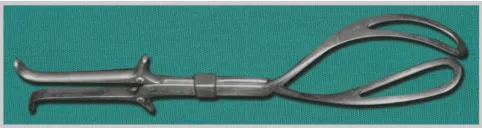
Identify the obstetric instrument shown?
Appeared in: RUHS, Jaipur, M.Sc Nursing Entrance Exam-2015
Explanation
- The instrument shown is Kielland's forceps, identified by its unique design features.
- The most prominent feature is the sliding lock on the shanks, which is specifically designed to correct for asynclitism (a tilted fetal head).
- It has a minimal pelvic curve (it is nearly straight), which allows it to be safely rotated within the maternal pelvis to correct fetal malposition, such as in deep transverse arrest.
- Its primary function is rotation of the fetal head, unlike other forceps which are mainly for traction.
Why Other Options Were Wrong
- Option A: Wrigley's forceps are much shorter and have a pronounced pelvic curve. They are not designed for rotation.
- Option B: Piper's forceps have very long shanks with a specific downward-curving perineal bend to fit around the fetal body.
- Option C: Das forceps are a type of long, curved obstetric forceps used for traction, similar to Simpson's forceps. They have a standard English lock and a significant pelvic curve, making them unsuitable for rotation.
Related Visual

Clinical Relevance
- Nursing practice connection: This is primarily an exam-oriented knowledge point with limited direct bedside application, so retain Identification of obstetric instruments based on their specific morphological features and clinical applications as background academic context rather than a clinical decision trigger.
- Correct identification and use of obstetric instruments are critical nursing and medical competencies in the labor room. Using the wrong instrument can lead to significant maternal and fetal trauma.
- For example, attempting to rotate the fetal head with a non-rotational forceps (like Das or Wrigley's) could cause severe vaginal, cervical, or uterine lacerations for the mother and skull fractures or nerve palsies for the fetus.
- A nurse assisting in an instrumental delivery must be able to anticipate the needs of the obstetrician by identifying the correct instrument for the specific clinical scenario (e.g., rotation vs. traction).
How to Approach the Question
- First, carefully examine the image of the instrument provided in the question.
- Identify its most distinct characteristics. In this case, note the overlapping shanks with a sliding lock, the minimal curvature of the blades, and the fenestrated (open) design of the blades.
- Recall the specific features of the different types of obstetric forceps listed in the options.
- Wrigley's are short outlet forceps. Piper's have a special curve for breech deliveries. Das forceps are standard traction forceps.
- Kielland's forceps are uniquely characterized by their sliding lock (for asynclitism) and minimal pelvic curve (for rotation).
- Match the features observed in the image to the correct description to arrive at the answer.
Concept Tested & Keywords
- Concept Tested: Identification of obstetric instruments based on their specific morphological features and clinical applications.
- Stem keywords: obstetric instrument, identify
- Lead-in keywords: Identify
Question ID
QpG3aepCPT1cOiY30BZMbt
Reference Book
E6 Midwifery Obstetrics and Gynecology Nursing Sandeep Kaur p. 27-35
E6 Obstetrics Williams p. 28-47
Practise the full RUHS, Jaipur, M.Sc Nursing Entrance Exam-2015
Attempt every question from this paper in a timed mock, then review the full solution for each one.
More Introduction Questions
- Which of the following will have the highest boiling point?
- Due to Frenkel defect, the density of the ionic solids?
- Electrolysis of water produces hydrogen and oxygen in the ratio?
- Identify an element with the lowest melting point?
- \ \ \ \ \ \ are atoms having the same mass number but different atomic numbers?
- Select the option that completes the following chemical reaction by giving the formula of the products X and Y. 2Na + 2CH₃CH₂OH → X + Y
- What is the primary objective of launching India's first National Biofoundry Network under the BioE3 policy in August 2025?
- In the presence of sunlight, chlorine is added to hydrocarbons in a very fast reaction. Chlorine can replace the hydrogen atoms one by one. It is cal…
- Which of the following elements is a diatomic molecule?
- In India, abortion was legalized by 'Medical Termination of Pregnancy' in?
More RUHS, Jaipur, M.Sc Nursing Entrance Exam-2015 Questions
- Example of ball and socket joint is?
- Excessive exercise without rest results in accumulation of carbon dioxide and Lactic acid and this causes fatigue in muscles. Therefore, what advice…
- Which of the following test is done to find out the difference between the demographic variables of the groups?
- A failure in lymphatic system to return body fluids adequately results in?
- The trachea or wind pipe is made up of cartilage rings; shape of the rings is?
- Which of the following is a master gland which influences the endocrine glands?
- One of the functions of cerebellum is to?
- Most of the infections spread to the ear from throat through?
- Food cooked in copper utensils lose ascorbic acid quickly because it?
- Lipids can be stored in the body as a food resource because they are?