
DSSSB - 29 August 2019 (Shift-2)
Child Health Nursing (Pediatrics)
Easy
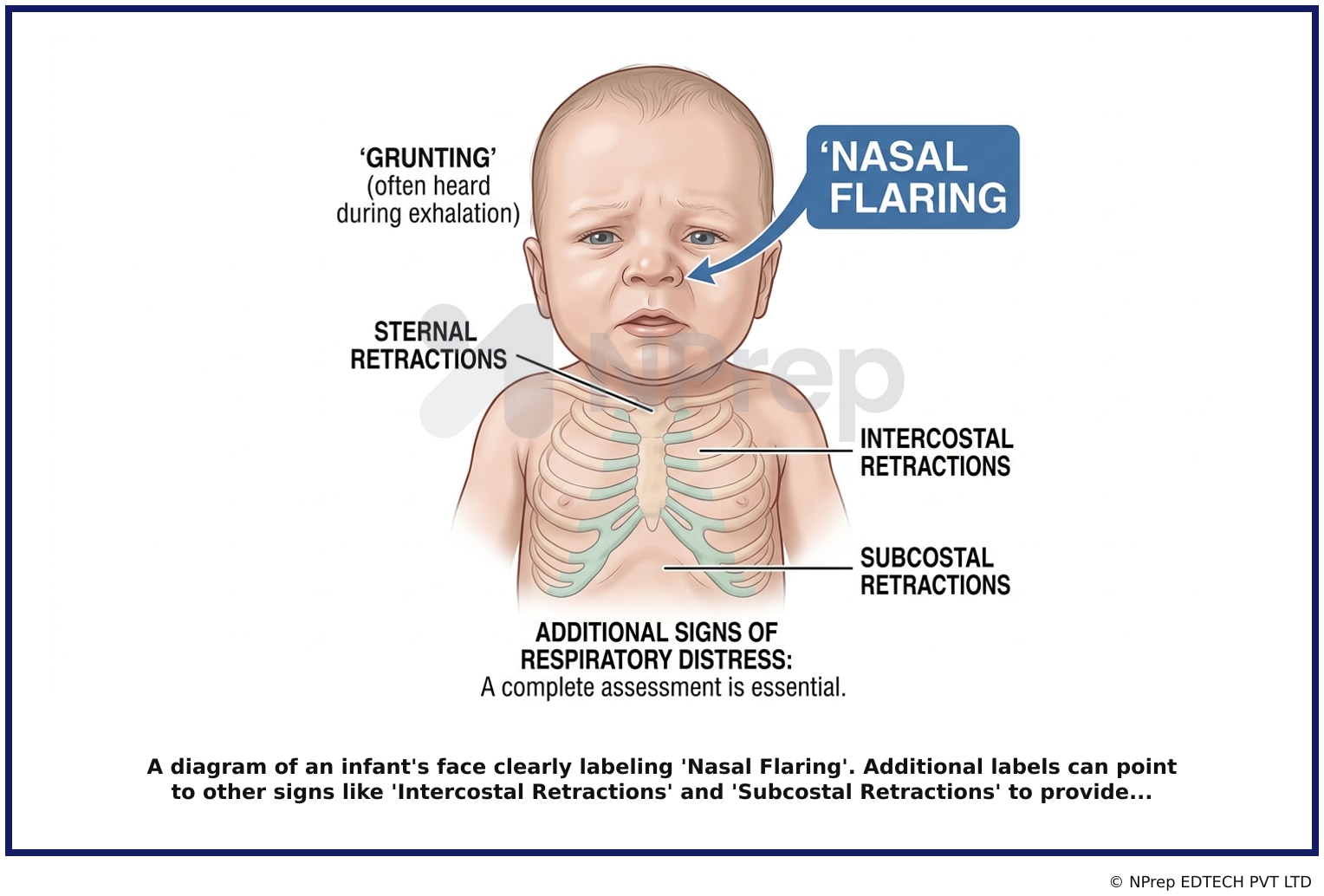
Flaring of the nostrils might indicate?
Appeared in: DSSSB - 29 August 2019 (Shift-2)
Explanation
- Nasal flaring is a cardinal sign of respiratory distress, indicating an increased work of breathing.
- It is a compensatory mechanism where the alae nasi muscles contract to widen the nasal passages, thereby reducing airway resistance.
- This action helps to increase the volume of air inhaled, which is particularly crucial for infants who are obligate nasal breathers.
- Its presence signals that the patient is actively struggling to get enough air.
Why Other Options Were Wrong
- Option A: A congenital anomaly is a structural defect present at birth. While it can cause breathing problems, nasal flaring is the resulting sign of distress, not the anomaly itself.
- Option B: Cyanosis is the bluish discoloration of the skin from poor circulation or inadequate oxygenation. It is a sign of hypoxia, which can occur with respiratory distress, but it is not what nasal flaring directly indicates.
- Option C: An injury, such as chest trauma or an airway obstruction from a foreign body, can lead to respiratory distress. However, the flaring is the sign of the body's response to the breathing difficulty caused by the injury, not the injury itself.
Related Visual
Clinical Relevance
- Nursing practice connection: This is primarily an exam-oriented knowledge point with limited direct bedside application, so retain Clinical signs of respiratory distress as background academic context rather than a clinical decision trigger.
- Early recognition of nasal flaring by a nurse is critical for timely intervention to prevent the progression to respiratory failure, especially in pediatric patients.
- A nurse must perform a complete respiratory assessment, looking for other signs like retractions, grunting, and abnormal respiratory rates to determine the severity of the distress.
- What if? If nasal flaring is accompanied by a slowing respiratory rate, lethargy, and cyanosis, it signifies exhaustion and impending respiratory arrest, requiring immediate emergency airway management and ventilation support.
How to Approach the Question
- First, identify the key clinical sign mentioned in the question: 'flaring of the nostrils'.
- Understand that the question is asking for the direct clinical condition that this sign indicates.
- Evaluate each option to determine its relationship to the sign.
- Differentiate between a direct sign (the body's compensatory action), an associated finding (a consequence like cyanosis), and a potential cause (an anomaly or injury).
- Select the option that represents the most immediate and accurate interpretation of the physical finding. Nasal flaring is a direct manifestation of the body's effort to breathe, which defines respiratory distress.
Concept Tested & Keywords
- Concept Tested: Clinical signs of respiratory distress
- Stem keywords: Flaring of the nostrils, indicate
- Lead-in keywords: BEST, MOST RELEVANT CLUE
Question ID
Qvj33SVj1A6AHPfT4GR-ms
Reference Book
E6 Nelson Textbook of Pediatrics(2024) — Volume 2 p. 330-332
E6 Nelson Textbook of Pediatrics(2024) — Volume 1 p. 657-659
Practise the full DSSSB - 29 August 2019 (Shift-2)
Attempt every question from this paper in a timed mock, then review the full solution for each one.
More Newborn Infants Questions
- When palpating the abdomen of hypertrophic pyloric stenosis infant, the Nurse finds:
- A pre-eclampsia woman's baby is lying with her mother. Neonate is born in 37 weeks. After 57 hours, when nurse is monitoring vital signs of baby, tem…
- Normally enteral feedings are flushed with water to open blocked tube and ease feeding. In which area it is done with air?
- A nurse is advised to give injection vitamin K for new born baby. The route and dose of Vitamin K is:
- Identify the following instrument used in hyperbilirubinemia monitoring based on the image:
- Which of the following equipment is used in Neonatal Resuscitation program?
- All of the following are the benefits of KMC (Kangaroo mother care); EXCEPT:
- Waxy or cheese like white substance found coating the skin of newborn human baby is known as:
- Identify 'at risk' infants from the following:-
- What is the normal length of the neonate body?
More DSSSB - 29 August 2019 (Shift-2) Questions
- A person walks 5 km towards north and then turns towards east and walks 8 km. He then turns right and walks 10 km and again turns right and walk 6 km…
- Which two signs should be interchanged to make the below equation mathematically correct? 15 + 3 - 4 x 5 ./.3 \= 18
- Out of the given options three are similar in a certain manner. However one option is NOT like the other three. Select the option which is different…
- Out of the given options, three are similar in a certain manner. However, one option is NOT like the other three. Select the option which is differen…
- Some letters are numbered as 1, 2, 3, 4, 5 and 6. In the options, four possible arrangements of these numbers are given. Choose the option so that th…
- Read the given statement and conclusions carefully. Assuming that the information in the statement is true, even if they appear to be in variance wit…
- From the given answer figures, select the one in which the question figure is hidden/embedded? Question Figure: Answer Figures:
- Which of the following Venn diagrams best represents the relationship between horses, herbivores and domestic animals?
- Five friends were comparing their marks. Ranjan's marks was greater than Manish's mark but less than Geeta's. Ashish's marks was greater than Sonali'…
- Which answer figure will complete the pattern in the question figure?