
AIIMS Nagpur NO- 2020
Applied Microbiology & Infection control
Easy
Causative organism of infectious mononucleosis is:
Appeared in: AIIMS Nagpur NO- 2020
Explanation
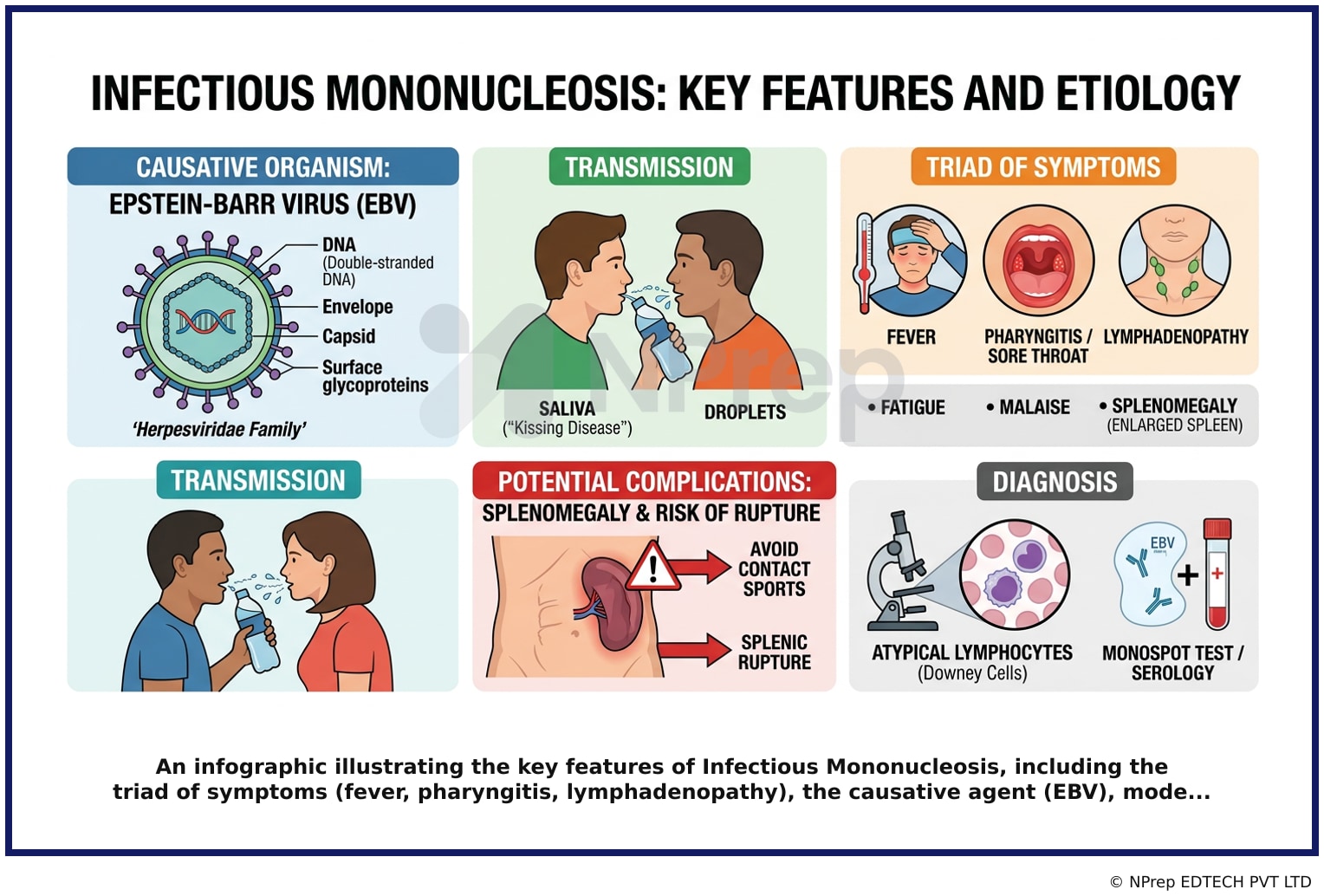
- Infectious mononucleosis, also known as 'glandular fever' or the 'kissing disease,' is primarily caused by the Epstein-Barr virus (EBV).
- EBV is a member of the Herpesviridae family and is one of the most common human viruses, infecting over 90% of adults worldwide.
- The virus is transmitted through saliva and infects B lymphocytes, leading to the classic triad of symptoms: fever, pharyngitis (sore throat), and lymphadenopathy (swollen lymph nodes).
- Diagnosis is confirmed by the presence of atypical lymphocytes on a blood smear and positive serologic tests for EBV-specific antibodies.
Why Other Options Were Wrong
- Option A: Cytomegalovirus (CMV) can cause a mononucleosis-like illness, especially in immunocompromised individuals, but it is a distinct entity from classic infectious mononucleosis caused by EBV. It is a common cause of 'heterophile-negative' mononucleosis.
- Option B: Toxoplasma is a protozoan parasite (Toxoplasma gondii), not a virus. It causes toxoplasmosis, which can present with some similar symptoms like swollen lymph nodes, but it is a different disease with a different mode of transmission (e.g., undercooked meat, cat feces).
- Option D: Varicella-zoster virus is another member of the herpesvirus family, but it is responsible for causing chickenpox (varicella) and shingles (herpes zoster). These diseases are primarily characterized by a vesicular skin rash, not the symptoms of mononucleosis.
Related Visual
Clinical Relevance
- Nursing practice connection: This is primarily an exam-oriented knowledge point with limited direct bedside application, so retain Etiology of Infectious Mononucleosis as background academic context rather than a clinical decision trigger.
- Nurses play a key role in educating patients with mononucleosis about the importance of rest, hydration, and symptom management (e.g., gargling with salt water for sore throat).
- A critical patient safety instruction is to avoid contact sports and strenuous activities for at least 3-4 weeks to prevent splenic rupture, a rare but life-threatening complication of splenomegaly.
- What if? If a patient with confirmed mononucleosis suddenly develops sharp, severe pain in the upper left abdomen, the nurse must recognize this as a potential sign of splenic rupture and initiate emergency medical protocols immediately.
How to Approach the Question
- First, identify the core of the question, which is to name the causative organism for a specific disease: 'infectious mononucleosis'.
- This is a factual recall question common in microbiology. Access your knowledge base about common pathogens and the diseases they cause.
- Evaluate each option. Epstein-Barr virus is classically and most commonly linked to infectious mononucleosis.
- Consider the other options to confirm your choice. CMV causes a similar illness but isn't the primary cause. Toxoplasma is a parasite, and Varicella-zoster causes chickenpox/shingles. This process of elimination confirms the correct answer.
Concept Tested & Keywords
- Concept Tested: Etiology of Infectious Mononucleosis
- Stem keywords: causative organism, infectious mononucleosis
- Lead-in keywords: is
- Negative lead-in flag: false
Question ID
QmhEDgiMP_44T7wE6R-8uK
Reference Book
E6 Medicine Harrison 22e Part 1 p. 1549-1551
E6 Ghai Essential Pediatrics(pp 26-904 of 913) p. 233-235
E6 Nelson Textbook of Pediatrics(2024) — Volume 1 p. 2012-2014
Practise the full AIIMS Nagpur NO- 2020
Attempt every question from this paper in a timed mock, then review the full solution for each one.
More Pathogenic Organisms Questions
- An acid-fast bacillus which is pathogenic:
- Which among the following is a Gram-positive organism?
- What is the causative organism for Syphilis?
- Who discovered virus in biology?
- Which vector causes Zika virus disease?
- All of the following diseases caused by viruses, except?
- What does SARS stand for?
- What is the name of the organism responsible for tuberculosis?
- What causes the spread of chickenpox?
- When was the first case of HIV detection confirm. ?
More AIIMS Nagpur NO- 2020 Questions
- An order for prednisolone reads 10 mg four times a day. The dose for the child is 2 mg/kg/day. How many pounds does the child weigh?
- Which type of leadership theories consider people inherit certain qualities that make them better suited to leadership?
- Which of the following helps prevent water loss through skin?
- What is the major nursing responsibility when administering sulfonamide preparation?
- Based on the knowledge of electroconvulsive treatment, the nurse explains to the student nurses that atropine is given before the treatment primarily…
- These agents decreases intestinal muscle tone to slow passage of feces:
- Ketone bodies are found in urine of patients with uncontrolled diabetes due to:
- Assessing the laboratory findings which results would the nurse most likely to expect to find in a client with chronic renal failure?
- Epidemic dropsy is due to: