
AIIMS Delhi NO- 2019
Child Health Nursing (Pediatrics)
Easy
Based on the following image, which one is true option:
Appeared in: AIIMS Delhi NO- 2019
Explanation
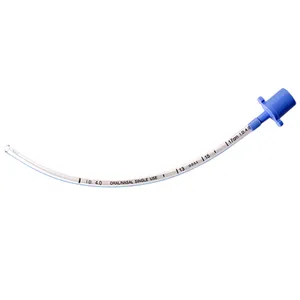
- The image clearly shows an endotracheal tube without an inflatable cuff or a pilot balloon, which identifies it as an uncuffed tube.
- Uncuffed endotracheal tubes are standard and appropriate for use in pediatric patients, particularly infants and young children.
- The narrowest part of a child's airway, the cricoid cartilage, forms a natural seal around the tube, making a cuff unnecessary and avoiding potential pressure injury to the trachea.
Why Other Options Were Wrong
- Option B: This option is incorrect because the tube shown in the image is visibly uncuffed. It lacks the inflatable balloon and pilot line characteristic of a cuffed tube.
- Option C: This statement is false. Uncuffed tubes are not only appropriate but are often the preferred choice for routine intubation in young children to prevent airway trauma.
- Option D: This option is incorrect on two counts: the tube is uncuffed, not cuffed, and uncuffed tubes are appropriate for children.
Related Visual

Clinical Relevance
- Nursing practice connection: This is primarily an exam-oriented knowledge point with limited direct bedside application, so retain Pediatric Airway Management as background academic context rather than a clinical decision trigger.
- A nurse must be able to quickly differentiate between cuffed and uncuffed endotracheal tubes to ensure the correct equipment is prepared for an intubation procedure, especially in an emergency.
- The nurse is responsible for monitoring a pediatric patient with an ET tube for signs of an air leak (audible sound during inspiration) or respiratory distress, which might indicate the tube is too small.
- What if? If a child required high ventilation pressures or had a high risk of aspiration, the provider might choose a cuffed endotracheal tube instead. In this case, the nurse's role would include monitoring the cuff pressure to keep it at the lowest possible level (typically below 20-25 cm H₂O) to minimize tracheal injury.
How to Approach the Question
- First, carefully examine the image to identify the key features of the medical device. Note the absence of an inflatable cuff and a pilot balloon at the ends of the tube.
- Based on these features, identify the device as an 'uncuffed endotracheal tube'.
- Next, consider the clinical context provided in the options: its use in a 'child'.
- Recall or deduce the principles of pediatric airway management. Remember that a child's airway anatomy (narrow cricoid cartilage) allows for the use of uncuffed tubes.
- Evaluate each option: Option A correctly identifies the tube as uncuffed and appropriate for a child. Options B and D are incorrect because they misidentify the tube as cuffed. Option C is incorrect because it wrongly states the tube is inappropriate.
Concept Tested & Keywords
- Concept Tested: Pediatric Airway Management
- Stem keywords: uncuffed tube, cuffed tube, child, appropriate
- Lead-in keywords: true option
- Clinical cues: Image of an uncuffed endotracheal tube
Question ID
QK_oz1lD7er8HsgUFCXYj8
Practise the full AIIMS Delhi NO- 2019
Attempt every question from this paper in a timed mock, then review the full solution for each one.
More Pediatric Critical Care Questions
More AIIMS Delhi NO- 2019 Questions
- A nurse is preparing to give bath to admitted patient with perineal problem. Which of the following will help the patient?
- In the absence of nurse from floor, patient falls from bed. This type of injury belongs to:
- Patient's Medical record with all essential information is responsibility of:
- Post-partum women having bleeding within 24 hrs after delivery is called:
- In which condition, distal pulse is preferred rather than apical pulse?
- A pre-eclampsia woman's baby is lying with her mother. Neonate is born in 37 weeks. After 57 hours, when nurse is monitoring vital signs of baby, tem…
- A woman with 3rd day postpartum has complaint of engorgement in both breasts. What is cut off temperature for fever in postpartum women?
- Universal blood donor?
- WHO hand wash time with soap?
- Why it is necessary to remove dark coloured nail paint before surgery?