
Combined AIIMS - 2020 (Jodhpur, Bhopal, Patna, Raipur)
Nursing Foundation
Medium
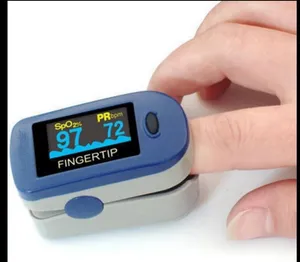
All of the following can alter the reading of the below mentioned device; EXCEPT:
Appeared in: Combined AIIMS - 2020 (Jodhpur, Bhopal, Patna, Raipur)
Explanation
- The device shown is a pulse oximeter, designed to measure the saturation of hemoglobin with oxygen.
- Oxyhemoglobin is the form of hemoglobin that is bound to oxygen; it is the substance the oximeter is designed to measure.
- The percentage of oxyhemoglobin relative to total hemoglobin is the value (SpO₂) that the device calculates and displays.
- Therefore, oxyhemoglobin is the target of measurement, not a factor that interferes with or alters the reading in an erroneous way.
Why Other Options Were Wrong
- Option A: Nail polish, particularly dark colors, can block the light from the pulse oximeter's sensor, leading to inaccurate or unobtainable readings.
- Option B: Certain intravascular dyes, such as methylene blue, absorb light in the same spectrum as deoxygenated hemoglobin, which can cause the oximeter to report a falsely low oxygen saturation.
- Option C: Carboxyhemoglobin, which is present in high levels during carbon monoxide poisoning, is misread by standard pulse oximeters as oxyhemoglobin. This leads to a dangerously false high SpO₂ reading, masking severe hypoxemia.
Related Visual

Clinical Relevance
- Nursing practice connection: This is primarily an exam-oriented knowledge point with limited direct bedside application, so retain Factors affecting the accuracy of pulse oximetry as background academic context rather than a clinical decision trigger.
- Accurate pulse oximetry is crucial for monitoring a patient's respiratory status. Nurses must be aware of factors that can cause false readings to avoid clinical errors.
- Before applying a pulse oximeter, the nurse should assess the patient's finger for nail polish, artificial nails, and adequate perfusion (warmth, capillary refill). If interference is suspected, use an alternative site like an earlobe, toe, or forehead sensor.
- In cases of suspected smoke inhalation or carbon monoxide poisoning, a pulse oximeter reading is unreliable. An arterial blood gas (ABG) with co-oximetry is required to measure carboxyhemoglobin levels accurately.
How to Approach the Question
- First, identify the device in the image as a pulse oximeter and recall its function: to measure oxygen saturation (SpO₂).
- Next, carefully read the question and note the keyword 'EXCEPT'. This means you are looking for the option that does not interfere with the device's reading.
- Evaluate each option's effect on pulse oximetry.
- Option A (Nail polish): Recall that dark polish blocks light and causes errors. So, it's an interfering factor.
- Option B (Intravascular dyes): Recall that dyes like methylene blue absorb light and cause errors. So, it's an interfering factor.
- Option C (Carboxyhemoglobin): Recall that oximeters misread this as oxygen, causing a falsely high reading. So, it's an interfering factor.
Concept Tested & Keywords
- Concept Tested: Factors affecting the accuracy of pulse oximetry.
- Stem keywords: alter the reading, device, pulse oximeter
- Lead-in keywords: EXCEPT
- Clinical cues: The image shows a pulse oximeter, which is key to understanding the question.
- Negative lead-in flag: Question is negatively framed using 'EXCEPT'
Question ID
QsTlp-aeTGP2JtvjJelpzI
Reference Book
E6 Nursing Fundamentals Potter Perry 12e Part 3 p. 23-25
E6 Nelson Textbook of Pediatrics(2024) — Volume 1 p. 661-663
Practise the full Combined AIIMS - 2020 (Jodhpur, Bhopal, Patna, Raipur)
Attempt every question from this paper in a timed mock, then review the full solution for each one.
More Oxygenation needs Questions
- The goal of pursed lip breathing exercise is to:
- If a chest drainage system line is broken or interrupted, the nurse's first course of action should be to?
- Normal pulse oximeter reading is?
- A nurse doing suctioning, she/he should know that once a time suction should not be applied more than?
- While recording oxygen with pulse oximetry of a newly married patient, the nurse should do?
- When performing suctioning on a patient, you should:
- What is the maximum time for airway suctioning?
- Priority nursing diagnosis for a client with ARDS?
- After laryngectomy, humidified oxygen is administered via tracheostomy because?
- The nurse is evaluating a client's response to cardio version. Which of the following observations would be of highest priority to the nurse?
More Combined AIIMS - 2020 (Jodhpur, Bhopal, Patna, Raipur) Questions
- The position used for most of the gynecological procedures?
- Thyroid eye disease (TED) is also known as:
- How many items are included in the WHO surgical safety checklist: SITOSO?
- In iron deficiency anemia, the fingernails become spoon shaped, this condition is referred to as:
- Which of the following code is associated with cardiac arrest during medical emergency?
- How is blood loss measured in Post-partum hemorrhage?
- The traction used for cervical spine injury:
- In operation theater during cauterization, the electric current passing from a single electrode is called:
- Tracheostomy is done in which tracheal ring?
- The instrument used for measuring fetal heart rate (FHR):