
RUHS, Jaipur, M.Sc Nursing Entrance Exam-2021
Nursing Foundation
Medium
A male client is having tonic-clonic seizures. What should the nurse do first?
Appeared in: RUHS, Jaipur, M.Sc Nursing Entrance Exam-2021
Explanation
- The highest priority in managing an active tonic-clonic seizure is ensuring the patient's safety.
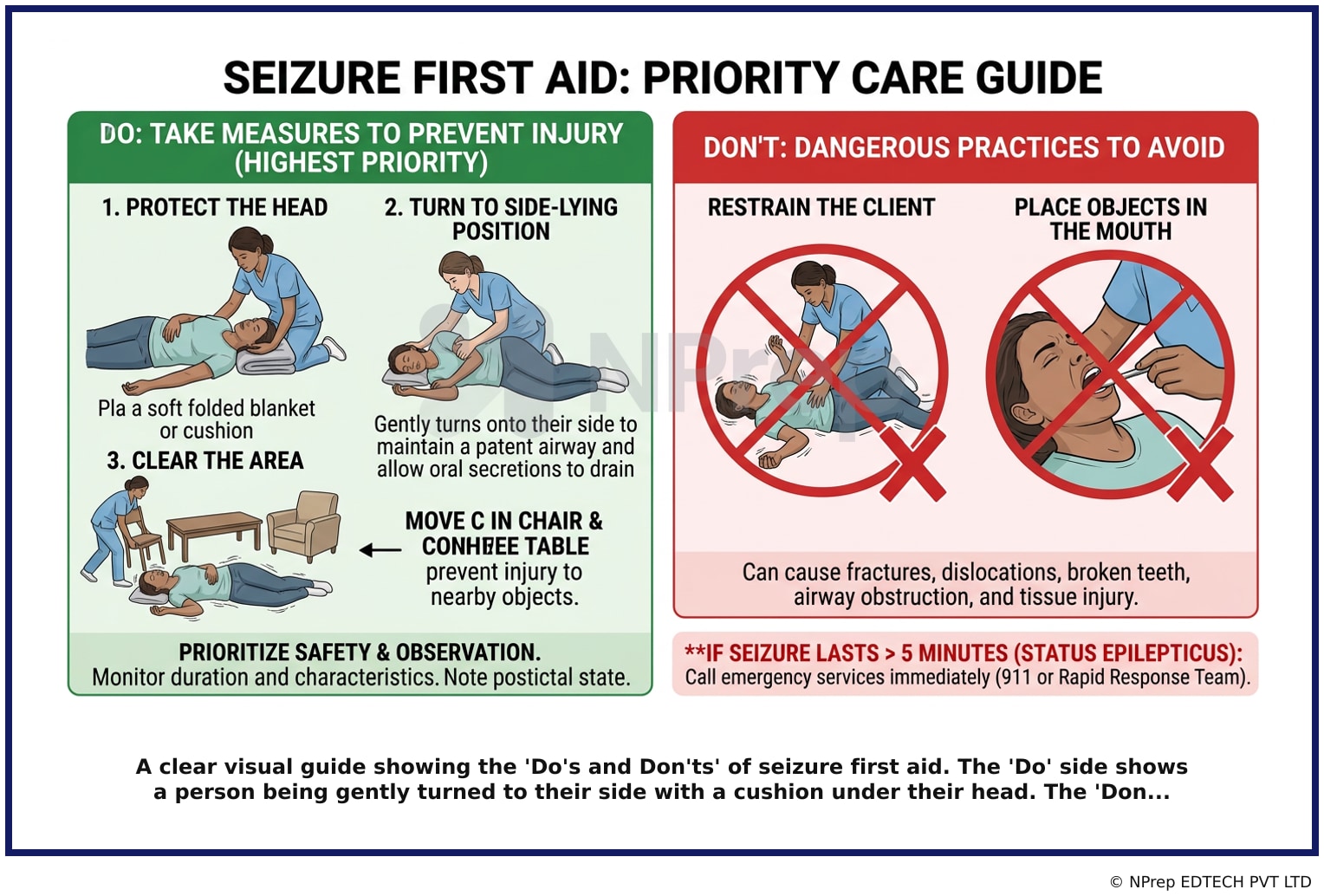
- This is a comprehensive action that includes protecting the head, clearing the area, and positioning the patient to maintain a patent airway.
- Violent muscle contractions and loss of consciousness create a significant risk for falls, head trauma, and other physical injuries.
- All other specific interventions, such as positioning, fall under the primary goal of preventing injury.
Why Other Options Were Wrong
- Option A: Elevating the head of the bed is not the first priority and may not be safe or feasible during convulsions. The correct positioning to maintain an airway is side-lying.
- Option B: Restraining a client during a seizure is contraindicated and dangerous. The force of the convulsions against restraints can cause fractures, dislocations, and soft tissue damage.
- Option C: Placing any object in the client's mouth is a dangerous and outdated practice. It can cause broken teeth, airway obstruction, and injury to the jaw or soft tissues.
Related Visual
Clinical Relevance
- Nursing practice connection: Prioritize focused assessment, early escalation, and real-time monitoring when managing Priority nursing interventions during a tonic-clonic seizure in acute care settings.
- A nurse's primary role during a seizure is to protect the patient and observe. Accurate observation and documentation of the seizure's characteristics (onset, duration, type of movement, postictal state) are crucial for diagnosis and treatment.
- Patient safety is the paramount principle. Actions that seem intuitive, like restraining, can cause significant harm. Evidence-based practice dictates a hands-off approach focused on creating a safe environment.
- What if the seizure lasts longer than 5 minutes? This is a medical emergency known as status epilepticus. The nurse's action would change to immediately calling for the rapid response team or emergency services while continuing to provide basic safety and airway support. IV access and administration of emergency antiepileptic drugs (like lorazepam or diazepam) would become the next priority.
How to Approach the Question
- First, identify the question type. This is a priority question, indicated by the word 'first'. It asks for the most important immediate action in a clinical scenario.
- Analyze the scenario: a client is actively having a tonic-clonic seizure. This is an acute, life-threatening event where safety is the main concern.
- Evaluate the options based on safety principles. Ask yourself, 'Which of these actions promotes safety, and which could cause harm?'
- Eliminate actively harmful options. Restraining a client (Option B) and putting something in their mouth (Option C) are known to be dangerous and are always incorrect answers for seizure management.
- Compare the remaining options. Elevating the head (Option A) is a specific action, while taking measures to prevent injury (Option D) is a broader, more comprehensive goal.
- Select the most encompassing and highest-priority option. Preventing injury is the overarching goal that guides all other nursing actions during a seizure. Therefore, it is the best first step.
Concept Tested & Keywords
- Concept Tested: Priority nursing interventions during a tonic-clonic seizure
- Stem keywords: tonic-clonic seizures, nurse, first
- Lead-in keywords: first
- Clinical cues: Active seizure is a medical emergency requiring immediate safety interventions.
Question ID
QSMK5SMZq2Wp95UfW9zLNM
Reference Book
E6 Nursing Fundamentals Potter Perry 12e Part 2 pp. 198-200, 197-199
E6 Pharmacology Nursing Lilley 11e Part 1 p. 246-248
Practise the full RUHS, Jaipur, M.Sc Nursing Entrance Exam-2021
Attempt every question from this paper in a timed mock, then review the full solution for each one.
More Promoting safety in health care environment Questions
- Identify the following symbol?
- In one case it is observed that the patient who is scheduled for a surgery didn't properly understand the physician's explanation. The patient is now…
- Cold application is also called as?
- When dangling the patient at the bedside, monitor for:
- Hazards of restraints are?
- The type of restraints to prevent the patient pulling a catheter, IV lines and Hair etc?
- What is the Primary Intervention to be taken after a fire incident in the hospital?
- A patient is admitted with complaints of shortness of breath. The nurse observes that patient becomes confused and combative. Which of the following…
- The most important intended outcome of using side rails on patient bed would be?
- In Below denote image, it is the puncture site used for?
More RUHS, Jaipur, M.Sc Nursing Entrance Exam-2021 Questions
- Pouch of Douglas is situated between?
- Axillary nerve supplies?
- Largest branch of brachial plexus is?
- The normal range for White Blood Cells is
- Cholesterol is needed for formation of all except?
- Protamine sulphate is the antidote for?
- All are spread by feco-oral route except?
- Most common cause of diarrhoea in children is?
- Priority nursing care need of an unconscious patient?
- All are true about tracheostomy suctioning except?