
KGMU 2023
Applied Physiology (E5)
Easy
Which of the following is used to test vestibular function?
Appeared in: KGMU 2023
Explanation
- The Caloric test is specifically designed to assess the vestibular system, which is responsible for balance and spatial orientation.
- It works by stimulating the horizontal semicircular canal of the inner ear with a thermal (temperature) stimulus.
- This stimulation induces a vestibulo-ocular reflex, which manifests as nystagmus (involuntary eye movements).
- The presence, direction, and intensity of the nystagmus are analyzed to determine if the vestibular function is normal or impaired.
- An abnormal result (absent or asymmetric nystagmus) points towards a peripheral vestibular lesion.
Why Other Options Were Wrong
- Option B: The Rinne test is an auditory assessment, not a vestibular one. It is used to evaluate hearing loss by comparing the patient's ability to hear sound via air conduction versus bone conduction.
- Option C: The Auditory Acuity test is a general screening for hearing ability. It provides a rough estimate of hearing sharpness (e.g., whisper test) but does not assess the balance function of the vestibular system.
- Option D: The Nerve Conduction Velocity (NCV) test evaluates the health of peripheral nerves throughout the body by measuring how fast an electrical impulse travels through them. It is not used to assess the specialized functions of the inner ear's vestibular system.
Related Visual
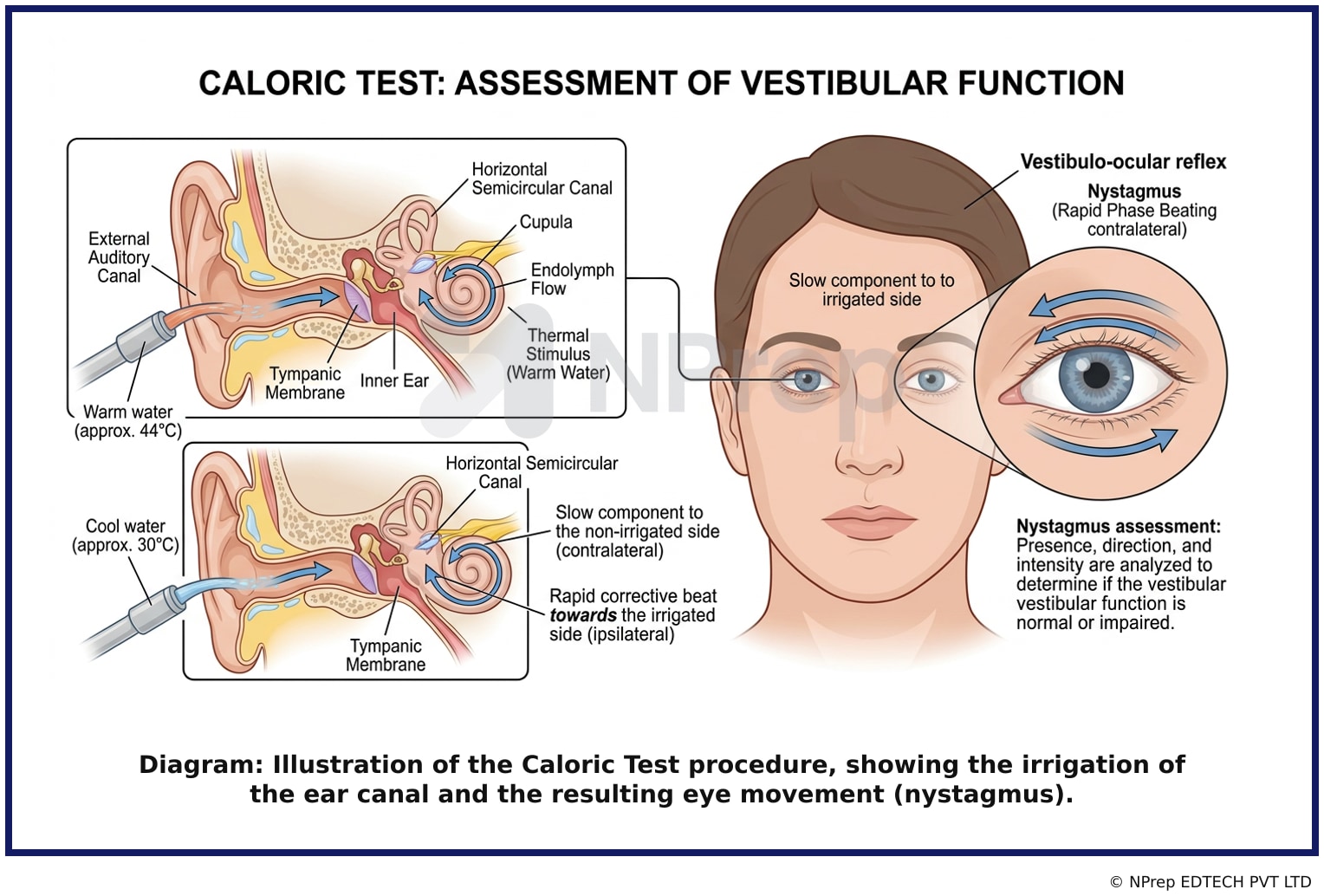
- Visual 1: Diagram: Illustration of the Caloric Test procedure, showing the irrigation of the ear canal and the resulting eye movement (nystagmus).
- Visual 2: Infographic: The COWS mnemonic (Cold-Opposite, Warm-Same) explained visually, showing the direction of the fast phase of nystagmus relative to the water temperature.
Clinical Relevance
- Nursing practice connection: This is primarily an exam-oriented knowledge point with limited direct bedside application, so retain Assessment of Vestibular Function as background academic context rather than a clinical decision trigger.
- Assessing vestibular function is crucial for diagnosing the cause of vertigo, dizziness, and balance disorders, helping to differentiate between peripheral (inner ear) and central (brain) causes.
- Nurses play a key role in patient education before the test, preparing the patient, observing for nystagmus, and monitoring for adverse reactions like dizziness or nausea during and after the procedure.
- What if? If a patient has a perforated tympanic membrane (eardrum), the caloric test using water is contraindicated due to the risk of infection and damage to the middle ear. In such cases, caloric testing with air or other vestibular tests like videonystagmography (VNG) would be considered.
How to Approach the Question
- First, identify the key concept in the question stem: 'vestibular function'. Recall that the vestibular system is primarily responsible for balance and is located in the inner ear.
- Next, analyze each option to determine its primary purpose and the system it assesses.
- Evaluate 'Caloric test'. This test uses temperature to stimulate the inner ear, which directly relates to the vestibular system's function.
- Evaluate 'Rinne Test' and 'Auditory Acuity test'. Recognize these as tests for the auditory system (hearing), not the vestibular system (balance).
- Evaluate 'Nerve Conduction Velocity test'. Identify this as a general test for peripheral nerves, not the specialized sensory systems of the inner ear.
- Conclude that the Caloric test is the only option specifically designed to assess the balance-related functions of the vestibular system.
Concept Tested & Keywords
- Concept Tested: Assessment of Vestibular Function
- Stem keywords: vestibular function, test
- Lead-in keywords: Which
Question ID
QoZxmpcOxHO9Mt2mJ2TYJQ
Practise the full KGMU 2023
Attempt every question from this paper in a timed mock, then review the full solution for each one.
More Sensorineural Function Questions
- Which ophthalmic diagnostic test measures the Intraocular pressure?
- Identify the following instrument in image:
- What sound is heard when percussing a distended bladder?
- Which test would be done to check balance in a patient with ataxia?
- Identify the condition:
- In the emergency you have 4 patients. By prioritizing your management plan, which patient's problem will you address first?:
- All of the following instructions are given to a patient before computed tomography (CT) scan, except?
- The nursing care of a patient with dengue fever includes all of the following, except?
- Which of the following equipment is used for the examination of the ear?
- An aged client with diabetes mellitus complaining of painless peripheral loss of vision is at risk for?
More KGMU 2023 Questions
- The teacher scalded Aruna in front of her classmates during Project submission. Conclusion I: Aruna was not as popular as her other classmates. Concl…
- Aruna leaves and goes 8 meters in the North direction from a certain point. Then she turns right and travels for 12 meters. She again turns right and…
- Kiran is Sister of Raj. Raj is Son of Suresh and Vinita is Mother of Suresh then what is relation between Vinita and Kiran?
- A person who lives at the same time with another?
- Select the most appropriate meaning of the below idiom. A black sheep?
- The train has arrived...the station.
- A vendor sold 20 kg of potato at 18 Rs. per kg. He bought 2-liter milk at the rate of 46 Rs./liter, 2 kg sugar at the rate of 35 Rs./kg and 10 packet…
- Which one is the perfect square?
- A is the smallest. C is taller than B and D. E is neither the tallest nor the smallest. Find which one is the tallest?
- From an entrance, a person walks 28 meters left, then turns right and walks 13 meters. They turn right again and walk 12 meters, and then walk 16 met…