
NORCET 10 Mains
Community Health Nursing
Easy
Which of the following is the most effective method for controlling mosquito larvae in water bodies?
Appeared in: NORCET 10 Mains
Explanation
- The question asks for the most effective method to control mosquito larvae in water.
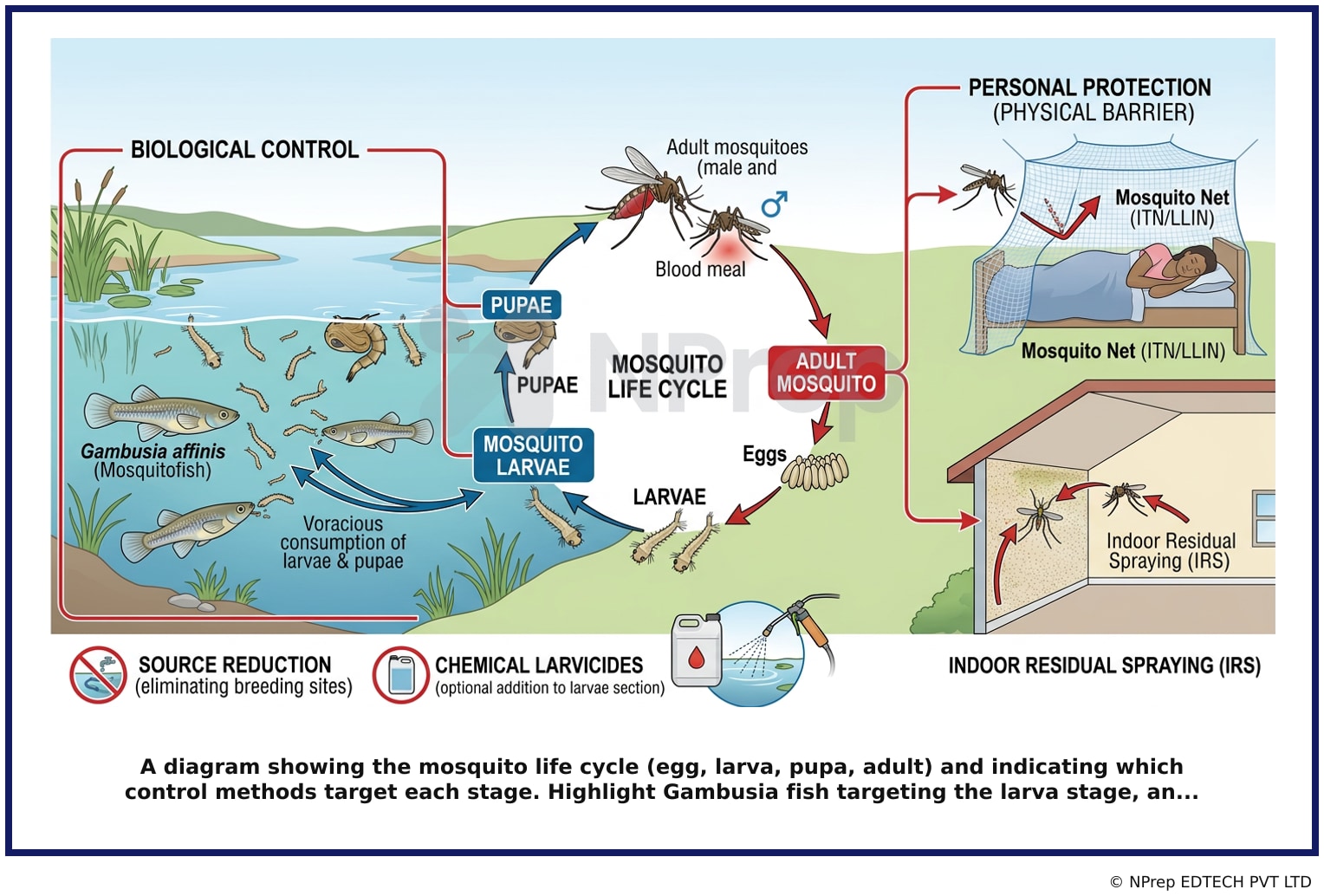
- Gambusia fish, also known as mosquitofish, are a well-established biological control agent.
- These fish are voracious predators of mosquito larvae and are introduced into stagnant water bodies like ponds, ditches, and tanks to consume the larvae.
- This method directly interrupts the mosquito life cycle at the larval stage, preventing them from developing into adult mosquitoes.
Why Other Options Were Wrong
- Option B: This is a broad term. While chemical larvicides can be sprayed on water, 'chemical spray' often refers to fogging or space sprays (adulticides) which target flying adult mosquitoes and have no effect on aquatic larvae.
- Option C: Mosquito nets are a physical barrier used for personal protection. They prevent adult mosquitoes from biting people, especially during sleep, but do not control or kill the larvae in water bodies.
- Option D: Indoor Residual Spraying (IRS) is an anti-adult measure. It involves spraying insecticides on the interior walls of homes to kill adult mosquitoes that rest on these surfaces after feeding. It does not target the larval stage.
Related Visual
Clinical Relevance
- Nursing practice connection: This is primarily an exam-oriented knowledge point with limited direct bedside application, so retain Methods of vector control, specifically targeting mosquito larvae as background academic context rather than a clinical decision trigger.
- Understanding vector control is vital for community health nurses in preventing outbreaks of diseases like dengue, malaria, chikungunya, and Japanese encephalitis.
- Nurses play a key role in educating communities about integrated vector management, which includes source reduction (eliminating breeding sites), biological control, and personal protection.
- In the Indian context, promoting biological controls like Gambusia fish in community ponds and tanks is a sustainable and eco-friendly component of the National Vector Borne Disease Control Programme (NVBDCP).
How to Approach the Question
- First, identify the core of the question: it specifically asks for a method to control the 'larval' stage of mosquitoes in 'water bodies'.
- Next, evaluate each option against this specific requirement.
- Option A (Gambusia fish): Recall or deduce that fish live in water and can eat smaller organisms. Gambusia are specifically known as 'mosquitofish', making them a strong candidate for larval control.
- Option B (Chemical spray): Recognize this is a broad term. While some sprays are for larvae (larvicides), many are for adults (adulticides/fogging). It's less specific than Option A.
- Option C (Mosquito nets) and Option D (Indoor residual spraying): Identify these as methods that target adult, flying mosquitoes to prevent bites or kill them after they enter a home. They do not affect the larval stage in water.
- Conclude that Gambusia fish is the only option that directly and effectively targets mosquito larvae in their aquatic habitat.
Concept Tested & Keywords
- Concept Tested: Methods of vector control, specifically targeting mosquito larvae.
- Stem keywords: mosquito larvae, control, water bodies
- Lead-in keywords: most effective
Question ID
Q1XgHiM1BGadW6e1o8KmNk
Reference Book
E6 Parks TextBook of Preventive & Social Medicine part 2 — Subpart B (pp 233-449 of 464) pp. 89-91, 88-90
Practise the full NORCET 10 Mains
Attempt every question from this paper in a timed mock, then review the full solution for each one.
More Environmental Science, Environmental Health, and Sanitation Questions
- Which form of chlorine preparation is used to reduce the bacterial residue in water?
- ICDS (Integrated Child Development Services) program was launched in the year;
- Match the greenhouse gases with their sources: Greenhouse gases Source a. Methane 1. Landfills b. Carbon dioxide 2. Fossil fuel burning c. Nitrous ox…
- If the earth had no atmosphere, the sky would have appeared:
- What is the main cause of noncommunicable diseases?
- What is the dictionary definition of 'Sanitation' according to the National Sanitation Foundation of the USA?
- Temporary hardness of water is removed by?
- The optimum fluoride concentration in drinking water in India is recommended to be?
- Hardness of water is expressed as?
- What is the minimum contact time required for the chlorination of water to take place?
More NORCET 10 Mains Questions
- Sign shown in image typically can be detected at which gestational age?
- Zika virus infection is primarily transmitted to humans through the bite of which of the following vectors?
- What is the correct interpretation of this 4th stage?
- During abdominal palpation in a pregnant woman, the sinciput and occiput are felt per abdomen. Approximately 3/5 of the fetal head is palpable above…
- Which of the following clinical features is most characteristic of acute epiglottitis?
- A 16-year-old boy has been playing online games for 10–12 hours daily for the past 14 months. He becomes irritable when asked to stop and shows impai…
- Which of the following is a characteristic clinical finding in a patient's lower limb with coarctation of the aorta?
- A patient who stopped consuming alcohol 12 hours ago presents with tremors, is oriented to time and place, and has increased blood pressure and heart…
- A father brings his son to a psychiatrist with complaints of repeated self-harm behavior, social isolation, and inability to maintain a stable relati…
- Which of the following is the most appropriate postoperative nursing intervention after cardiac catheterization?