
NORCET-11 Prelims
Medical & Surgical Nursing
Medium
Which of the following dermatologic manifestations commonly appears on the posterior neck and flexural folds in patients with diabetes mellitus and insulin resistance?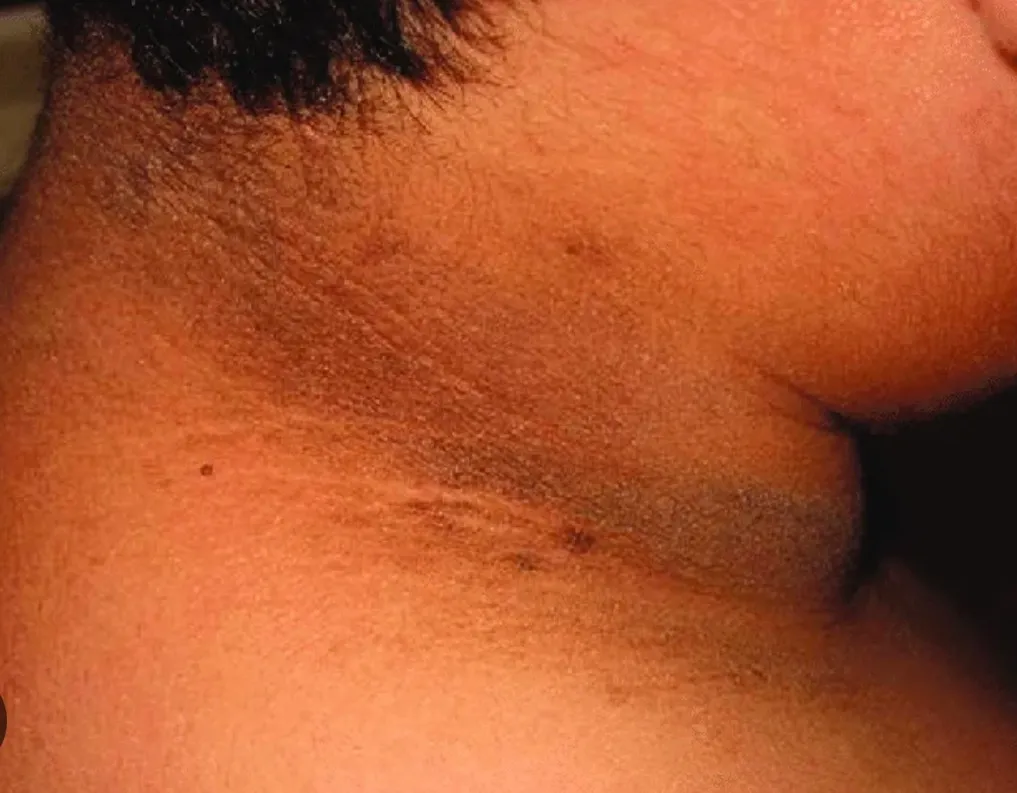
Appeared in: NORCET-11 Prelims
Explanation
- Acanthosis nigricans is characterized by velvety, hyperpigmented, thickened plaques in intertriginous areas, especially the posterior neck and axillae.
- It is strongly associated with insulin resistance and diabetes mellitus, serving as a clinical marker for metabolic syndrome.
- The pathogenesis involves hyperinsulinemia stimulating growth factor receptors, leading to epidermal proliferation and skin changes.
Why Other Options Were Wrong
- Option B: Atopic dermatitis typically presents as itchy, red, and inflamed patches, often in flexural areas in children but is not specifically associated with diabetes or insulin resistance.
- Option C: Psoriasis presents as well-demarcated, erythematous plaques with silvery scales, commonly on extensor surfaces like elbows and knees, not flexural folds or posterior neck in diabetes.
- Option D: Eczema is a general term for inflammatory skin conditions with redness, itching, and scaling, but it does not specifically present as velvety, hyperpigmented plaques in flexural areas related to insulin resistance.
Related Visual

Clinical Relevance
- Nursing practice connection: This is primarily an exam-oriented knowledge point with limited direct bedside application, so retain Recognition of dermatologic manifestations associated with diabetes and insulin resistance as background academic context rather than a clinical decision trigger.
- Nurses should recognize acanthosis nigricans as a visible marker for insulin resistance and screen for diabetes in affected patients.
- Early identification can prompt lifestyle interventions and metabolic evaluation, reducing long-term complications.
- What if? If the skin lesion was red, scaly, and on extensor surfaces, psoriasis would be more likely, not acanthosis nigricans.
How to Approach the Question
- Identify the clinical scenario: diabetes mellitus and insulin resistance.
- Focus on the location: posterior neck and flexural folds.
- Recall the classic skin findings associated with metabolic syndrome.
- Eliminate options that do not match the described distribution or association with diabetes.
- Select the answer that best fits the clinical and anatomical clues.
Concept Tested & Keywords
- Concept Tested: Recognition of dermatologic manifestations associated with diabetes and insulin resistance
- Stem keywords: dermatologic manifestations, posterior neck, flexural folds, diabetes mellitus, insulin resistance
- Lead-in keywords: commonly appears
- Clinical cues: Posterior neck and flexural folds are classic sites for acanthosis nigricans in diabetes
Question ID
QFZnA6_dB0ZcSY2EzQnXmE
Reference Book
E6 Nelson Textbook of Pediatrics(2024) — Volume 2 p. 1919-1921
E6 Gynecology Williams p. 99-128
E6 Pathology- ROBBINS & COTRAN PATHOLOGIC BASIS OF DISEASE 10TH Ed p. 1142-1144
Practise the full NORCET-11 Prelims
Attempt every question from this paper in a timed mock, then review the full solution for each one.
More Integumentary Function Questions
- This type of dressing is known as:
- The following picture shows is bedsore present in bedridden patient. Which grade of bedsore is present?
- In second degree bedsore, there is an involvement of:
- What is the bath used to remove the irritation of certain types of skin diseases and provide soothing effect?
- A female patient has come with facial burn injury into the emergency department in conscious condition. What will be the treatment for this patient?
- A patient comes into the emergency with a burn injury of 40% then what is first nursing intervention?
- A nurse caring a bedridden patient with a pressure ulcer, 2 hourly position changes and massaging & rubbing the back but pressure sore does not heal.…
- Second degree burn considered?
- Identify the stage of pressure ulcer
- A 23 year old man comes to the emergency department with thermal burns. In this case according to rule of nine which part of the body burned maximum?
More NORCET-11 Prelims Questions
- What is the capital of Arunachal Pradesh?
- A patient opens his eyes only when periorbital pressure is applied, makes incomprehensible sounds, and shows abnormal flexion to painful stimulus. Wh…
- Select the correctly spelt word from the options given below.
- Select the correctly spelt word from the options given below.
- Convert a patient's HbA1c value of 7% into estimated average glucose in mg/dL.
- A patient's recorded blood pressure is 150/90 mmHg. What is the calculated Mean Arterial Pressure?
- Identify the ECG pattern shown in the image below.
- At 36 weeks of pregnancy, a woman presents for an antenatal visit with suspected rupture of membranes. A Nitrazine paper test is conducted to differe…
- What is the official currency of Iran?
- Which of the following conditions is caused by a protozoan parasite?