
AIIMS Delhi NO- 2019
Medical & Surgical Nursing
Medium
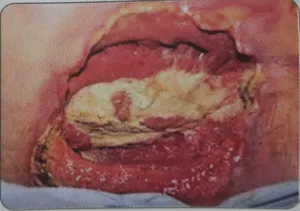
The following picture shows is bedsore present in bedridden patient. Which grade of bedsore is present?
Appeared in: AIIMS Delhi NO- 2019
Explanation
- The image shows a deep crater with full-thickness skin and tissue loss, which is a hallmark of an advanced pressure injury.
- There is extensive tissue destruction and necrosis (slough, the yellowish tissue), indicating damage that extends beyond the subcutaneous fat layer.
- Stage 4 is defined as full-thickness skin and tissue loss with exposed or directly palpable fascia, muscle, tendon, ligament, cartilage, or bone. The severity in the image is most consistent with this definition.
- Complications such as undermining (tissue loss under the wound edges) and tunneling are often present in Stage 4 ulcers and are suggested by the appearance of the wound in the image.
Why Other Options Were Wrong
- Option A: Stage 1 involves intact skin with non-blanchable redness. The image clearly shows broken skin and a deep open wound.
- Option B: Stage 2 is a partial-thickness loss, appearing as a shallow ulcer or blister. The wound in the image is a deep, full-thickness crater, far more severe than a Stage 2 injury.
- Option C: Stage 3 is a full-thickness wound where subcutaneous fat is visible, but muscle, tendon, or bone is not exposed. While the wound is full-thickness, its depth and the extent of necrotic tissue suggest damage beyond what is typical for Stage 3, pointing towards Stage 4.
Related Visual
- No visual required for this question type.
Clinical Relevance
- Nursing practice connection: Use the key finding related to Staging of Pressure Ulcers (Bedsores) to guide bedside assessment, documentation, and the next nursing action.
- Accurate staging of pressure injuries is a critical nursing skill that directly impacts the plan of care, including wound dressing selection, nutritional support, and pressure redistribution strategies.
- Stage 4 ulcers are serious medical conditions with a high risk of life-threatening complications, such as osteomyelitis (bone infection) and sepsis (blood infection), requiring intensive management and often surgical intervention.
- What if? If the yellowish tissue (slough) completely obscured the base of the wound, making the depth impossible to determine, the correct classification would be 'Unstageable'. The wound would need debridement before it could be staged as either 3 or 4.
How to Approach the Question
- First, carefully observe the image provided. Identify the key features of the wound.
- Assess the skin integrity: Is the skin intact or broken?
- Determine the depth of tissue involvement. Is it partial-thickness (affecting only the top layers of skin) or full-thickness (extending into deeper tissues)?
- Look for specific tissues in the wound bed: Is there subcutaneous fat, muscle, tendon, or bone visible? Is there slough (yellow/tan dead tissue) or eschar (black/brown hard tissue)?
- Compare your observations with the standard definitions for each stage of pressure injury.
- Select the stage that best matches the visual evidence. A deep crater with extensive destruction and visible deep structures or significant necrosis corresponds to Stage 4.
Concept Tested & Keywords
- Concept Tested: Staging of Pressure Ulcers (Bedsores)
- Stem keywords: bedsore, bedridden patient, grade of bedsore
- Lead-in keywords: Which grade
- Clinical cues: Image of a deep wound with necrotic tissue
Question ID
QyJo8tMzb2X1Fm56mwc8IT
Reference Book
E6 Nursing Fundamentals Taylor p. 560-562
E6 Nursing Fundamentals Potter Perry 12e Part 6 p. 70-72
Practise the full AIIMS Delhi NO- 2019
Attempt every question from this paper in a timed mock, then review the full solution for each one.
More Integumentary Function Questions
- This type of dressing is known as:
- In second degree bedsore, there is an involvement of:
- What is the bath used to remove the irritation of certain types of skin diseases and provide soothing effect?
- A female patient has come with facial burn injury into the emergency department in conscious condition. What will be the treatment for this patient?
- A patient comes into the emergency with a burn injury of 40% then what is first nursing intervention?
- A nurse caring a bedridden patient with a pressure ulcer, 2 hourly position changes and massaging & rubbing the back but pressure sore does not heal.…
- Second degree burn considered?
- Identify the stage of pressure ulcer
- A 23 year old man comes to the emergency department with thermal burns. In this case according to rule of nine which part of the body burned maximum?
- Identify the condition shown in image:
More AIIMS Delhi NO- 2019 Questions
- A nurse is preparing to give bath to admitted patient with perineal problem. Which of the following will help the patient?
- In the absence of nurse from floor, patient falls from bed. This type of injury belongs to:
- Patient's Medical record with all essential information is responsibility of:
- Post-partum women having bleeding within 24 hrs after delivery is called:
- In which condition, distal pulse is preferred rather than apical pulse?
- A pre-eclampsia woman's baby is lying with her mother. Neonate is born in 37 weeks. After 57 hours, when nurse is monitoring vital signs of baby, tem…
- A woman with 3rd day postpartum has complaint of engorgement in both breasts. What is cut off temperature for fever in postpartum women?
- Universal blood donor?
- WHO hand wash time with soap?
- Why it is necessary to remove dark coloured nail paint before surgery?