
AIIMS Delhi NO- 2019
Pharmacology
Medium
Which of the following combination is incompatible?
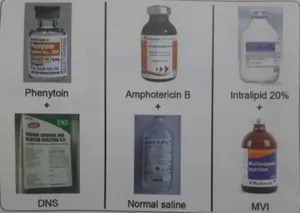
Appeared in: AIIMS Delhi NO- 2019
Explanation
- This option is correct because it correctly identifies both combinations A and B as incompatible.
- Phenytoin (A) is incompatible with dextrose-containing solutions like DNS because the acidic nature of dextrose causes the alkaline phenytoin to precipitate.
- Amphotericin B (B) is a colloidal suspension that is incompatible with electrolyte-containing solutions like Normal Saline, as the salts cause the drug to aggregate and precipitate.
- Combination C (Intralipid + MVI) is a compatible mixture commonly used in Total Parenteral Nutrition (TPN).
Why Other Options Were Wrong
- Option A: This option is incomplete. While combination A (Phenytoin + DNS) is indeed incompatible, combination B (Amphotericin B + Normal Saline) is also incompatible.
- Option C: This option is incorrect because combination C (Intralipid 20% + MVI) is a compatible mixture used in TPN.
- Option D: This option is incorrect because two of the combinations shown (A and B) are clearly incompatible and dangerous to administer together.
Related Visual

Clinical Relevance
- Nursing practice connection: This is primarily an exam-oriented knowledge point with limited direct bedside application, so retain IV Drug-Fluid Compatibility as background academic context rather than a clinical decision trigger.
- Patient Safety: Administering incompatible IV medications can cause the formation of precipitates, leading to serious complications like catheter occlusion, phlebitis, systemic inflammatory response, and life-threatening pulmonary embolism.
- Therapeutic Failure: Incompatibility can also lead to the chemical degradation and inactivation of a drug, resulting in the patient not receiving the intended therapeutic dose.
- Nursing Responsibility: It is a critical nursing responsibility to verify drug and fluid compatibility before administration using a drug reference guide, consulting with a pharmacist, and adhering to the principle of 'CATS PRRR' (Compatibilities, Allergies, Tubing, Site, Pump, Right Rate, Release, Return/Reassess).
How to Approach the Question
- First, identify the three distinct drug-fluid pairs presented in the image: (A) Phenytoin + DNS, (B) Amphotericin B + Normal Saline, and (C) Intralipid + MVI.
- For each pair, recall the specific rules for IV administration and compatibility. Focus on known, critical incompatibilities.
- Analyze Pair A: Phenytoin is highly alkaline and famously precipitates in acidic dextrose solutions. Since DNS contains dextrose, this is an incompatible pair.
- Analyze Pair B: Amphotericin B is a colloid that is unstable in electrolyte solutions. Normal Saline is an electrolyte solution, causing precipitation. This is an incompatible pair.
- Analyze Pair C: Intralipid and MVI are standard, compatible components of TPN solutions.
- Based on the analysis, conclude that pairs A and B are incompatible. Scan the options to find the one that matches this conclusion, which is 'A and B'.
Concept Tested & Keywords
- Concept Tested: IV Drug-Fluid Compatibility
- Stem keywords: combination, incompatible, Phenytoin, DNS, Amphotericin B, Normal Saline
- Lead-in keywords: Which
- Clinical cues: The question requires visual identification of drug pairs and knowledge of their chemical compatibility for IV administration.
Question ID
QnxZmVgMBcLQWoi5Cq5Tn7
Reference Book
E6 Pharmacology Nurses Shanbhag 3e p. 36-38
E6 Nursing Fundamentals Potter Perry 12e Part 3 p. 178-180
Practise the full AIIMS Delhi NO- 2019
Attempt every question from this paper in a timed mock, then review the full solution for each one.
More Administration of Medication Questions
- The nurse is to administer Iron injection to an adult. How can it be administered?
- When preparing IV fluids of various strengths, which of the following factors should be considered?
- All of the following are the recommended sites for subcutaneous injections, EXCEPT:
- What is the nurse's responsibility in an unusual situation when she administers wrong medicine orally?
- While instilling ear drops, the canal of an adult is straightened by pulling the pinna?
- Z-track injection is a method of injecting medication into?
- An assessment specific to safe administration of IV mannitol is?
- The flow rate (drops/minute) of 800 ml Ringer lactate solution for 10 hrs transfusion through macro drip set?
- Which muscles are used for injections in the arm?
- Which injection is given under the skin?
More AIIMS Delhi NO- 2019 Questions
- A nurse is preparing to give bath to admitted patient with perineal problem. Which of the following will help the patient?
- In the absence of nurse from floor, patient falls from bed. This type of injury belongs to:
- Patient's Medical record with all essential information is responsibility of:
- Post-partum women having bleeding within 24 hrs after delivery is called:
- In which condition, distal pulse is preferred rather than apical pulse?
- A pre-eclampsia woman's baby is lying with her mother. Neonate is born in 37 weeks. After 57 hours, when nurse is monitoring vital signs of baby, tem…
- A woman with 3rd day postpartum has complaint of engorgement in both breasts. What is cut off temperature for fever in postpartum women?
- Universal blood donor?
- WHO hand wash time with soap?
- Why it is necessary to remove dark coloured nail paint before surgery?