
NORCET 2 -2021 (Shift-2)
Child Health Nursing (Pediatrics)
Medium
Which is the correct placement of simple oxygen mask in paediatrics?
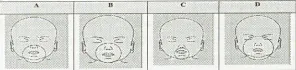
Appeared in: NORCET 2 -2021 (Shift-2)
Explanation
- The correct placement for a simple oxygen mask is to ensure it covers both the child's nose and mouth.
- This creates a seal that allows the child to inhale the delivered oxygen effectively, regardless of whether they are breathing through their nose or mouth.
- As shown in Image B, the mask should fit snugly from the bridge of the nose to just under the chin, without covering the eyes.
- This method ensures the prescribed fraction of inspired oxygen (FiO2) is delivered to the lungs.
Why Other Options Were Wrong
- Option A: This placement is incorrect and dangerous. The mask is positioned too high, covering the child's eyes, which can cause corneal abrasion or irritation from the oxygen flow.
- Option C: This placement is incorrect because it only covers the mouth, leaving the nose exposed. This is highly ineffective, especially for infants who are often obligate nose breathers and will not receive adequate oxygen.
- Option D: This placement is completely wrong as the mask is on the child's chin and neck, not covering the airway (nose or mouth) at all. It will provide no oxygen to the patient.
Related Visual

Clinical Relevance
- Nursing practice connection: This is primarily an exam-oriented knowledge point with limited direct bedside application, so retain Correct application of a simple oxygen mask in pediatric patients as background academic context rather than a clinical decision trigger.
- Nurses must always select the correct size of oxygen mask for pediatric patients, as a mask that is too large or too small will result in an ineffective seal and inadequate oxygenation.
- Patient monitoring is critical. A child's movement or agitation can easily displace the mask. The nurse must frequently check and readjust the mask to ensure it remains correctly positioned.
- What if? If a child is claustrophobic or highly agitated by a face mask, the nurse should assess if an alternative delivery device, such as a nasal cannula or an oxygen hood (for infants), would be more appropriate and tolerated, while still meeting the child's oxygen needs.
How to Approach the Question
- First, identify the core question, which is about the 'correct placement' of an oxygen mask.
- Recall the primary function of an oxygen mask: to deliver oxygen to the lungs via the patient's airway (nose and mouth).
- Systematically evaluate each image based on this principle.
- Eliminate Image A because covering the eyes is harmful and incorrect.
- Eliminate Image C because not covering the nose makes oxygen delivery ineffective, especially for nose-breathing infants.
- Eliminate Image D as it completely misses the airway.
Concept Tested & Keywords
- Concept Tested: Correct application of a simple oxygen mask in pediatric patients.
- Stem keywords: simple oxygen mask, paediatrics, correct placement
- Lead-in keywords: Which is the correct
- Clinical cues: The question requires visual identification of a standard nursing procedure.
Question ID
Qz6_Nz8li0UN1meDl0MbmU
Reference Book
E6 Nelson Textbook of Pediatrics(2024) — Volume 1 p. 604-606
E6 Ghai Essential Pediatrics(pp 26-904 of 913) p. 780-782
Practise the full NORCET 2 -2021 (Shift-2)
Attempt every question from this paper in a timed mock, then review the full solution for each one.
More Newborn Infants Questions
- When palpating the abdomen of hypertrophic pyloric stenosis infant, the Nurse finds:
- A pre-eclampsia woman's baby is lying with her mother. Neonate is born in 37 weeks. After 57 hours, when nurse is monitoring vital signs of baby, tem…
- Normally enteral feedings are flushed with water to open blocked tube and ease feeding. In which area it is done with air?
- A nurse is advised to give injection vitamin K for new born baby. The route and dose of Vitamin K is:
- Identify the following instrument used in hyperbilirubinemia monitoring based on the image:
- Which of the following equipment is used in Neonatal Resuscitation program?
- All of the following are the benefits of KMC (Kangaroo mother care); EXCEPT:
- Waxy or cheese like white substance found coating the skin of newborn human baby is known as:
- Identify 'at risk' infants from the following:-
- What is the normal length of the neonate body?
More NORCET 2 -2021 (Shift-2) Questions
- Preferred route of tranexamic acid drug administration is?
- Parts of the fallopian tube, except?
- After thyroidectomy the patient complains for hoarseness of voice that occurs due to injury in?
- Highest source of vitamin-C?
- After the RTA, a patient was brought to the emergency department. After Massive blood transfusion, which electrolyte imbalance occurs in the patient?
- A patient suffering from shock is receiving normal saline (NS). What is the normal osmolarity of Na\ in NS?
- A patient is unconscious nurse is going to take the sterile urine sample for culture from the urinary catheter. What technique is to be used by the n…
- Covid face shield is sterilized by?
- Which reflex should check when death of the brain stem occurs, except?
- Which is an example of a tocolytic agent?