
DSSSB -28 August 2019 (Shift-2)
Medical & Surgical Nursing
Easy
What is the ideal position during a lumbar puncture?
Appeared in: DSSSB -28 August 2019 (Shift-2)
Explanation
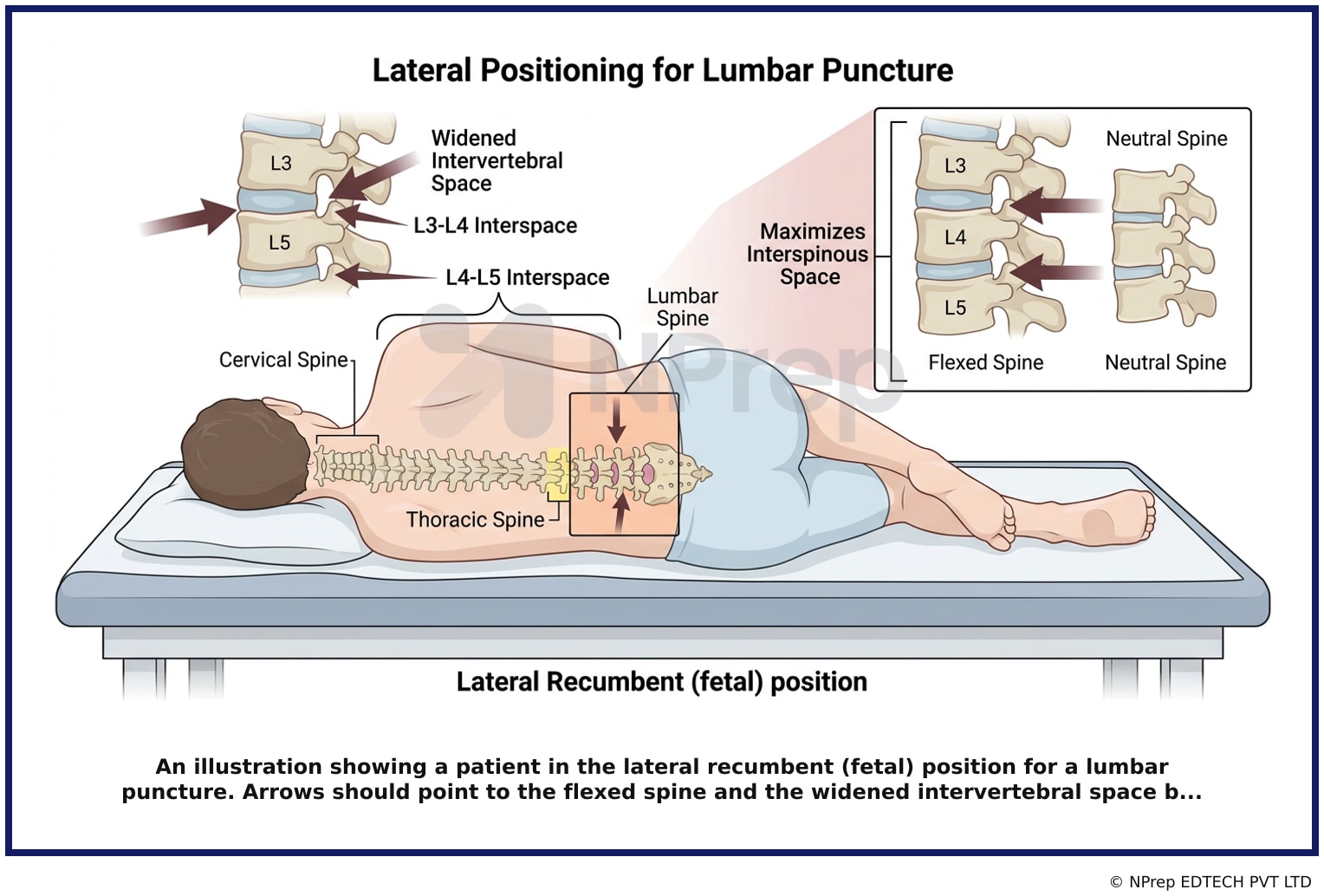
- The lateral recumbent position, with the patient lying on their side, provides direct and stable access to the lumbar spine.
- Flexing the knees towards the chest (the fetal position) and encouraging the patient to arch their back 'like a cat' maximizes the flexion of the lumbar spine.
- This flexion significantly widens the interspinous spaces, making it easier for the clinician to insert the needle into the subarachnoid space and reducing the risk of trauma or a 'dry tap'.
Why Other Options Were Wrong
- Option B: In the supine position, the patient lies on their back. This completely blocks access to the posterior lumbar spine, making the procedure impossible.
- Option C: Placing extra pillows under the head causes lateral flexion (sideways bending) of the spine. This misaligns the vertebrae, narrows the interspinous space, and makes needle insertion more difficult.
- Option D: Fowler's position is a semi-sitting position. While a 'sitting' position (leaning forward over a table) is a recognized alternative, it is not considered the ideal standard. The lateral recumbent position is preferred for obtaining an accurate opening pressure reading.
Related Visual
Clinical Relevance
- Nursing practice connection: This is primarily an exam-oriented knowledge point with limited direct bedside application, so retain Patient Positioning for Lumbar Puncture as background academic context rather than a clinical decision trigger.
- The nurse's role in correctly positioning and supporting the patient is critical for the success of a lumbar puncture, minimizing patient discomfort and reducing the risk of complications.
- Proper positioning directly impacts the ease of the procedure, potentially reducing the number of attempts needed and the risk of a traumatic tap (introducing blood into the CSF sample).
- After the procedure, the nurse is responsible for monitoring for complications, the most common of which is a post-lumbar puncture headache, often managed by keeping the patient supine and ensuring adequate hydration.
How to Approach the Question
- First, identify the key procedure in the question: 'lumbar puncture'.
- Recall the anatomical goal of this procedure: to insert a needle between the lumbar vertebrae to access the subarachnoid space.
- Think about how to make this access easier. To get between the bones of the spine, you need to open up the spaces between them.
- Consider the movement that would open the posterior aspect of the spine. Flexion (bending forward) will separate the spinous processes.
- Evaluate the options based on which one best achieves spinal flexion. The 'fetal position' (lateral recumbent with knees flexed) is the classic example of maximizing spinal flexion.
- Eliminate the other options based on anatomical principles: supine blocks access, extra pillows cause misalignment, and Fowler's is not the primary or ideal position.
Concept Tested & Keywords
- Concept Tested: Patient Positioning for Lumbar Puncture
- Stem keywords: lumbar puncture, ideal position
- Lead-in keywords: What is
- Negative lead-in flag: false
Question ID
QiVAGbgh_4o6mFQyiPouQJ
Reference Book
E6 Nelson Textbook of Pediatrics(2024) — Volume 2 p. 1363-1365
E6 Nursing Fundamentals Taylor p. 209-211
Practise the full DSSSB -28 August 2019 (Shift-2)
Attempt every question from this paper in a timed mock, then review the full solution for each one.
More Perioperative Concepts and Nursing Management Questions
- The nurse is informed that a client with a large surgical incision is being transferred from the intensive care unit to the surgical unit. What medic…
- Why it is necessary to remove dark coloured nail paint before surgery?
- A patient planned for surgery advised to remove Jewellery because:
- Vicryl 3-0 is:
- All of the following are correct regarding stoma formation; EXCEPT:
- A surgeon is going to give a skin incision on patient. Which of the following is to be done?
- Following is the picture of sterile sponge used in emergency. It has a blue colour thread. What is the purpose of this colour thread?
- How many items are included in the WHO surgical safety checklist: SITOSO?
- In operation theater during cauterization, the electric current passing from a single electrode is called:
- Which position is given to a client by nursing officer, who has been brought from OT after craniotomy surgery?
More DSSSB -28 August 2019 (Shift-2) Questions
- Read the given statement and conclusions carefully. Assuming that the information in the statement is true, even if they appear to be at variance wit…
- Out of the given options, three are similar in a certain manner. However, one option is NOT like the other three. Select the option which is differen…
- Five girls took part in a race. Rashi finished before Manisha but behind Garima. Ankita finished before Sakshi but behind Manisha. Who won the race?
- If a mirror is placed on the line MN, then which of the answer figures will be the right mirror image of the given figure?
- Out of the given options, three are similar in a certain manner. However, one option is NOT like the other three. Select the option which is differen…
- Which of the following answer figures completes the series of the question figure?
- Out of the given options, three are similar in a certain manner. However, one option is NOT like the other three. Select the option which is differen…
- Which of the following cubes in the answer figure CANNOT be made based on the unfolded cube in the question figure?
- Which two signs should be interchanged to make the below equation mathematically correct? (56+6) 8 × 3 + 3 \= 18
- Two men Kashish and Yash start from the same point. Kashish walks 0.3 km west, then turns north and walks 0.45 m, then turns to his right and walks 0…