
DSSSB October 2024
Medical & Surgical Nursing
Easy
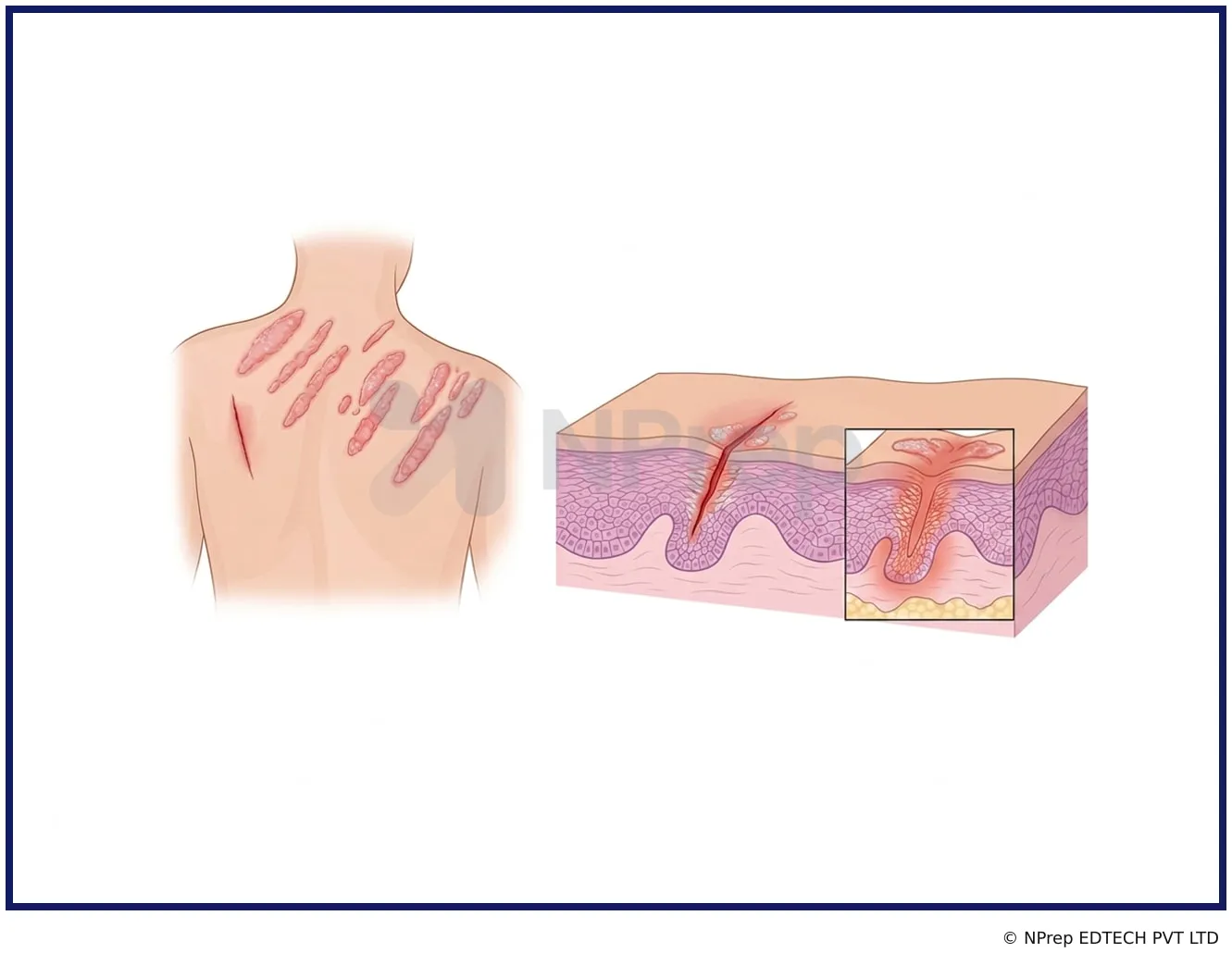
Select the option that correctly describes the sign being shown in the following image.
Appeared in: DSSSB October 2024
Explanation
- the Koebner phenomenon, also known as the isomorphic response.
- This phenomenon is defined by the appearance of new skin lesions of a pre-existing dermatosis on areas of cutaneous injury or trauma.
- The image is intended to show lesions forming in a line, for example, after a scratch, which is the classic presentation of this sign.
- It is commonly seen in conditions such as psoriasis, lichen planus, and vitiligo.
Why Other Options Were Wrong
- Option A: Open comedones are blackheads, a primary sign of acne vulgaris. They are individual plugged pores and do not form linear plaques in response to trauma.
- Option C: Brudzinski's phenomenon is a key sign of meningeal irritation (meningitis). It is a neurological test involving neck flexion and has no relation to skin lesions.
- Option D: Nikolsky's phenomenon involves the shearing of the epidermis from the dermis with gentle pressure, leading to blisters. It indicates a loss of cohesion between epidermal cells, characteristic of blistering diseases.
Related Visual

Clinical Relevance
- Nursing practice connection: This is primarily an exam-oriented knowledge point with limited direct bedside application, so retain Identification of clinical dermatological signs from a visual representation as background academic context rather than a clinical decision trigger.
- Recognizing the Koebner phenomenon is crucial for patient education. Nurses should advise patients with susceptible conditions (like psoriasis) to avoid skin trauma, including vigorous scratching, tattoos, and certain cosmetic procedures, to prevent new lesions.
- The presence of this sign can help confirm a diagnosis of an underlying inflammatory dermatosis.
- What if the lesions were vesicles in a dermatomal pattern? If the lesions were vesicles (small blisters) and followed a dermatome (a specific area of skin supplied by a single spinal nerve), the diagnosis would likely be Herpes Zoster (shingles), not related to the Koebner phenomenon.
How to Approach the Question
- First, analyze the image for key features. Despite the blurriness, the implied feature is a linear arrangement of lesions.
- Next, evaluate the options provided. Categorize them if possible (e.g., dermatological vs. neurological signs).
- Define each term. Koebner phenomenon relates to trauma-induced linear lesions. Open comedones are blackheads. Brudzinski's sign is for meningitis. Nikolsky's sign is for blistering diseases.
- Compare the visual information (linear lesions) with the definitions. The linear pattern directly matches the definition of the Koebner phenomenon.
- Eliminate the other options based on their definitions, which do not match the visual cue. Brudzinski's is non-dermatological, and the others describe different types of lesions.
Concept Tested & Keywords
- Concept Tested: Identification of clinical dermatological signs from a visual representation.
- Stem keywords: sign, image
- Lead-in keywords: Select, correctly describes
- Clinical cues: The linear arrangement of skin lesions is the primary clinical cue, pointing towards an external trigger like trauma.
Question ID
QypXd1gFVTkJJD7U8oyFGp
Reference Book
E6 Medicine Macleod Clinical Examination 15e p. 331-333
E6 Medicine Harrison 22e Part 1 p. 419-421
Practise the full DSSSB October 2024
Attempt every question from this paper in a timed mock, then review the full solution for each one.
More Integumentary Function Questions
- This type of dressing is known as:
- The following picture shows is bedsore present in bedridden patient. Which grade of bedsore is present?
- In second degree bedsore, there is an involvement of:
- What is the bath used to remove the irritation of certain types of skin diseases and provide soothing effect?
- A female patient has come with facial burn injury into the emergency department in conscious condition. What will be the treatment for this patient?
- A patient comes into the emergency with a burn injury of 40% then what is first nursing intervention?
- A nurse caring a bedridden patient with a pressure ulcer, 2 hourly position changes and massaging & rubbing the back but pressure sore does not heal.…
- Second degree burn considered?
- Identify the stage of pressure ulcer
- A 23 year old man comes to the emergency department with thermal burns. In this case according to rule of nine which part of the body burned maximum?
More DSSSB October 2024 Questions
- What is the main indication of the flooding therapy?
- Which of the following is the correct sequence of general anaesthesia?
- Identify the article in the following image.
- A schizophrenic patient was asked how many members were there in his family. He replied, "Oh, maybe seven-since many people tell me because it is too…
- What is the size of the pink colour-coded IV cannula?
- Which is a chronic, progressive and degenerative disorder that occurs due to the destruction of myelin sheath?
- Which of the following programmes is known as the National Programme of Nutritional Support to Primary Education?
- Which of the following stages of psychosexual development is commonly characterised by the Electra complex and Oedipus complex?
- All of the following are the features of Reiter's syndrome, EXCEPT:
- Which article is shown in the given image?