
AIIMS Delhi NO - 2017
Child Health Nursing (Pediatrics)
Easy
See the image below and identify the disease?
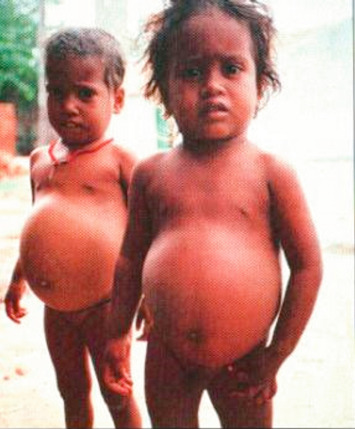
Appeared in: AIIMS Delhi NO - 2017
Explanation
- The image clearly shows children with generalized edema, most prominently as ascites, which results in a 'pot belly'.
- This presentation is the hallmark of Kwashiorkor, a condition caused by severe dietary protein deficiency while calorie intake may be relatively adequate.
- The protein deficiency leads to hypoalbuminemia, reducing plasma oncotic pressure and causing fluid to shift into the interstitial space.
- Other features consistent with Kwashiorkor and visible or suggested by the image include muscle wasting (thin limbs), apathy, and potential hair and skin changes.
Why Other Options Were Wrong
- Option B: Marasmus is incorrect because it is characterized by severe wasting of both muscle and subcutaneous fat, leading to an emaciated, 'skin and bones' appearance without the significant edema or swollen belly seen in the image.
- Option C: Measles is a viral infection. Its classic signs are fever, cough, coryza, conjunctivitis, and a maculopapular rash, often accompanied by Koplik's spots in the mouth. The image does not show any of these features.
- Option D: Rubella (German measles) is another viral infection that causes a fine, pink rash, and swollen lymph nodes, particularly behind the ears and in the neck. The children in the image do not present with these symptoms.
Related Visual

Clinical Relevance
- Nursing practice connection: Use the key finding related to The key concept is the clinical differentiation between Kwashiorkor and Marasmus, two forms of severe acute malnutrition (SAM), based on their distinct physical signs to guide bedside assessment, documentation, and the next nursing action.
- Nurses must be able to quickly identify signs of severe malnutrition in pediatric patients, as it is a life-threatening condition requiring urgent intervention.
- Accurate differentiation between Kwashiorkor and Marasmus is critical because their management strategies differ, particularly in the initial refeeding phase.
- Nursing care involves careful nutritional rehabilitation, monitoring for refeeding syndrome, managing infections (as immunity is compromised), and providing skin care due to edema and dermatosis.
How to Approach the Question
- First, carefully analyze the provided image, paying close attention to the overall physical appearance of the children.
- Identify the most prominent clinical signs. In this case, the key findings are the severely swollen abdomens ('pot bellies') and thin arms and legs.
- Consider the pathophysiology that could lead to these signs. A swollen abdomen suggests fluid accumulation (edema or ascites), while thin limbs indicate muscle wasting.
- Evaluate each option against the visual evidence. Kwashiorkor is defined by edema due to severe protein deficiency.
- Rule out the other options. Marasmus involves severe wasting without edema. Measles and Rubella are viral illnesses with characteristic rashes, which are absent here.
- Conclude that the combination of edema (pot belly) and muscle wasting is the classic presentation of Kwashiorkor.
Concept Tested & Keywords
- Concept Tested: The key concept is the clinical differentiation between Kwashiorkor and Marasmus, two forms of severe acute malnutrition (SAM), based on their distinct physical signs.
- Stem keywords: identify the disease, image
- Lead-in keywords: identify
- Clinical cues: The visual cue of a distended, swollen abdomen ('pot belly') in contrast to thin limbs is the most critical sign for diagnosis.
Question ID
QU0wOwR6sFjn9axr6B_el
Reference Book
E6 Pathology- ROBBINS & COTRAN PATHOLOGIC BASIS OF DISEASE 10TH Ed pp. 441-443, 440-442
E6 textbook of Applied Biochemistry and Nutrition & DieteticsHarbans Lal (pp 26-464 of 479) p. 355-357
Practise the full AIIMS Delhi NO - 2017
Attempt every question from this paper in a timed mock, then review the full solution for each one.
More Nutrition Questions
- Calorie intake of 1-year-old child:
- Which refers to the alternating bands of pigmentation in the hair of a child suffering from kwashiorkor?
- What is the clinical sign of Kwashiorkor?
- Which of the following is a true statement regarding breast milk?
- What is the full form of SAM?
- What should be done for a child suffering from severe acute malnutrition (SAM) with hypothermia?
- How much energy do infants require daily?
- A specialized health facility dedicated to where children with Severe Acute Malnutrition (SAM) are managed.?
- Exclusive breastfeeding should be continued up to?
- Rickets in children is caused by which vitamin deficiency?
More AIIMS Delhi NO - 2017 Questions
- Which is a live attenuated vaccine?
- The injection haloperidol is given intramuscularly by which technique?
- One of the most initial things that should be done by a nurse while going to a home visit?
- Most common type of shock in a trauma patient?
- Most common cause of hypotension in trauma patients?
- CSF draining from the nose and ear occurs in which type of skull fracture?
- Allen test should be performed before?
- See the following image and identify this?& x20;
- Identify the appropriate action based on the Vaccine Vial Monitor (VVM) shown in the image.
- Identify the following image?