
MP NHM CHO-2024 (Shift-2)
Medical & Surgical Nursing
Easy
______ is inflammation that can cause temporary or permanent vision loss.
Appeared in: MP NHM CHO-2024 (Shift-2)
Explanation
- Optic neuritis is defined as inflammation of the optic nerve.
- This inflammation disrupts the nerve's ability to transmit signals, causing symptoms like sudden vision loss, blurred or dim vision, and pain with eye movement.
- While vision often recovers, repeated episodes can lead to permanent damage and vision loss, fitting the question's description.
- It is a distinct inflammatory process, unlike the other options which are primarily degenerative or pressure-related.
Why Other Options Were Wrong
- Option A: Glaucoma is an optic neuropathy, not primarily an inflammatory condition. The damage to the optic nerve is caused by increased intraocular pressure (IOP).
- Option C: A cataract is the clouding or opacification of the eye's lens. It is a degenerative process, most commonly related to aging, and is not caused by inflammation.
- Option D: Macular degeneration is a degenerative disease affecting the central part of the retina (the macula). While inflammation can play a role in its progression, its primary pathology is deterioration, not acute inflammation.
Related Visual
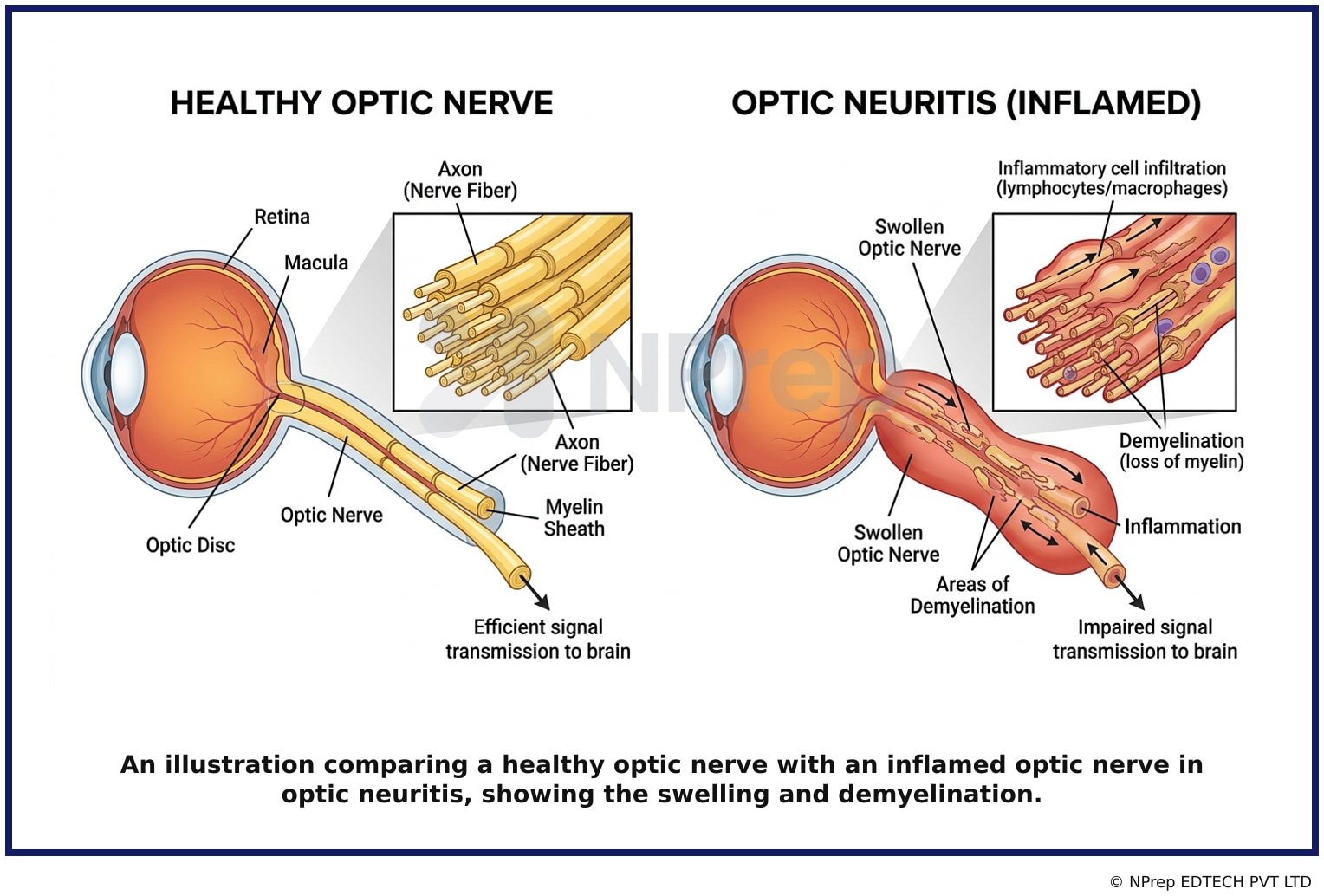
- Visual 1: Diagram - An illustration comparing a healthy optic nerve with an inflamed optic nerve in optic neuritis, showing the swelling and demyelination.
- Visual 2: Chart - A comparison table outlining the key differences in pathology (inflammation vs. pressure vs. degeneration), typical symptoms, and vision loss patterns for the four conditions.
Clinical Relevance
- Nursing practice connection: This is primarily an exam-oriented knowledge point with limited direct bedside application, so retain Pathophysiology of common eye disorders causing vision loss as background academic context rather than a clinical decision trigger.
- Optic neuritis is often the first presenting sign of Multiple Sclerosis (MS), an autoimmune disease affecting the central nervous system. A nurse should be aware of this strong association and ensure the patient is evaluated accordingly.
- Nursing assessment for a patient with suspected optic neuritis includes checking for pain with eye movement, assessing visual acuity, and testing for color vision deficits (especially for the color red).
- Patient education is crucial. The nurse should explain that while vision may improve, follow-up is essential to monitor for underlying conditions like MS and to manage any permanent visual deficits.
How to Approach the Question
- First, identify the key term in the question stem, which is 'inflammation'.
- Next, analyze each option based on its fundamental pathology.
- Recall or deduce the primary cause of each condition: Glaucoma (pressure), Optic neuritis (inflammation), Cataract (lens clouding/degeneration), and Macular Degeneration (retinal deterioration).
- Match the key term 'inflammation' directly to the definition of Optic neuritis.
- Eliminate the other options because their primary mechanisms are not inflammatory, even if inflammation can be a secondary factor in some.
Concept Tested & Keywords
- Concept Tested: Pathophysiology of common eye disorders causing vision loss.
- Stem keywords: inflammation, temporary or permanent vision loss
- Lead-in keywords: BEST, MOST RELEVANT CLUE
Question ID
QsjAvgTfHPq1mnQRZ5e8jY
Practise the full MP NHM CHO-2024 (Shift-2)
Attempt every question from this paper in a timed mock, then review the full solution for each one.
More Sensorineural Function Questions
- Which ophthalmic diagnostic test measures the Intraocular pressure?
- Identify the following instrument in image:
- What sound is heard when percussing a distended bladder?
- Which test would be done to check balance in a patient with ataxia?
- Identify the condition:
- In the emergency you have 4 patients. By prioritizing your management plan, which patient's problem will you address first?:
- All of the following instructions are given to a patient before computed tomography (CT) scan, except?
- The nursing care of a patient with dengue fever includes all of the following, except?
- Which of the following equipment is used for the examination of the ear?
- An aged client with diabetes mellitus complaining of painless peripheral loss of vision is at risk for?
More MP NHM CHO-2024 (Shift-2) Questions
- \ \ \ \ \ \ fluid represents the 2/3 of Total Body Weight.
- The \ \ \ \ cavity contains the urinary bladder, uterus/ prostate and rectum.
- Where are lymphocytes formed?
- During muscle relaxation, the \ \ \ \ covers the active site on actin.
- Which of the following occurs when small defects in the muscle of the wall of the large intestine or colon allow small pockets or pouches to form?
- Which of the following body system is primarily responsible for maintaining homeostasis?
- How much time does a heartbeat last?
- Which equation is correct for stroke volume (SV)?
- \ \ \ \ type of nephrons have short loops of Henle that do not dip far beyond the cortex.
- What does the ciliary body in the eye do?