
NORCET 2 -2021 (Shift-2)
Medical & Surgical Nursing
Easy
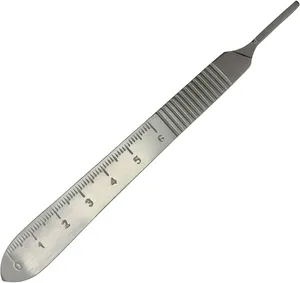
Identify use of the instrument that denote in the following image?
Appeared in: NORCET 2 -2021 (Shift-2)
Explanation
- The instrument shown is a scalpel handle, also known as a Bard-Parker handle.
- Its primary and most fundamental function is to securely hold (fix) an interchangeable surgical blade.
- The handle itself is not used for cutting but enables the surgeon to safely and effectively use the sharp blade attached to it.
- The specific model in the image is a No. 3 handle, which is compatible with smaller blades like the #10, #11, and #15.
Why Other Options Were Wrong
- Option B: Dissection of tissues is performed by the sharp surgical blade, not the handle alone. The handle's role is to hold the blade that performs the dissection.
- Option C: Cutting the skin is done with the attached blade. The handle's purpose is to provide a grip and control for the blade.
- Option D: Ear examinations are performed using an otoscope, which is a specialized instrument with a light and a magnifying lens designed to look into the ear canal.
Related Visual

Clinical Relevance
- Nursing practice connection: This is primarily an exam-oriented knowledge point with limited direct bedside application, so retain Surgical Instrument Identification and Function as background academic context rather than a clinical decision trigger.
- A nurse's role in the operating room includes preparing instruments like the scalpel by correctly and safely loading the blade onto the handle. This is a critical patient safety and staff safety skill.
- Understanding which handle corresponds to which blade is essential for anticipating the surgeon's needs and ensuring the procedure runs smoothly.
- What if? If a nurse hands a surgeon a scalpel handle without a blade when an incision is needed, it causes a delay and breaks the flow of the surgery. If they load the wrong blade size, it won't fit or could detach, posing a significant risk of injury.
How to Approach the Question
- First, carefully examine the image to identify the instrument. Note its key features: a flat handle, a tip designed for attachment, a textured grip, and a ruler.
- Recognize the instrument as a scalpel handle (Bard-Parker handle).
- Consider the primary, most fundamental function of this specific part. While the complete tool cuts, the handle's job is to hold the part that cuts.
- Evaluate the options. 'Use for fix surgical blade' directly describes the handle's specific purpose.
- Analyze the other options. 'Dissection' and 'cut the skin' describe the action of the combined tool (handle + blade), making them less precise answers for the handle alone.
- Eliminate 'Use for ear examination' as it involves a completely different instrument (otoscope).
Concept Tested & Keywords
- Concept Tested: Surgical Instrument Identification and Function
- Stem keywords: instrument, image, use
- Lead-in keywords: Identify
- Negative lead-in flag: false
Question ID
Q8L6NURSN3grJ9USUG9hdu
Reference Book
E6 Gynecology Williams p. 429-435
Practise the full NORCET 2 -2021 (Shift-2)
Attempt every question from this paper in a timed mock, then review the full solution for each one.
More Perioperative Concepts and Nursing Management Questions
- The nurse is informed that a client with a large surgical incision is being transferred from the intensive care unit to the surgical unit. What medic…
- Why it is necessary to remove dark coloured nail paint before surgery?
- A patient planned for surgery advised to remove Jewellery because:
- Vicryl 3-0 is:
- All of the following are correct regarding stoma formation; EXCEPT:
- A surgeon is going to give a skin incision on patient. Which of the following is to be done?
- Following is the picture of sterile sponge used in emergency. It has a blue colour thread. What is the purpose of this colour thread?
- How many items are included in the WHO surgical safety checklist: SITOSO?
- In operation theater during cauterization, the electric current passing from a single electrode is called:
- Which position is given to a client by nursing officer, who has been brought from OT after craniotomy surgery?
More NORCET 2 -2021 (Shift-2) Questions
- Preferred route of tranexamic acid drug administration is?
- Parts of the fallopian tube, except?
- After thyroidectomy the patient complains for hoarseness of voice that occurs due to injury in?
- Highest source of vitamin-C?
- After the RTA, a patient was brought to the emergency department. After Massive blood transfusion, which electrolyte imbalance occurs in the patient?
- A patient suffering from shock is receiving normal saline (NS). What is the normal osmolarity of Na\ in NS?
- A patient is unconscious nurse is going to take the sterile urine sample for culture from the urinary catheter. What technique is to be used by the n…
- Covid face shield is sterilized by?
- Which reflex should check when death of the brain stem occurs, except?
- Which is an example of a tocolytic agent?