
MP CHO -2021 (Shift 1st)
Obstetrics & Gynaecology
Easy
Identify this instrument. 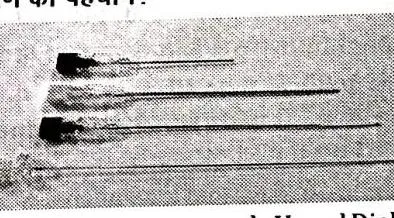
Appeared in: MP CHO -2021 (Shift 1st)
Explanation
- The instrument in the image is a Lumbar Puncture (Spinal) Needle, used to access the subarachnoid space.
- The defining feature, clearly visible, is the combination of a hollow outer cannula and a removable inner stylet.
- The stylet's function is crucial: it prevents skin and tissue from being cored and introduced into the spinal canal, which could cause complications.
- The presence of multiple needles of varying lengths is common in a lumbar puncture tray to accommodate different patient sizes.
Why Other Options Were Wrong
- Option A: An I.V. cannula consists of a flexible plastic catheter over a needle. The instrument shown is a rigid metal needle with an inner stylet, not a flexible catheter.
- Option B: A vessel dilator is a blunt, tapered plastic device used to widen an opening in tissue or a vessel. It is not a sharp, hollow needle and does not have a stylet.
- Option D: 'Long Needle' is a non-specific, generic term. While the instrument is a long needle, 'Lumbar Puncture Needle' is the precise medical name for this specific device which includes a stylet for a specialized purpose.
Related Visual

Clinical Relevance
- Nursing practice connection: This is primarily an exam-oriented knowledge point with limited direct bedside application, so retain Identification of specialized medical instruments as background academic context rather than a clinical decision trigger.
- A nurse's primary roles during a lumbar puncture include correctly positioning the patient (fetal or sitting position), maintaining sterility, providing comfort, labeling CSF specimen tubes correctly, and monitoring the patient post-procedure.
- Post-procedure monitoring is critical for detecting complications like a post-dural puncture headache (PDPH), bleeding, or signs of infection. Instructing the patient to remain flat helps reduce CSF leakage and the risk of PDPH.
- What if the patient complains of a severe, throbbing headache that worsens when they sit up after the procedure? This is a classic sign of a post-dural puncture headache. The nurse should instruct the patient to lie flat, encourage hydration, administer analgesics as ordered, and notify the provider, as a blood patch may be required.
How to Approach the Question
- First, carefully examine the image, paying close attention to the unique features of the instrument shown.
- Identify the key components: a long, thin needle and a removable inner part (stylet). Note that there are several of these instruments of different sizes.
- Consider the function of these components. A needle with a stylet is designed for a specific purpose: to pass through tissues without collecting a core of tissue.
- Evaluate the given options based on your visual analysis.
- Eliminate 'I.V. Cannula' as it is a flexible plastic tube, and 'Vessel Dilator' as it is a blunt, tapered rod.
- Choose 'Lumbar Puncture Needle' over the generic 'Long Needle' because it is the specific medical term for a needle with a stylet used for this purpose.
Concept Tested & Keywords
- Concept Tested: Identification of specialized medical instruments
- Stem keywords: Identify, instrument
- Lead-in keywords: Identify
- Negative lead-in flag: false
Question ID
QNMj5qVaKB790wjl-a3qPN
Reference Book
E6 Nelson Textbook of Pediatrics(2024) — Volume 2 p. 1363-1365
E6 Nursing Fundamentals Potter Perry 12e Part 5 p. 69-71
E6 OBGY Williams Obstetrics 26e p. 342-345
Practise the full MP CHO -2021 (Shift 1st)
Attempt every question from this paper in a timed mock, then review the full solution for each one.
More Practical Gynecology Questions
- Identify the following sample collection tube shown:
- Identify the instrument shown in the picture below?& x20;
- The following instrument is used for the collection of?& x20;
- What is used to take a cervical sample from the vagina?
- Instrument used for collection of Pap smear is?
- Which instrument is used to take a cervical smear?
- Identify the instrument given below denote picture?& x20;
- Identify the following instrument?& x20;
- To know the length of uterine cavity and its position, the instrument used is
More MP CHO -2021 (Shift 1st) Questions
- What does Thrombocytopenia mean?
- What is the function of a Flame cell?
- Which of the following is a Bleeding Disorder?
- Where is the rate of Drug Absorption highest?
- Which of the following bones is called the Collar Bone?
- Which of the following glands is called the Master Gland?
- Which of the following allows air to enter the Lungs?
- Which membrane separates the Middle Ear from the Auditory Canal?
- What is the characteristic of the High Stationary Stage in the demographic cycle?
- Maternal Mortality Rate is expressed per which of the following?