
AIIMS Delhi NO - 2018
Obstetrics & Gynaecology
Easy
Identify the instrument given below denote picture?
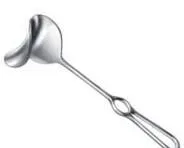
Appeared in: AIIMS Delhi NO - 2018
Explanation
- The instrument in the image is a Doyen's retractor.
- It is identified by its characteristic wide, curved, concave blade designed for broad tissue retraction.
- It also features a long shaft and a fenestrated (looped) handle for a secure grip, which is typical for handheld retractors.
- This instrument is frequently used in abdominal and pelvic surgeries, most notably to retract the bladder during a Caesarean section.
Why Other Options Were Wrong
- Option B: A Balfour retractor is a self-retaining retractor, meaning it holds itself in place. It consists of a frame with multiple blades (typically two side blades and a central blade) and looks very different from the handheld instrument in the image.
- Option C: A Fritsch retractor is very similar to a Doyen's and is considered a modification. However, the instrument shown is the classic Doyen's pattern. In examinations, Doyen's is the standard answer for this design.
- Option D: An Omni Tract retractor is a complex, table-mounted, self-retaining retractor system. It consists of a frame that attaches to the operating table and uses various arms and blades for retraction, which is completely different from the simple handheld tool shown.
Related Visual

Clinical Relevance
- Nursing practice connection: This is primarily an exam-oriented knowledge point with limited direct bedside application, so retain Identification of Surgical Instruments as background academic context rather than a clinical decision trigger.
- A scrub nurse must be able to quickly and accurately identify hundreds of surgical instruments. Handing the wrong instrument can delay the surgery and compromise patient safety.
- During a Caesarean section, the correct and prompt placement of the Doyen's retractor is critical to protect the bladder from accidental injury by the scalpel.
- Nurses are responsible for instrument counts before, during, and after surgery. Knowing the names and appearances of all instruments, including retractors, is essential to prevent retained surgical items.
How to Approach the Question
- First, carefully examine the image of the surgical instrument. Note its key characteristics: Is it handheld or self-retaining? What is the shape of the blade? What does the handle look like?
- The instrument in the picture is clearly handheld, has a long shaft, a looped handle, and a wide, curved blade.
- Next, evaluate the given options based on your knowledge of surgical instruments.
- Option A, Doyen's retractor, is a handheld retractor with a wide, curved blade, matching the image.
- Option B, Balfour retractor, is a large, self-retaining retractor with a frame and multiple blades. This does not match the image.
- Option D, Omni Tract retractor, is a complex, table-mounted self-retaining system. This does not match the image.
Concept Tested & Keywords
- Concept Tested: Identification of Surgical Instruments
- Stem keywords: Identify, instrument, picture
- Lead-in keywords: Identify
- Clinical cues: Image of a specific surgical instrument
Question ID
Qgt6qn_zXty2MMg70TIJt7
Reference Book
E6 Gynecology Williams p. 429-437
Practise the full AIIMS Delhi NO - 2018
Attempt every question from this paper in a timed mock, then review the full solution for each one.
More Practical Gynecology Questions
- Identify the following sample collection tube shown:
- Identify the instrument shown in the picture below?& x20;
- The following instrument is used for the collection of?& x20;
- What is used to take a cervical sample from the vagina?
- Instrument used for collection of Pap smear is?
- Which instrument is used to take a cervical smear?
- Identify this instrument.
- Identify the following instrument?& x20;
- To know the length of uterine cavity and its position, the instrument used is
More AIIMS Delhi NO - 2018 Questions
- Another tentative diagnosis made for the client is Wernicke's Encephalopathy. If the client has this, the nurse anticipates that the first physician'…
- A 35-year-old man was in an automobile accident with an admitting diagnosis of a head injury. He has a Glasgow Coma Scale score of 4. Upon MRI and CT…
- A 28-year-old male client is admitted to the hospital for a suspected brain tumor. While assessing this client, the nurse would keep in mind that the…
- Following admission to the hospital, a diagnosis of increasing intracranial pressure was made. The nursing intervention appropriate in the care of th…
- The nurse has orders to administer phenytoin (Dilantin) 100 mg IV as an anticoagulant. The priority action while administering this drug is to:
- The client is to take lithium regularly after she is discharged from the hospital. The nursing care plan includes discharge planning. The most import…
- A patient is taking a proper diet as prescribed for bulimia nervosa, but the patient's weight is not gaining. Which nursing action is appropriate?
- Identify the size of the cannula shown here?& x20;
- Identify the following image? & x20;
- Identify the instrument below?& x20;