
NORCET 1 - 2020
Medical & Surgical Nursing
Easy
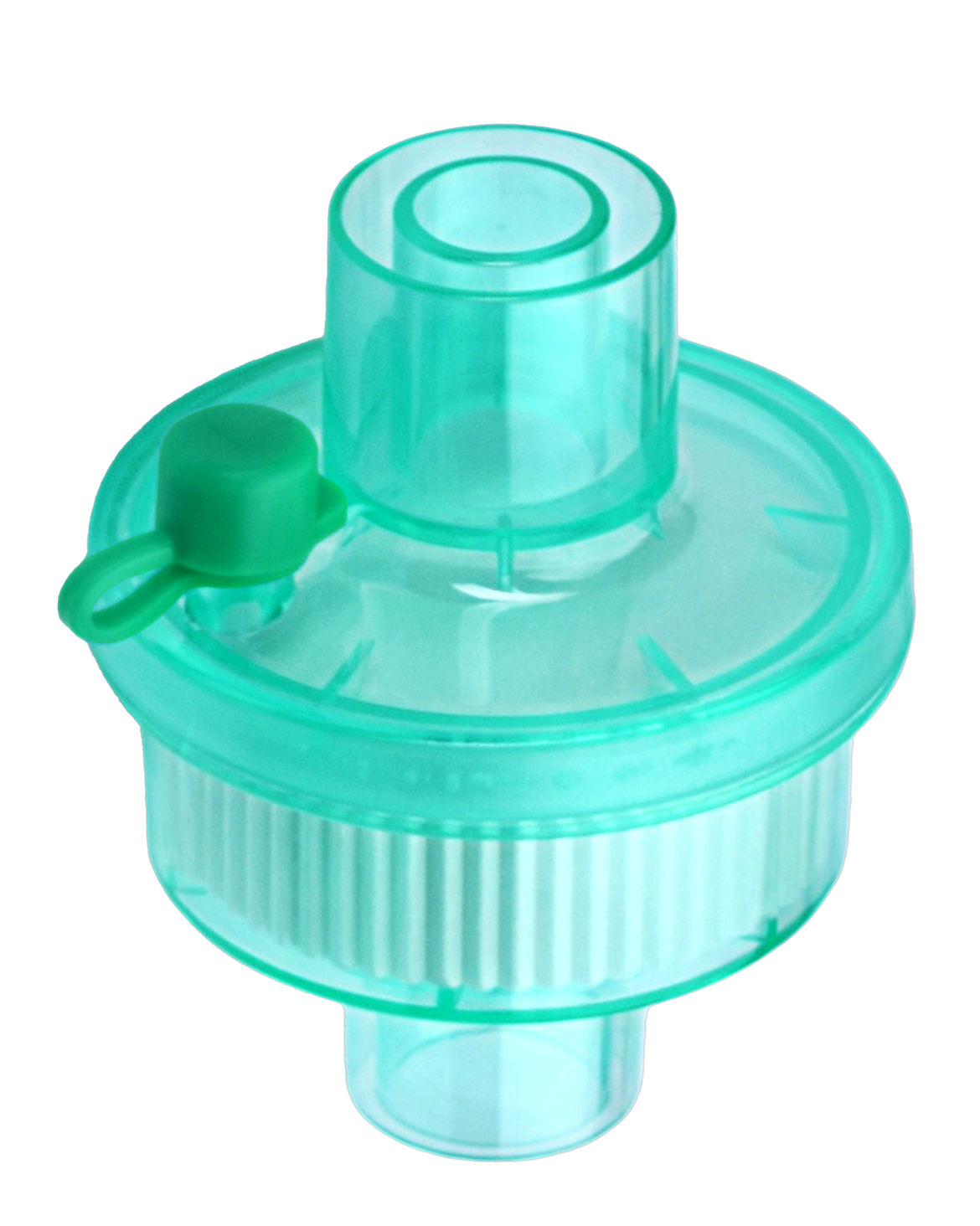
Identify this image ?

Appeared in: NORCET 1 - 2020
Explanation
- The device shown is a Heat and Moisture Exchanger (HME) filter, identifiable by its transparent casing, internal pleated filter medium, and standard respiratory circuit connectors.
- Its primary function is to act as an 'artificial nose' by capturing heat and moisture from a patient's exhaled breath to warm and humidify the next inhaled breath from the ventilator.
- The filter component also serves a crucial role in preventing the transmission of bacteria and viruses between the patient and the ventilator circuit.
- It is correctly placed between the artificial airway (like an ET tube or tracheostomy tube) and the ventilator's Y-piece.
Why Other Options Were Wrong
- Option A: A tracheostomy connector is a simple adapter, often angled, used to connect a tracheostomy tube to a breathing circuit. It does not have the bulky housing or internal filter medium seen in the HME filter.
- Option C: An ET tube connector is the integrated 15mm connector at the end of an endotracheal tube. It is part of the tube itself, not a separate, attachable device like the one pictured.
- Option D: A hemofilter is a completely different medical device used for filtering blood during hemodialysis or continuous renal replacement therapy (CRRT). It is part of a blood circuit, not a respiratory circuit, and has a very different appearance.
Related Visual

Clinical Relevance
- Nursing practice connection: This is primarily an exam-oriented knowledge point with limited direct bedside application, so retain Identification of Respiratory Care Equipment as background academic context rather than a clinical decision trigger.
- Proper identification and management of HME filters are essential nursing responsibilities in critical care to ensure effective ventilation and prevent complications.
- Failure to monitor for HME occlusion from secretions can lead to increased airway pressure, inadequate ventilation, and respiratory distress.
- Using an HME filter is contraindicated with heated humidifiers, as this can cause excessive condensation, block the filter, and potentially flood the airway.
How to Approach the Question
- First, analyze the image to identify the key features of the object. Note the transparent housing, the white, pleated material inside, and the connectors on both ends.
- Recognize that these features are characteristic of a filter used in a medical setting.
- Consider the context of the options provided. They all relate to medical tubing and filters.
- Evaluate each option against your visual analysis. A 'tracheostomy connector' or 'ET tube connector' are simple adapters, not filters. A 'hemofilter' is for blood, not air. An 'HME filter' (Heat and Moisture Exchanger) perfectly matches the appearance and function of the device shown.
- Conclude that the device is an HME filter based on its structure and purpose in a respiratory circuit.
Concept Tested & Keywords
- Concept Tested: Identification of Respiratory Care Equipment
- Stem keywords: Identify, image
- Lead-in keywords: BEST, MOST RELEVANT CLUE
- Negative lead-in flag: false
Question ID
Q0c9FCEYiWxyVJGDe9UjGC
Reference Book
E6 Nursing Fundamentals Taylor p. 736-738
Practise the full NORCET 1 - 2020
Attempt every question from this paper in a timed mock, then review the full solution for each one.
More Gas Exchange and Respiratory Function Questions
- Which is the most relevant knowledge about oxygen administration to a client with COPD?
- Patient in emergency department diagnosed to have fluid and air present in lung. What is the above-mentioned condition known as?
- Patient is suffering from dyspnea. Which position will you provide for patient to relieve?
- Which of the following is not involved in chest physiotherapy?
- Respiration which is abnormally shallow for two or three breaths followed by irregular period of apnea is termed:
- Identify the following instrument which is used in diagnostic procedures:
- Identify the instrument shown in the following image:
- Identify the tube in the following image:
- A patient suddenly develops respiratory difficulties such as dyspnea, what is the first priority of the nursing officer?
- Which of the following method is used for high flow oxygen administration:
More NORCET 1 - 2020 Questions
- The relation between the fetal presenting part and maternal pelvis is known as?
- Which vaccine can be frozen?
- Which vaccine, after administration, forms blisters, heals by itself, and forms a permanent scar mark?
- Identify the conjugate measured in the picture?& x20;
- A post LSCS woman passes 400 ml urine in the past 24 hours. This condition is known as?
- Red color urine is caused by which anti-tubercular drug?
- Visualization of bone occurs in which stage of burn?
- The given retractor is used in which of the following surgeries?
- Identify the size of IV Cannula in the image?
- What will you do if you have a needle stick injury from an HIV patient?