
AIIMS Delhi NO - 2018
Obstetrics & Gynaecology
Easy
Identify the palpation technique in the image below?
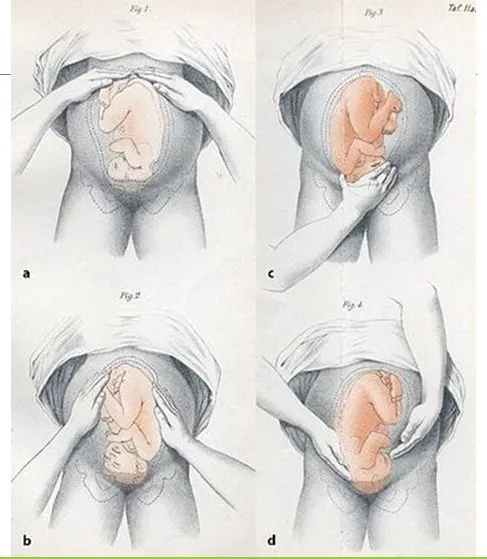
Appeared in: AIIMS Delhi NO - 2018
Explanation
- The image clearly illustrates the four sequential steps of the Leopold maneuvers, a standard procedure in prenatal care.
- Each step (Fundal Grip, Lateral Grip, Pawlik's Grip, and Pelvic Grip) is designed to systematically determine the fetus's orientation within the uterus.
- This technique helps ascertain the fetal lie (longitudinal, transverse), presentation (cephalic, breech), and position (e.g., left occiput anterior).
- The information gathered is vital for managing labor and delivery, helping to anticipate the need for interventions like external cephalic version or cesarean section.
Why Other Options Were Wrong
- Option B: The Heimlich maneuver (commonly misspelled as Helmich) is an emergency procedure involving abdominal thrusts to clear an obstructed airway in a choking person. It is not a palpation technique for assessing a fetus.
- Option C: The jaw-thrust maneuver is a first-aid technique used to open the airway of an unconscious patient, particularly when a spinal injury is suspected. It involves lifting the jaw forward without tilting the head and has no application in obstetrics.
- Option D: The Rington maneuver is not a recognized or standard medical or nursing procedure. It serves as a plausible-sounding but incorrect option (a distractor).
Related Visual

Clinical Relevance
- Nursing practice connection: This is primarily an exam-oriented knowledge point with limited direct bedside application, so retain Obstetric Abdominal Palpation Techniques as background academic context rather than a clinical decision trigger.
- Performing Leopold maneuvers correctly allows the nurse or midwife to assess fetal well-being, estimate fetal weight, and identify the fetal heart rate location for auscultation.
- Identifying a breech presentation or transverse lie before labor allows for timely counseling and intervention, such as offering an External Cephalic Version (ECV) or planning a cesarean delivery, which can prevent complications during labor.
- What if? If the third maneuver (Pawlik's Grip) reveals that the presenting part is not engaged in a first-time mother (primigravida) at term, it could indicate cephalopelvic disproportion (CPD), requiring further evaluation of the maternal pelvis and fetal size.
How to Approach the Question
- First, carefully analyze the image provided. Observe the actions being performed. The image shows four distinct hand placements on a pregnant woman's abdomen.
- Recognize that these systematic palpations are a well-known obstetric assessment. The goal is to determine the baby's position inside the uterus.
- Read the question, which asks to identify the specific technique shown.
- Evaluate the given options. 'Leopold Maneuvers' is the specific medical term for this four-step abdominal palpation technique in obstetrics.
- Eliminate the other options by recalling their definitions: 'Heimlich maneuver' is for choking, 'Jaw thrust maneuver' is for airway management, and 'Rington maneuver' is not a standard term.
- Conclude that the image depicts the Leopold Maneuvers.
Concept Tested & Keywords
- Concept Tested: Obstetric Abdominal Palpation Techniques
- Stem keywords: palpation technique, image, identify
- Lead-in keywords: BEST, MOST RELEVANT CLUE
- Clinical cues: Image shows four-step palpation of a pregnant abdomen.
Question ID
QaU13mvXUjQtViWZO9-Msi
Reference Book
E6 Comprehensive Textbook of Community Health Nursing for BSc Nursing Students Part 2 — Subpart A (pp 1-275 of 550) p. 200-202
E6 Obstetrics Williams p. 19-36
E6 Midwifery Obstetrics and Gynecology Nursing Sandeep Kaur p. 16-24
Practise the full AIIMS Delhi NO - 2018
Attempt every question from this paper in a timed mock, then review the full solution for each one.
More Fetus-in-Utero Questions
- Which method is used to determine the engagement of the fetal presenting part during a prenatal examination?
- The relationship of the long axis of foetus to the long axis of uterus is?
- The relation of the long axis of the fetus to the long axis of the uterus is known as?
- When the lower pole of the uterus is grasped with the right hand and facing the woman's head, it is known as?
- Identify the obstetric maneuver shown in the image ?
- What does the term "lie" refer to in obstetrics?
More AIIMS Delhi NO - 2018 Questions
- Another tentative diagnosis made for the client is Wernicke's Encephalopathy. If the client has this, the nurse anticipates that the first physician'…
- A 35-year-old man was in an automobile accident with an admitting diagnosis of a head injury. He has a Glasgow Coma Scale score of 4. Upon MRI and CT…
- A 28-year-old male client is admitted to the hospital for a suspected brain tumor. While assessing this client, the nurse would keep in mind that the…
- Following admission to the hospital, a diagnosis of increasing intracranial pressure was made. The nursing intervention appropriate in the care of th…
- The nurse has orders to administer phenytoin (Dilantin) 100 mg IV as an anticoagulant. The priority action while administering this drug is to:
- The client is to take lithium regularly after she is discharged from the hospital. The nursing care plan includes discharge planning. The most import…
- A patient is taking a proper diet as prescribed for bulimia nervosa, but the patient's weight is not gaining. Which nursing action is appropriate?
- Identify the size of the cannula shown here?& x20;
- Identify the following image? & x20;
- Identify the instrument below?& x20;