
Combined AIIMS - 2020 (Jodhpur, Bhopal, Patna, Raipur)
Medical & Surgical Nursing
Medium
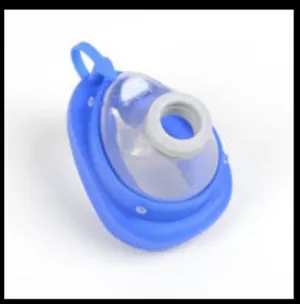
Identify the instrument device name:
Appeared in: Combined AIIMS - 2020 (Jodhpur, Bhopal, Patna, Raipur)
Explanation
- The device in the image is an AMBU mask, a component of a Bag-Valve-Mask (BVM) resuscitator.
- Its key features are a soft, inflatable cushion for creating a tight seal over the mouth and nose, and a transparent body for patient monitoring.
- It is used to provide positive pressure ventilation (manual breaths) to patients who are not breathing or are breathing inadequately.
- The standard 22mm connector allows it to be attached to a self-inflating bag (the 'AMBU bag').
Why Other Options Were Wrong
- Option A: A tracheostomy mask is a small device designed to fit over a stoma in the neck, not the face. The image clearly shows a face mask.
- Option C: A partial rebreather mask has a reservoir bag attached to it for oxygen delivery and is used on spontaneously breathing patients. The device in the image has no reservoir bag and is designed for manual ventilation.
- Option D: A Venturi mask is characterized by its color-coded diluter jets that allow for precise oxygen concentration delivery. The mask in the image lacks these specific adaptors.
Related Visual

Clinical Relevance
- Nursing practice connection: This is primarily an exam-oriented knowledge point with limited direct bedside application, so retain Identification of emergency respiratory equipment as background academic context rather than a clinical decision trigger.
- A nurse must be able to instantly recognize and differentiate emergency respiratory equipment. Using the wrong device, such as trying to ventilate with a Venturi mask, can lead to catastrophic patient outcomes.
- Proper technique for using a BVM involves a two-person approach for the best seal (one person holding the mask with two hands, the other squeezing the bag), known as the 'C-E' grip.
- What if? If the patient was breathing spontaneously but had severe hypoxemia (low blood oxygen), a non-rebreather mask would be a more appropriate choice than an AMBU mask to deliver the highest possible concentration of oxygen, assuming they have an adequate respiratory drive.
How to Approach the Question
- First, carefully examine the image for key features. Note the shape, size, attachments (or lack thereof), and material (e.g., transparent, cushioned).
- The image shows a mask designed to fit over the mouth and nose with a prominent cushion and a standard port but no oxygen bag or colored jets.
- Next, evaluate each option against your visual analysis.
- Option A (Tracheostomy mask) is for the neck, not the face. Incorrect.
- Option C (Partial Rebreather) requires a reservoir bag. Incorrect.
- Option D (Venturi) requires color-coded diluters. Incorrect.
Concept Tested & Keywords
- Concept Tested: Identification of emergency respiratory equipment
- Stem keywords: instrument, device, identify
- Lead-in keywords: Identify
- Clinical cues: The image shows a mask used for manual ventilation, not for passive oxygen delivery.
Question ID
QG78w7wN6qgDYlVGGtarZ7
Reference Book
E6 Nursing Fundamentals Taylor p. 731-733
E6 Nelson Textbook of Pediatrics(2024) — Volume 1 p. 663-665
Practise the full Combined AIIMS - 2020 (Jodhpur, Bhopal, Patna, Raipur)
Attempt every question from this paper in a timed mock, then review the full solution for each one.
More Gas Exchange and Respiratory Function Questions
- Which is the most relevant knowledge about oxygen administration to a client with COPD?
- Patient in emergency department diagnosed to have fluid and air present in lung. What is the above-mentioned condition known as?
- Patient is suffering from dyspnea. Which position will you provide for patient to relieve?
- Which of the following is not involved in chest physiotherapy?
- Respiration which is abnormally shallow for two or three breaths followed by irregular period of apnea is termed:
- Identify the following instrument which is used in diagnostic procedures:
- Identify the instrument shown in the following image:
- Identify the tube in the following image:
- A patient suddenly develops respiratory difficulties such as dyspnea, what is the first priority of the nursing officer?
- Which of the following method is used for high flow oxygen administration:
More Combined AIIMS - 2020 (Jodhpur, Bhopal, Patna, Raipur) Questions
- The position used for most of the gynecological procedures?
- Thyroid eye disease (TED) is also known as:
- How many items are included in the WHO surgical safety checklist: SITOSO?
- In iron deficiency anemia, the fingernails become spoon shaped, this condition is referred to as:
- Which of the following code is associated with cardiac arrest during medical emergency?
- How is blood loss measured in Post-partum hemorrhage?
- The traction used for cervical spine injury:
- In operation theater during cauterization, the electric current passing from a single electrode is called:
- Tracheostomy is done in which tracheal ring?
- The instrument used for measuring fetal heart rate (FHR):