
AIIMS Delhi NO - 2018
Nursing Foundation
Easy
Identify the instrument being applied by the nurse?
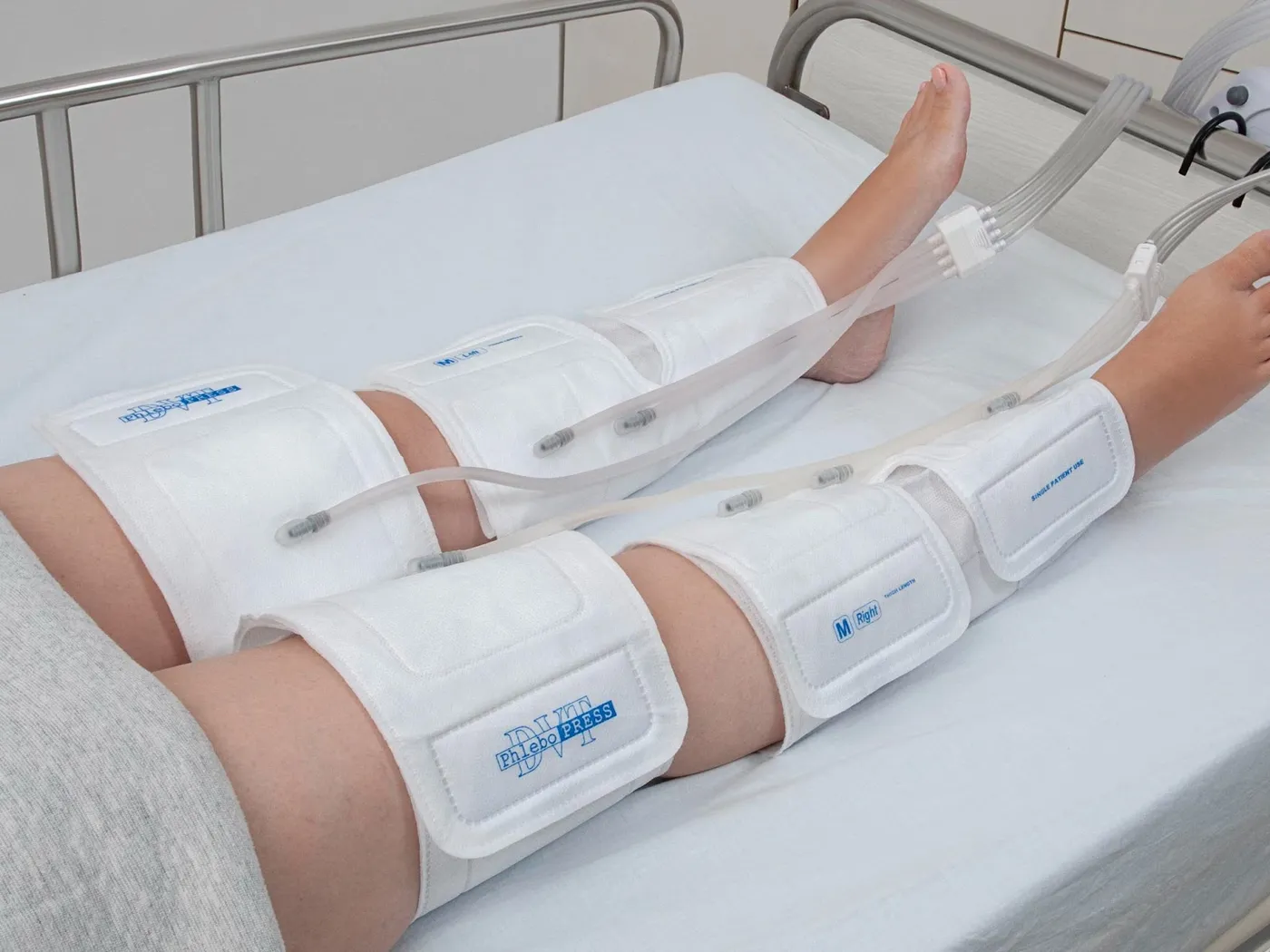
Appeared in: AIIMS Delhi NO - 2018
Explanation
- The device shown in the image, with its inflatable sleeve, tubing, and connection to a pump (implied), is correctly identified as a Pneumatic Sequential Compression Device (SCD).
- SCDs are specifically designed to prevent deep vein thrombosis (DVT) by applying intermittent, sequential pressure to the limbs.
- This pressure enhances venous blood flow and stimulates the body's natural muscle-pumping action, which is crucial for immobile or post-operative patients.
- The name 'sequential' refers to the fact that the chambers within the sleeve inflate in a sequence, typically from the ankle upwards, to effectively push blood toward the heart.
Why Other Options Were Wrong
- Option B: While an SCD is a type of pneumatic garment, 'Pneumatic garments' is a very general term. The device shown is a specific type used for DVT prophylaxis. The term 'Pneumatic Sequential Compression Device' is more precise and accurate.
- Option C: A cast is a hard, rigid shell made of plaster or fiberglass. Its purpose is to immobilize a fractured bone to allow it to heal. The device in the image is soft, inflatable, and connected by tubes, which is inconsistent with a cast.
- Option D: A warm blanket is used for patient comfort and to maintain body temperature. It does not have the mechanical components like inflatable sleeves, tubes, or a pump seen in the image.
Related Visual

Clinical Relevance
- Nursing practice connection: Knowing Identification and purpose of a Pneumatic Sequential Compression Device (SCD) helps nurses interpret findings accurately and avoid errors in routine assessment, medication administration, and patient teaching.
- Nurses are responsible for the correct application, operation, and monitoring of SCDs. Improper fit can lead to skin breakdown or nerve damage, while failure to use it can increase DVT risk.
- Patient education is vital. The nurse must explain the purpose of the device (to prevent blood clots) and instruct the patient to call for assistance before getting out of bed so the sleeves can be removed.
- What if? If a patient develops signs of a DVT (e.g., unilateral leg swelling, pain, redness, warmth) while on an SCD, the nurse should stop the device on the affected leg immediately and notify the healthcare provider. Continuing compression on a limb with an existing clot could cause it to dislodge and travel to the lungs (pulmonary embolism).
How to Approach the Question
- First, carefully analyze the image provided. Identify the key features of the object: it's a sleeve-like device, it's being wrapped around a patient's leg, and it has tubes attached.
- Consider the function implied by these features. The tubes suggest that air or fluid is pumped into the device, pointing towards a pneumatic (air-powered) function.
- Evaluate each option against your visual analysis. 'Pneumatic Sequential Compression Device' perfectly matches the appearance and implied function.
- Eliminate the other options by comparing them to the image. A 'cast' is rigid and solid. A 'warm blanket' is a simple covering with no tubes. 'Pneumatic garments' is a possible but less specific answer.
- Select the most precise and accurate term that describes the device shown. In this case, 'Pneumatic Sequential Compression Device' is the best fit.
Concept Tested & Keywords
- Concept Tested: Identification and purpose of a Pneumatic Sequential Compression Device (SCD)
- Stem keywords: instrument, nurse, applying
- Lead-in keywords: Identify
- Clinical cues: The image shows a sleeve with tubing being applied to a patient's leg, which is a visual cue for a pneumatic device.
Question ID
Qfyt2fYIz57ZMie-2BxqB2
Reference Book
E6 Nursing Fundamentals Taylor p. 332-334
E6 Nursing Fundamentals Potter Perry 12e Part 4 p. 150-152
Practise the full AIIMS Delhi NO - 2018
Attempt every question from this paper in a timed mock, then review the full solution for each one.
More Care of altered functioning of sensory organ & Unconscious patient Questions
- The priority when providing oral hygiene to an unconscious client is to prevent?
- In ICU, a nurse is assisting a doctor for inserting an NG tube into a comatose patient. What position is given to this patient during the procedure?
- Early indicator of hypoxia in an unconscious client?
- Eye padding is applied on unconscious patients to prevent:
- Which of the following is used to access the level of consciousness?
- A patient who is unconscious needs frequent mouth care. When performing mouth care, the best position of the patient is:
- Mechanical or electrical device that improves hearing?
- Which is a priority responsibility of on duty nurse for a patient who is legally blind?
- Purpose of eye care in a comatose patient is?
- The position to be given to an unconscious patient for mouth care is?
More AIIMS Delhi NO - 2018 Questions
- Another tentative diagnosis made for the client is Wernicke's Encephalopathy. If the client has this, the nurse anticipates that the first physician'…
- A 35-year-old man was in an automobile accident with an admitting diagnosis of a head injury. He has a Glasgow Coma Scale score of 4. Upon MRI and CT…
- A 28-year-old male client is admitted to the hospital for a suspected brain tumor. While assessing this client, the nurse would keep in mind that the…
- Following admission to the hospital, a diagnosis of increasing intracranial pressure was made. The nursing intervention appropriate in the care of th…
- The nurse has orders to administer phenytoin (Dilantin) 100 mg IV as an anticoagulant. The priority action while administering this drug is to:
- The client is to take lithium regularly after she is discharged from the hospital. The nursing care plan includes discharge planning. The most import…
- A patient is taking a proper diet as prescribed for bulimia nervosa, but the patient's weight is not gaining. Which nursing action is appropriate?
- Identify the size of the cannula shown here?& x20;
- Identify the following image? & x20;
- Identify the instrument below?& x20;