
NORCET 2 -2021 (Shift-2)
Medical & Surgical Nursing
Easy
Identify the following instrument?
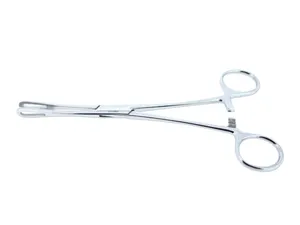
Appeared in: NORCET 2 -2021 (Shift-2)
Explanation
- The instrument displayed is a Sponge Holding Forceps, also known as a Forester forceps.
- It is clearly identified by its long shaft, ratchet lock mechanism, and two distinctive circular, fenestrated (ring-shaped) tips.
- Its primary function is to securely hold sponges or gauze for various surgical tasks, such as prepping the surgical site, dabbing fluids, or gently grasping tissue.
Why Other Options Were Wrong
- Option B: An ovum holder has different tips. Its jaws are typically cup-shaped or spoon-like and lack a locking mechanism to gently handle delicate tissues like products of conception without causing damage.
- Option C: Babcock forceps have fenestrated, atraumatic jaws, but they are not circular rings. Their design is for grasping delicate tubular structures like the intestine or fallopian tube without crushing them.
- Option D: A needle holder has short, strong, and stout jaws with a cross-hatched or serrated inner surface. This design is for firmly gripping a suture needle, which is very different from the ringed tips of the instrument shown.
Related Visual

Clinical Relevance
- Nursing practice connection: This is primarily an exam-oriented knowledge point with limited direct bedside application, so retain Surgical Instrument Identification as background academic context rather than a clinical decision trigger.
- Accurate and rapid instrument identification is a critical skill for scrub nurses and circulating nurses to ensure the surgical procedure flows smoothly and safely.
- Using a sponge holder is essential for maintaining aseptic technique during skin preparation and for performing sponge counts, a vital patient safety measure to prevent retained surgical items.
- What if? If a surgeon asked for a sponge holder to grasp the cervix but was handed a Babcock forceps, it would still be acceptable as both are used for grasping, but the sponge holder provides a firmer grip. However, if handed a needle holder, it would be inappropriate as its serrated jaws could crush and damage the delicate cervical tissue.
How to Approach the Question
- First, focus on the most distinguishing part of the surgical instrument, which is usually the tip or jaws. In this image, note the circular, ring-like tips.
- Observe the other features: the long shaft, the finger rings for gripping, and the presence of a ratchet lock.
- Systematically compare these observed features with the descriptions of the instruments provided in the options.
- Recall or deduce the function based on the design. The ringed tips are perfectly suited for holding a folded piece of gauze or a sponge.
- Eliminate the other options based on their distinct features: Ovum holders have cups, Babcock forceps have atraumatic loops for tubular organs, and needle holders have short, strong jaws for needles.
- Conclude that the instrument's features align perfectly with those of a sponge holder.
Concept Tested & Keywords
- Concept Tested: Surgical Instrument Identification
- Stem keywords: Identify, instrument
- Lead-in keywords: Identify
Question ID
QmLBpw63FFNj3sfcSeNh3x
Reference Book
E6 Midwifery Obstetrics and Gynecology Nursing Sandeep Kaur p. 50-58
E6 Nursing Brunner Adult Health 3SA Vol 1 Part 1 p. 78-80
Practise the full NORCET 2 -2021 (Shift-2)
Attempt every question from this paper in a timed mock, then review the full solution for each one.
More Perioperative Concepts and Nursing Management Questions
- The nurse is informed that a client with a large surgical incision is being transferred from the intensive care unit to the surgical unit. What medic…
- Why it is necessary to remove dark coloured nail paint before surgery?
- A patient planned for surgery advised to remove Jewellery because:
- Vicryl 3-0 is:
- All of the following are correct regarding stoma formation; EXCEPT:
- A surgeon is going to give a skin incision on patient. Which of the following is to be done?
- Following is the picture of sterile sponge used in emergency. It has a blue colour thread. What is the purpose of this colour thread?
- How many items are included in the WHO surgical safety checklist: SITOSO?
- In operation theater during cauterization, the electric current passing from a single electrode is called:
- Which position is given to a client by nursing officer, who has been brought from OT after craniotomy surgery?
More NORCET 2 -2021 (Shift-2) Questions
- Preferred route of tranexamic acid drug administration is?
- Parts of the fallopian tube, except?
- After thyroidectomy the patient complains for hoarseness of voice that occurs due to injury in?
- Highest source of vitamin-C?
- After the RTA, a patient was brought to the emergency department. After Massive blood transfusion, which electrolyte imbalance occurs in the patient?
- A patient suffering from shock is receiving normal saline (NS). What is the normal osmolarity of Na\ in NS?
- A patient is unconscious nurse is going to take the sterile urine sample for culture from the urinary catheter. What technique is to be used by the n…
- Covid face shield is sterilized by?
- Which reflex should check when death of the brain stem occurs, except?
- Which is an example of a tocolytic agent?