
NORCET 2 -2021 (Shift-2)
Medical & Surgical Nursing
Easy
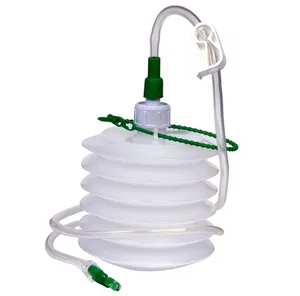
Identify the following image?
Appeared in: NORCET 2 -2021 (Shift-2)
Explanation
- The device in the image is a closed drainage system, specifically a Romovac or Hemovac drain.
- It consists of a drainage tube connected to a collapsible, bellows-like reservoir that creates negative pressure (suction) to actively remove fluid from a surgical site.
- This design constitutes a 'closed' system because the fluid is collected in a sealed container, minimizing the risk of environmental contamination and infection.
- The primary purpose is to prevent the accumulation of blood or fluid in a wound, which can delay healing and serve as a medium for bacterial growth.
Why Other Options Were Wrong
- Option A: An open drain, like a Penrose drain, allows fluid to drain passively onto a gauze dressing. The device shown is an active suction system that collects fluid in a sealed container.
- Option C: A pigtail drain is a type of catheter with a curled end (the 'pigtail') that is typically placed percutaneously under radiologic guidance to drain fluid collections or abscesses. The device in the image is a post-surgical wound drain with a different design and mechanism.
- Option D: A Penrose drain is a specific type of open drain. It is a soft, flat, flexible rubber tube that works by gravity and capillary action. The device in the image is a closed suction drain.
Related Visual

Clinical Relevance
- Nursing practice connection: This is primarily an exam-oriented knowledge point with limited direct bedside application, so retain Identification of Surgical Drainage Systems as background academic context rather than a clinical decision trigger.
- A nurse's primary responsibilities when managing a closed suction drain include ensuring the drain remains patent, maintaining suction by keeping the reservoir compressed, monitoring the amount and character (color, consistency, odor) of the drainage, and emptying the drain using aseptic technique to prevent infection.
- Accurate recording of the drainage output is crucial for assessing fluid balance and detecting potential complications like hemorrhage (sudden increase in bright red blood) or infection (purulent, foul-smelling drainage).
- What if? If the bellows reservoir is fully expanded but there is no drainage, the nurse should first check the tubing for kinks or clots. If none are found, it may indicate that drainage has ceased or the drain is blocked, which should be reported to the surgeon.
How to Approach the Question
- First, carefully examine the image provided. Identify the key components of the device: a collapsible, concertina-like reservoir, clear tubing, and a port for emptying.
- Analyze the function based on the design. The collapsible reservoir suggests it is designed to create suction when it expands.
- Consider the term 'closed system'. The fluid is collected in a sealed container, not exposed to the open air, which fits this description.
- Evaluate the given options based on your analysis. 'Open drain' is incorrect because the system is sealed. 'Pigtail drain' has a different structure (curled tip). 'Penrose drain' is a type of open drain.
- Conclude that 'Close drain' is the correct category that accurately describes the device shown in the image.
Concept Tested & Keywords
- Concept Tested: Identification of Surgical Drainage Systems
- Stem keywords: Identify, image, drain
- Lead-in keywords: Identify
- Clinical cues: The image shows a collapsible, bellows-shaped reservoir, which is characteristic of a closed suction drain.
Question ID
Qu6hsdfnOyERMhmSH8eLlG
Reference Book
E6 Nursing Brunner Adult Health 3SA Vol 1 Part 1 p. 122-124
E6 Nursing Fundamentals Potter Perry 12e Part 6 p. 81-83
E6 Nursing Fundamentals Taylor p. 1094-1096
Practise the full NORCET 2 -2021 (Shift-2)
Attempt every question from this paper in a timed mock, then review the full solution for each one.
More Perioperative Concepts and Nursing Management Questions
- The nurse is informed that a client with a large surgical incision is being transferred from the intensive care unit to the surgical unit. What medic…
- Why it is necessary to remove dark coloured nail paint before surgery?
- A patient planned for surgery advised to remove Jewellery because:
- Vicryl 3-0 is:
- All of the following are correct regarding stoma formation; EXCEPT:
- A surgeon is going to give a skin incision on patient. Which of the following is to be done?
- Following is the picture of sterile sponge used in emergency. It has a blue colour thread. What is the purpose of this colour thread?
- How many items are included in the WHO surgical safety checklist: SITOSO?
- In operation theater during cauterization, the electric current passing from a single electrode is called:
- Which position is given to a client by nursing officer, who has been brought from OT after craniotomy surgery?
More NORCET 2 -2021 (Shift-2) Questions
- Preferred route of tranexamic acid drug administration is?
- Parts of the fallopian tube, except?
- After thyroidectomy the patient complains for hoarseness of voice that occurs due to injury in?
- Highest source of vitamin-C?
- After the RTA, a patient was brought to the emergency department. After Massive blood transfusion, which electrolyte imbalance occurs in the patient?
- A patient suffering from shock is receiving normal saline (NS). What is the normal osmolarity of Na\ in NS?
- A patient is unconscious nurse is going to take the sterile urine sample for culture from the urinary catheter. What technique is to be used by the n…
- Covid face shield is sterilized by?
- Which reflex should check when death of the brain stem occurs, except?
- Which is an example of a tocolytic agent?