
AIIMS Delhi NO- 2019
Medical & Surgical Nursing
Easy
Identify the following image:
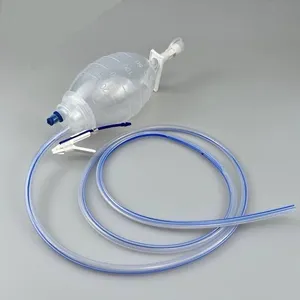
Appeared in: AIIMS Delhi NO- 2019
Explanation
- The device in the image is a Jackson-Pratt (JP) drain, characterized by its grenade-shaped, compressible bulb.
- This type of drain is a closed-suction system, meaning it uses negative pressure to actively pull fluid from a wound.
- The bulb is squeezed flat before the port is closed; as it expands, it creates a vacuum that draws fluid through the attached tubing.
- This system is used post-surgically to prevent the collection of fluid (like blood or serous fluid), which can lead to hematoma or seroma formation and increase infection risk.
Why Other Options Were Wrong
- Option B: 'Wound drain' is a general, non-specific term. While a JP drain is a type of wound drain, the image shows a specific device that can be identified more precisely.
- Option C: A Hemovac drain has a different appearance. It uses a circular, spring-loaded container to create suction, not a soft, grenade-shaped bulb.
- Option D: This option is incorrect because the device in the image is clearly identifiable as a Jackson-Pratt drain, which is listed as option A.
Related Visual

Clinical Relevance
- Nursing practice connection: This is primarily an exam-oriented knowledge point with limited direct bedside application, so retain Identification of surgical drainage systems as background academic context rather than a clinical decision trigger.
- Nurses are responsible for managing JP drains, which includes emptying the bulb, measuring and documenting the amount and character of the drainage, and maintaining suction.
- Patient education is crucial. The nurse must teach the patient and caregivers how to care for the drain at home, including how to empty it, how to 'strip' the tubing to prevent clots, and signs of infection to report.
- What if? If the JP drain bulb is found fully inflated, it means suction has been lost. The nurse must assess for leaks, ensure the plug is secure, and re-compress the bulb to re-establish negative pressure. If it doesn't hold suction, the provider should be notified.
How to Approach the Question
- First, carefully examine the image provided. Identify the key visual characteristics of the object shown. Notice the shape of the reservoir (grenade-like), the compressible nature of the bulb, and the attached tubing.
- Next, read all the options provided. Compare your visual analysis with each option.
- Option A is 'Jackson-Pratt drain'. This matches the classic appearance of the device.
- Option B, 'Wound drain', is a broad category. While true, it's not the most specific and accurate identification.
- Option C, 'Hemovac drain', describes a different type of drain with a circular, spring-loaded design.
- Based on the specific features, conclude that 'Jackson-Pratt drain' is the most accurate and specific answer.
Concept Tested & Keywords
- Concept Tested: Identification of surgical drainage systems
- Stem keywords: Identify, image, drain
- Lead-in keywords: Identify
- Clinical cues: The grenade-shaped bulb is a classic feature of the Jackson-Pratt drain.
Question ID
QBWjBmpMBCGdJ6BQR0AGtT
Reference Book
E6 Nursing Brunner Adult Health 3SA Vol 1 Part 1 p. 122-124
E6 Nursing Fundamentals Potter Perry 12e Part 6 p. 81-83
E6 Nursing Fundamentals Taylor p. 1094-1096
Practise the full AIIMS Delhi NO- 2019
Attempt every question from this paper in a timed mock, then review the full solution for each one.
More Other Acute Problems Questions
- A patient presents to the emergency department with the following vital signs: blood pressure 120/66 mmHg, pulse rate 88 beats per minute, respirator…
- A 30-year-old patient presents to the emergency department with a body temperature of 104°F (40°C). The patient’s additional vital signs are as follo…
- A patient was in an automobile accident, and sustained a head injury. Following admission to the hospital, a diagnosis of increasing ICP was made. Th…
- A patient was in an automobile accident and sustained a head injury following admission to the hospital a diagnosis of increased ICP was made. Which…
- What is the first step to take if someone has a convulsion? (Choose the most appropriate option from below)
- A patient admitted in the emergency is having tachypnoea with a respiratory rate of 28 breaths per minute. The likely diagnosis is:
- An example of an Open Drainage system used in surgical wounds is:
- You observe that a patient of head injury opens his eyes on painful stimuli but not on command; he localizes the site of the painful stimulus; and mu…
- An emergency room nurse is assessing a 22-year-old male who has been using opioids. What symptoms indicate that the client has overdose?
- A 70-year old client is confined to her bed due to advanced Parkinson's disease. Which nursing diagnosis takes the highest priority for a client with…
More AIIMS Delhi NO- 2019 Questions
- A nurse is preparing to give bath to admitted patient with perineal problem. Which of the following will help the patient?
- In the absence of nurse from floor, patient falls from bed. This type of injury belongs to:
- Patient's Medical record with all essential information is responsibility of:
- Post-partum women having bleeding within 24 hrs after delivery is called:
- In which condition, distal pulse is preferred rather than apical pulse?
- A pre-eclampsia woman's baby is lying with her mother. Neonate is born in 37 weeks. After 57 hours, when nurse is monitoring vital signs of baby, tem…
- A woman with 3rd day postpartum has complaint of engorgement in both breasts. What is cut off temperature for fever in postpartum women?
- Universal blood donor?
- WHO hand wash time with soap?
- Why it is necessary to remove dark coloured nail paint before surgery?