
AIIMS Rishikesh NO - 2019
Nursing Foundation
Hard
Identify the following device? 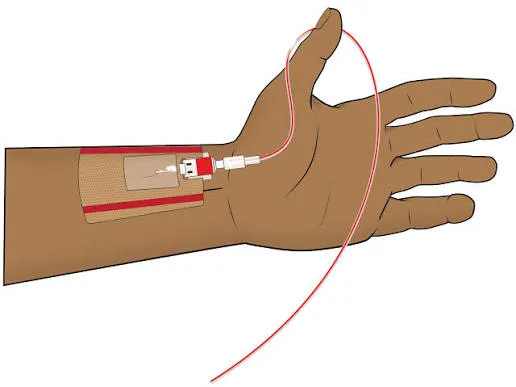
Appeared in: AIIMS Rishikesh NO - 2019
Explanation
- The device shown is a radial arterial line, identified by its placement in the radial artery on the lateral side of the wrist.
- This type of line is specifically used for invasive, continuous blood pressure monitoring and for obtaining arterial blood samples for analysis (like ABGs).
- The location is consistent with the course of the radial artery, which is the most common site for arterial cannulation due to its accessibility and good collateral circulation to the hand.
- The setup with pressure tubing (often color-coded red) is characteristic of an arterial monitoring system, not a line for fluid or medication infusion.
Why Other Options Were Wrong
- Option B: A venous line is used for administering fluids and medications, not for continuous blood pressure monitoring. The appearance and purpose are inconsistent with a venous line.
- Option C: An ulnar arterial line would be placed on the medial (pinky finger) side of the wrist. The image clearly shows the catheter on the lateral (thumb) side, which is the location of the radial artery.
- Option D: This option is incorrect due to both location and function. The catheter is on the radial side, not the ulnar side, and it is an arterial line for monitoring, not a venous line for infusion.
Related Visual

Clinical Relevance
- Nursing practice connection: This is primarily an exam-oriented knowledge point with limited direct bedside application, so retain Identification and purpose of vascular access devices as background academic context rather than a clinical decision trigger.
- A critical nursing responsibility is to continuously monitor the patient's hemodynamic status via the arterial line and assess the limb distal to the insertion site for signs of circulatory compromise (e.g., pallor, coolness, numbness, or weak pulse).
- Patient safety is paramount. Arterial lines must be clearly labeled to prevent the catastrophic error of injecting medications, which can lead to arterial thrombosis, ischemia, and potential limb loss.
- Before insertion, an Allen test is typically performed to confirm adequate collateral blood flow to the hand from the ulnar artery, which is a key safety check.
How to Approach the Question
- First, analyze the image to determine the anatomical location of the device. Note that it is placed on the wrist, specifically on the side of the thumb.
- Recall the anatomy of the wrist: the artery on the thumb side is the radial artery, and the one on the pinky side is the ulnar artery. This narrows the options to 'Radial' lines.
- Next, consider the function of the device. The setup with pressure tubing suggests monitoring rather than infusion. Arterial lines are used for blood pressure monitoring, while venous lines are for giving fluids/meds.
- Combine these observations: the location is radial, and the function is arterial. This leads to the correct answer: Radial arterial line.
- Eliminate the other options based on incorrect location (Ulnar) or incorrect function (Venous).
Concept Tested & Keywords
- Concept Tested: Identification and purpose of vascular access devices
- Stem keywords: device, identify, radial, arterial, venous, ulnar
- Lead-in keywords: Identify
- Clinical cues: Catheter inserted in the wrist
- Clinical cues: Location on the thumb-side of the wrist
Question ID
QSt-AbRxx8cdxKb3yOxz-Y
Reference Book
E6 Nelson Textbook of Pediatrics(2024) — Volume 1 p. 615-617
E6 Anatomy Grays 43e Vol 2 Part 2 p. 73-75
Practise the full AIIMS Rishikesh NO - 2019
Attempt every question from this paper in a timed mock, then review the full solution for each one.
More Nursing Care & Specific Procedures Questions
- Identify the procedure done in the given image:
- Match the following:
- Look at the image and tell which of the following is incorrect combination:
- Identify the airway used in emergency in the following image:
- According to hospital's protocol during emergency situation "code pink" is used for which condition?
- Which is the appropriate nursing action by nursing officer after taking ABG sample from radial artery?
- The common veins used for placement of central line are all; EXCEPT:
- Who discovered Catgut suture?
- The sutures used to close deep, multi-layer lacerations are:
- You are preparing to suction a patient who is intubated with a 4.5 mm endotracheal tube (ETT). What size suction catheter would you choose to minimiz…
More AIIMS Rishikesh NO - 2019 Questions
- Identify the following instrument?& x20;
- Which procedure is being performed in the following image?
- Identify the following instrument?
- Prolonged nasogastric suctioning may cause?
- Which position is given to a child after lumbar Puncture?
- What are the urine specific gravity and color of urine in a 6-year-old child?
- Dengue fever is caused by which mosquito?
- What is the maximum dose of an Intramuscular injection?
- Aspirin can be given with which fluid?
- What are the ECG changes in Hyperkalemia?