
Combined AIIMS - 2020 (Jodhpur, Bhopal, Patna, Raipur)
Medical & Surgical Nursing
Hard
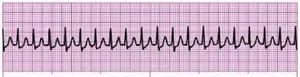
Identify the ECG strip:
Appeared in: Combined AIIMS - 2020 (Jodhpur, Bhopal, Patna, Raipur)
Explanation
- The ECG demonstrates a regular, narrow-complex tachycardia with a rate of approximately 200 beats per minute.
- This combination of a fast rate (tachycardia), regular rhythm, and narrow QRS complexes is characteristic of Supraventricular Tachycardia (SVT).
- In SVT, the P waves are often obscured because the rapid rate causes them to merge with the preceding T-wave, which is consistent with the provided ECG strip.
- The electrical impulse originates above the ventricles, leading to a rapid but organized ventricular contraction, resulting in the narrow QRS.
Why Other Options Were Wrong
- Option A: Atrial fibrillation is characterized by an 'irregularly irregular' rhythm and the absence of distinct P waves, which are replaced by chaotic fibrillatory waves. The ECG in the question shows a perfectly regular rhythm.
- Option B: Ventricular fibrillation is a chaotic, disorganized rhythm with no identifiable P waves, QRS complexes, or T waves. It appears as a wavy, erratic line on the ECG and is a life-threatening emergency. The ECG in the question shows clear, organized QRS complexes.
- Option D: First-degree AV block is defined by a prolonged but consistent PR interval (greater than 0.20 seconds) with a normal heart rate and regular rhythm. The ECG in the question shows a very fast heart rate, and the PR interval cannot be measured because the P waves are not visible.
Related Visual

Clinical Relevance
- Nursing practice connection: This is primarily an exam-oriented knowledge point with limited direct bedside application, so retain ECG interpretation of tachyarrhythmias as background academic context rather than a clinical decision trigger.
- Recognizing SVT is a critical nursing skill. Patients often present with palpitations, dizziness, shortness of breath, or chest pain. Prompt identification allows for timely intervention.
- Initial nursing interventions for a stable patient with SVT include instructing them to perform vagal maneuvers (like bearing down or coughing) to try and slow the heart rate while preparing for potential medication administration (e.g., adenosine).
- What if? If the patient with this rhythm became unstable (e.g., hypotensive, altered mental status), the priority would shift from vagal maneuvers and medication to immediate synchronized cardioversion.
How to Approach the Question
- First, assess the overall rate. In this image, the QRS complexes are very close together, indicating a tachycardia (fast heart rate).
- Next, determine the rhythm by measuring the R-R interval. Here, the distance between each R wave is consistent, indicating a regular rhythm.
- Then, examine the QRS complex width. The QRS is narrow (less than 3 small squares), which points to a supraventricular origin (above the ventricles).
- Look for P waves. In this strip, distinct P waves are not visible before each QRS, suggesting they are hidden or buried in the T-wave.
- Synthesize the findings: a regular, narrow-complex tachycardia with absent/hidden P waves is the classic presentation of SVT. Compare this with the definitions of the other options to confirm the diagnosis.
Concept Tested & Keywords
- Concept Tested: ECG interpretation of tachyarrhythmias.
- Stem keywords: ECG strip, identify
- Lead-in keywords: Identify
- Clinical cues: The key visual cues are a very fast rate, regular rhythm, and narrow QRS complexes, which strongly point towards a supraventricular origin.
Question ID
Q2TLX6SCj7zu1OZecfPs6m
Reference Book
E6 Medicine Harrison 22e Part 1 p. 1973-1975
E6 Robert Boland, Marcia L. Verduin - Kaplan and Sadock's Comprehensive Text of Psychiatry-Wolters Kluwer Health (2024) (pp 1-16525 of 16525) p. 7321-7323
Practise the full Combined AIIMS - 2020 (Jodhpur, Bhopal, Patna, Raipur)
Attempt every question from this paper in a timed mock, then review the full solution for each one.
More Cardiovascular, Circulatory, and Hematologic Function Questions
- A patient was brought to ED with complaint of chest pain from last 1 hour. Which test is done to detect myocardial infarction?
- A patient is undergoing blood transfusion and suddenly shows complaints of transfusion reaction. What will be the priority nursing intervention?
- Normal hemoglobin level in adult is:
- The following all are blood transfusion complications from; EXCEPT:
- Symptoms of acute blood loss are:
- An obstruction of blood flowing from the left atrium into the left ventricle is known as:
- 'Sequestration crisis' is related to:
- Which is the most common HIV related malignancy?
- Calculate the pulse pressure from the below image of cardiac monitor:
- Identify the use of following machine used in pneumatic compression device:
More Combined AIIMS - 2020 (Jodhpur, Bhopal, Patna, Raipur) Questions
- The position used for most of the gynecological procedures?
- Thyroid eye disease (TED) is also known as:
- How many items are included in the WHO surgical safety checklist: SITOSO?
- In iron deficiency anemia, the fingernails become spoon shaped, this condition is referred to as:
- Which of the following code is associated with cardiac arrest during medical emergency?
- How is blood loss measured in Post-partum hemorrhage?
- SCD (Sequential Compressive Device) used for treatment of DVT patients, ensures:
- The traction used for cervical spine injury:
- In operation theater during cauterization, the electric current passing from a single electrode is called:
- Tracheostomy is done in which tracheal ring?