
AIIMS Delhi NO- 2019
Medical & Surgical Nursing
Medium
Identify the cannula which is used in patient with hemorrhagic shock shown in the picture:
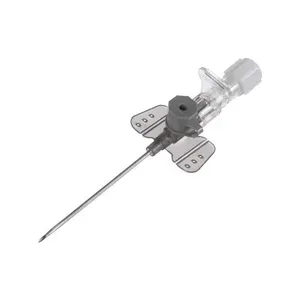
Appeared in: AIIMS Delhi NO- 2019
Explanation
- The cannula shown in the image has a gray hub, which universally corresponds to a 16-gauge (16 G) size.
- A 16 G cannula is a large-bore catheter with a high flow rate of approximately 180 mL/min.
- This high flow rate is essential for the rapid administration of intravenous fluids and blood products required in emergencies like hemorrhagic shock to quickly restore circulating volume and prevent cardiovascular collapse.
Why Other Options Were Wrong
- Option A: Although a 14 G (orange) cannula has an even higher flow rate (240 mL/min) and is also ideal for major trauma, the cannula specifically shown in the image is gray, which identifies it as 16 G.
- Option C: An 18 G (green) cannula has a significantly lower flow rate (around 90 mL/min). This rate may be insufficient for the rapid volume replacement needed to stabilize a patient in severe hemorrhagic shock.
- Option D: A 20 G (pink) cannula has a relatively low flow rate (about 60 mL/min) and is not suitable for rapid, large-volume resuscitation.
Related Visual

Clinical Relevance
- Nursing practice connection: Prioritize focused assessment, early escalation, and real-time monitoring when managing IV Cannula Gauge Identification and Clinical Application in acute care settings.
- In an emergency, quickly selecting the correct IV cannula size is a critical nursing skill that directly impacts patient outcomes. Choosing a large-bore cannula (14G or 16G) for a trauma or shock patient is a priority action.
- Using an undersized cannula (e.g., 20G or 22G) in a patient with hemorrhagic shock can lead to inadequate fluid resuscitation, worsening hypotension, and irreversible organ damage.
- What if? If the patient was a stable adult scheduled for elective surgery with no anticipated blood loss, an 18 G or 20 G cannula would be a more appropriate choice.
How to Approach the Question
- First, carefully examine the image to identify the key visual feature of the IV cannula, which is the color of its hub.
- Recall the standard color-coding system for IV cannulas. In this case, the gray color corresponds to a 16-gauge (16 G) cannula.
- Next, analyze the clinical scenario provided: a 'patient with hemorrhagic shock'.
- Consider the physiological needs of this condition. Hemorrhagic shock requires rapid administration of large volumes of fluid and/or blood to restore perfusion.
- Relate the identified cannula size to the clinical need. A 16 G cannula is a large-bore catheter designed for high flow rates, making it an appropriate choice for managing shock.
- Finally, select the option that matches the cannula identified in the image (16 G).
Concept Tested & Keywords
- Concept Tested: IV Cannula Gauge Identification and Clinical Application
- Stem keywords: cannula, hemorrhagic shock, picture
- Lead-in keywords: Identify
- Clinical cues: The clinical condition 'hemorrhagic shock' is a key cue, indicating the need for rapid, large-volume fluid resuscitation.
Question ID
Q0936SuJXYBj5zQCY5TXco
Reference Book
E6 Nursing Fundamentals Taylor pp. 1092-1094, 798-800
Practise the full AIIMS Delhi NO- 2019
Attempt every question from this paper in a timed mock, then review the full solution for each one.
More Shock and Multisystem Failure Questions
- What is an early sign of hypovolemic shock?
- What is the risk factor for septic shock?
- A Patient with RTA comes into the emergency department that needs resuscitation. Which cannula is least preferred?
- A patient is suffering from bradycardia, warm dry skin and hypotension. Symptoms suggestive to neurogenic shock. What is another name of neurogenic s…
- A RTA patient brought into the emergency department with loss of massive blood with cervical spine injury, after assessment revealed that blood press…
- A patient has GI bleeding, with clot, BP 80/40 mm of hg. Priority nursing action is?
- Decrease blood pressure, rapid respiration, cold clammy & pale skin and decrease urine output all are clinical features seen in?
- Which of the following is a symptom of shock? (Choose the most appropriate option from below)
- A patient presents to the emergency with a history of multiple bee stings and a blood pressure of 80/50 mm Hg. He is having:
- The MAST garment is used for treatment of:
More AIIMS Delhi NO- 2019 Questions
- A nurse is preparing to give bath to admitted patient with perineal problem. Which of the following will help the patient?
- In the absence of nurse from floor, patient falls from bed. This type of injury belongs to:
- Patient's Medical record with all essential information is responsibility of:
- Post-partum women having bleeding within 24 hrs after delivery is called:
- In which condition, distal pulse is preferred rather than apical pulse?
- A pre-eclampsia woman's baby is lying with her mother. Neonate is born in 37 weeks. After 57 hours, when nurse is monitoring vital signs of baby, tem…
- A woman with 3rd day postpartum has complaint of engorgement in both breasts. What is cut off temperature for fever in postpartum women?
- Universal blood donor?
- WHO hand wash time with soap?
- Why it is necessary to remove dark coloured nail paint before surgery?