
AIIMS Delhi NO- 2019
Medical & Surgical Nursing
Medium
Find out the problem in the following image:
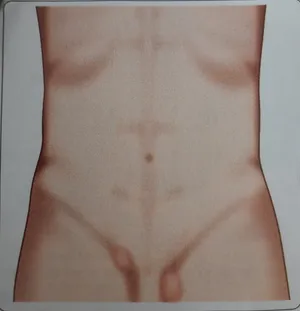
Appeared in: AIIMS Delhi NO- 2019
Explanation
- An inguinal hernia is defined as the protrusion of abdominal contents through the inguinal canal, resulting in a bulge in the groin area.
- The image clearly illustrates a swelling or bulge in the right inguinal region, which is the classic presentation of an inguinal hernia.
- This type of hernia is the most common, especially in males, and its diagnosis is primarily based on visual inspection and physical examination of the groin.
- The hallmark sign is a smooth, firm mass that emerges through the external inguinal ring and may become more prominent with increased intra-abdominal pressure (e.g., coughing).
Why Other Options Were Wrong
- Option B: An incisional hernia occurs at the site of a previous surgical incision, where the abdominal wall has been weakened. The image shows a bulge in the natural inguinal region, not over a surgical scar.
- Option C: A scrotal hernia is a type of inguinal hernia that has descended into the scrotum. The bulge in the provided image is located in the groin area, superior to the scrotum.
- Option D: This option is incorrect because the image clearly depicts a well-known medical condition, an inguinal hernia, which is one of the listed options.
Related Visual
- No visual required for this question type.
Clinical Relevance
- Nursing practice connection: This is primarily an exam-oriented knowledge point with limited direct bedside application, so retain Identification of abdominal hernias based on anatomical location as background academic context rather than a clinical decision trigger.
- Nurses are often the first to detect an inguinal hernia during routine physical assessments or when a patient reports a lump in the groin.
- Patient education is a key nursing role, involving teaching patients to recognize signs of complications like incarceration (pain, nausea, inability to reduce the hernia) and the importance of seeking immediate medical attention.
- Post-operative nursing care after hernia repair includes pain management, wound care, and instructing the patient to avoid heavy lifting and straining to prevent recurrence.
How to Approach the Question
- First, carefully examine the image to identify the anatomical location of the abnormality. The image shows a bulge in the groin area.
- Next, review the provided options, which are different types of hernias.
- Correlate the visual information with the definitions of each hernia type. 'Inguinal' refers to the groin region.
- An inguinal hernia is a protrusion in the inguinal canal. This matches the image.
- Eliminate the other options. An incisional hernia is at a surgery site, and a scrotal hernia extends into the scrotum. Neither matches the image.
- Conclude that the problem shown is an inguinal hernia.
Concept Tested & Keywords
- Concept Tested: Identification of abdominal hernias based on anatomical location.
- Stem keywords: image, problem
- Lead-in keywords: Find out
- Clinical cues: Bulge in the groin area
Question ID
Q3p88iPmVsGJ6mIDapVMAU
Reference Book
E6 Nelson Textbook of Pediatrics(2024) — Volume 2 p. 200-202
E6 Nursing Fundamentals Potter Perry 12e Part 3 p. 116-118
Practise the full AIIMS Delhi NO- 2019
Attempt every question from this paper in a timed mock, then review the full solution for each one.
More Digestive and Gastrointestinal Function Questions
- Which of the following is the contraindication of gastric aspiration from NG tube?
- Borborygmi refers to:
- An inflammation of oral mucosa is termed:
- Identify the following procedure which nurse is doing in following image:
- What is the colostomy size for a client whose stoma diameter is of 27 mm size?
- A common nursing diagnosis for all patients with an ileostomy is:-
- Which condition is defined as the inflammation of the peritoeum?
- Which types of stools are seen in Gastric bleeding?
- A patient comes to the ED with 105°F fever and hypertension and bradycardia also having vomiting and diarrhea past one day and he also has loosening…
- A patient complains of right abdominal tenderness, pain at the right lower quadrants region, nausea, vomiting and too much restlessness. In X-ray fil…
More AIIMS Delhi NO- 2019 Questions
- A nurse is preparing to give bath to admitted patient with perineal problem. Which of the following will help the patient?
- In the absence of nurse from floor, patient falls from bed. This type of injury belongs to:
- Patient's Medical record with all essential information is responsibility of:
- Post-partum women having bleeding within 24 hrs after delivery is called:
- In which condition, distal pulse is preferred rather than apical pulse?
- A pre-eclampsia woman's baby is lying with her mother. Neonate is born in 37 weeks. After 57 hours, when nurse is monitoring vital signs of baby, tem…
- A woman with 3rd day postpartum has complaint of engorgement in both breasts. What is cut off temperature for fever in postpartum women?
- Universal blood donor?
- WHO hand wash time with soap?
- Why it is necessary to remove dark coloured nail paint before surgery?