
BTSC Staff Nurse 1 August-2025
Pharmacology
Easy
Dextrose 5% in water (D5W) is classified as which type of intravenous (IV) fluid?
Appeared in: BTSC Staff Nurse 1 August-2025
Explanation
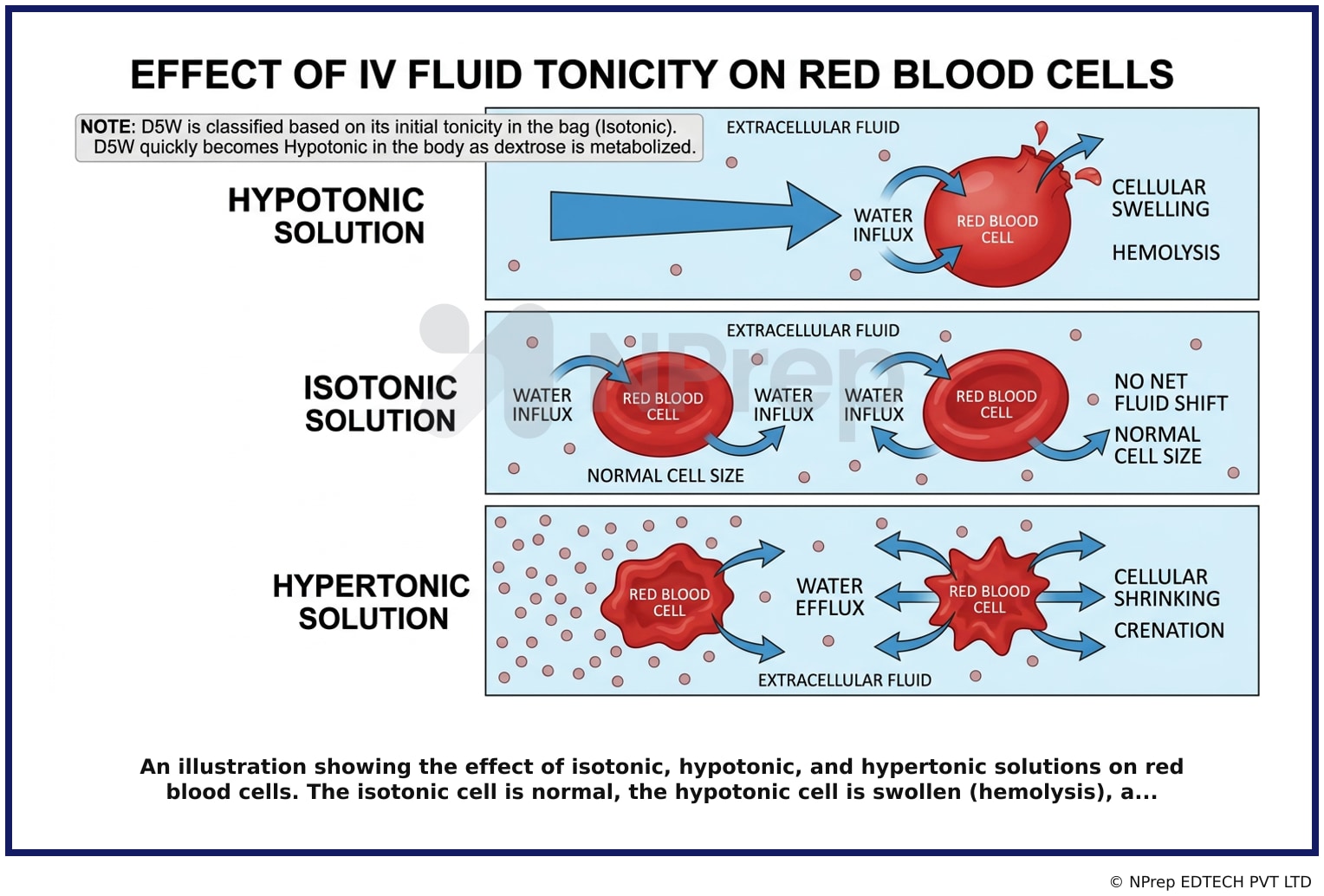
- Dextrose 5% in water (D5W) is classified as an isotonic solution because its initial osmolarity in the IV bag is similar to that of blood plasma.
- It is considered a unique fluid because although it is isotonic upon administration, it becomes hypotonic in the body.
- Once infused, the dextrose is quickly metabolized by the cells, leaving behind free water, which exerts a hypotonic effect, causing fluid to shift into cells.
- This solution provides 170 calories per liter and free water to aid in renal excretion of solutes.
Why Other Options Were Wrong
- Option A: D5W is a crystalloid solution, containing small molecules (dextrose and water) that can pass through capillary membranes.
- Option B: While D5W has a hypotonic effect in the body, its classification is based on its initial tonicity in the bag, which is isotonic.
- Option D: Hypertonic solutions have a higher osmolarity than blood plasma. D5W's osmolarity is similar to plasma's.
Related Visual
Clinical Relevance
- Nursing practice connection: This is primarily an exam-oriented knowledge point with limited direct bedside application, so retain Classification of Intravenous (IV) Fluids as background academic context rather than a clinical decision trigger.
- A nurse must understand D5W's dual nature. While it provides free water, it can also lead to cellular swelling and increased intracranial pressure. Therefore, it is contraindicated for patients with head injuries, neurosurgery, or infants.
- What if? If a patient needed rapid intravascular volume expansion for hypovolemic shock, D5W would be an inappropriate choice. Its hypotonic effect would shift fluid into cells instead of keeping it in the vascular space. A true isotonic solution like 0.9% Normal Saline or Lactated Ringer's would be the correct choice to expand plasma volume.
How to Approach the Question
- First, identify the core of the question: the classification of D5W.
- Recall the definitions of the four main types of IV solutions: colloid, hypotonic, isotonic, and hypertonic.
- Remember that D5W is a special case. Its classification is based on its state in the IV bag, not its ultimate effect in the body.
- Compare the initial osmolarity of D5W to that of blood plasma to determine its classification as isotonic.
- Eliminate the other options based on their definitions. D5W is not a colloid, and its initial state is not hypotonic or hypertonic.
Concept Tested & Keywords
- Concept Tested: Classification of Intravenous (IV) Fluids
- Stem keywords: Dextrose 5% in water, D5W, classified, intravenous (IV) fluid
- Lead-in keywords: which type
Question ID
QcP86662UUQzg_OFJ2EDkl
Reference Book
E6 Nursing Fundamentals Potter Perry 12e Part 5 p. 68-70
E6 Nursing Brunner Adult Health 3SA Vol 1 Part 1 p. 142-144
Practise the full BTSC Staff Nurse 1 August-2025
Attempt every question from this paper in a timed mock, then review the full solution for each one.
More Miscellaneous Questions
- These agents decreases intestinal muscle tone to slow passage of feces:
- Lactated Ringer's solution is contraindicated in:
- When designing a web page that should appeal to both males and females, a good choice of background color is:
- Adrenaline dose in anaphylactic shock is:
- A patient came to ED unconscious with pinpoint pupil, lacrimation and history of substance abuse. Which of the drug will be administered?
- In rehabilitation center, which of the following drug is used as opioid substitute in substance abuse patient?
- 0.45% NS is?
- Which of the following component is not present in normal saline?
- What is the antidote of narcotics?
- Antidote for heparin is:
More BTSC Staff Nurse 1 August-2025 Questions
- What does 'I' stand for in the SOAPIE progress notes format used for documentation?
- Hirschsprung disease is associated with a defect in which of the following developmental processes involving the enteric nervous system?
- What is FFQ in the context of dietary assessment tools?
- Formulating a family health and nursing care plan comes under which phase of the Nursing Process?
- What is the indication for aversion therapy?
- Which of the following is NOT a typical symptom of somatoform autonomic disorder?
- Which neurological disease can be caused by the prolonged consumption of khesari dal over a period of 2-6 months?
- Which of the following principles is primarily followed when transferring a patient onto a stretcher using a blanket (blanket lift)?
- Which of the following is a primary benefit of using Electronic Health Records (EHR) in patient care?
- What is the incubation period of measles (Rubeola)?