
RRB Staff Nurse Ahmedabad-2015
Non Nursing Subjects
Hard
X's income is 20% more than Y's income. Y's income is less than X's income by
Appeared in: RRB Staff Nurse Ahmedabad-2015
Explanation
- To solve this, assume a base income for Y, such as ₹100. Since X's income is 20% more, X's income becomes ₹120.
- The question asks for the percentage by which Y's income is less than X's. This means X's income (₹120) is the base for the calculation.
- The difference in income is ₹20. The percentage is calculated as (Difference / Base) × 100, which is (20 / 120) × 100.
- Simplifying the fraction (20/120) gives 1/6. Multiplying by 100 gives 16.66..., which is equivalent to 16 2/3%.
Why Other Options Were Wrong
- Option A: This is an incorrect calculation. It does not correspond to the correct formula for percentage decrease from a larger base.
- Option C: This is a common mistake. It incorrectly assumes that the percentage increase and decrease between two numbers are symmetrical. The percentage difference depends on the base value used for comparison.
- Option D: This is an incorrect calculation. It does not result from the correct application of the percentage change formula.
Related Visual
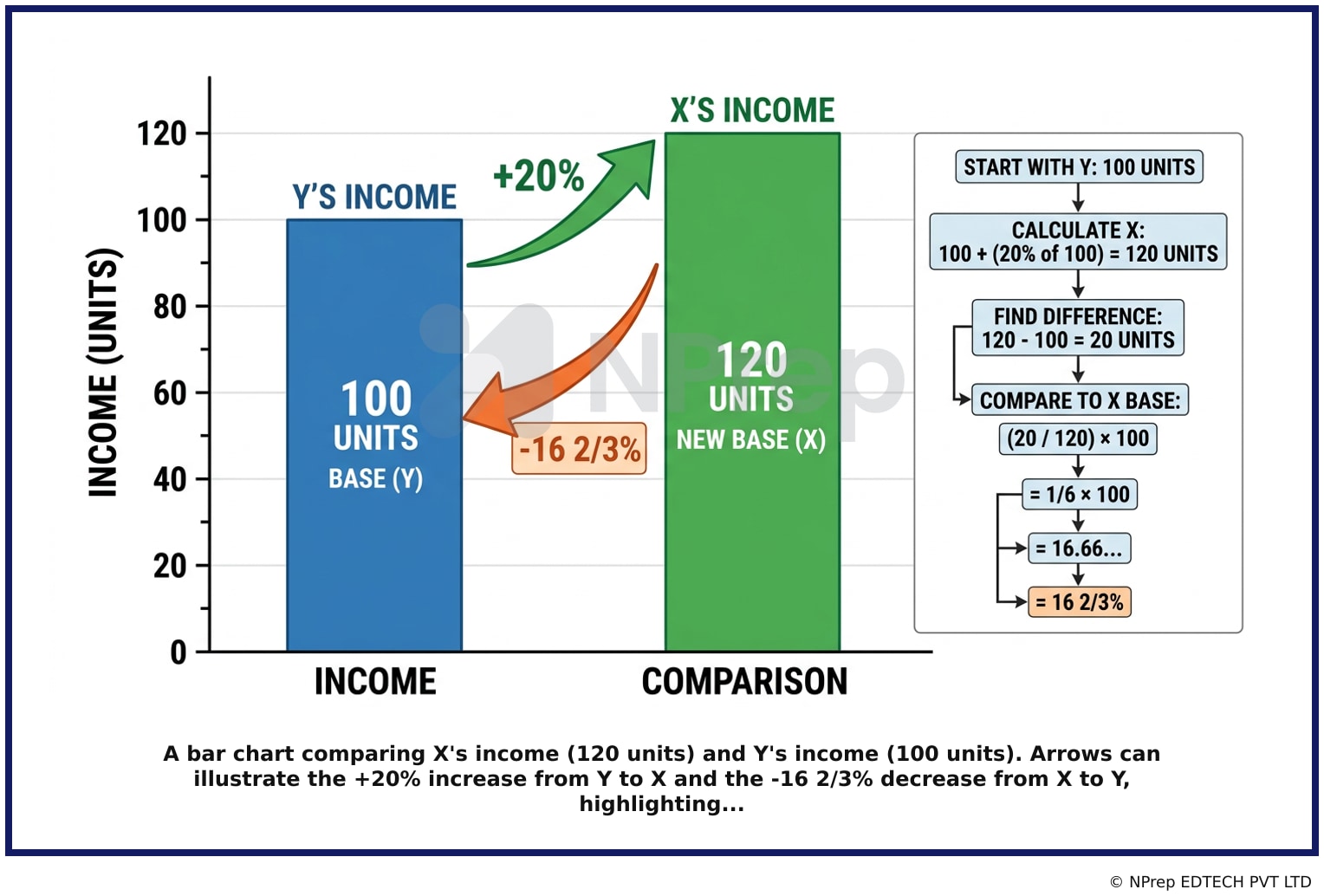
- Visual 1: Infographic - A bar chart comparing X's income (120 units) and Y's income (100 units). Arrows can illustrate the +20% increase from Y to X and the -16 2/3% decrease from X to Y, highlighting the different base values used in each calculation.
Clinical Relevance
- Nursing practice connection: This is primarily an exam-oriented knowledge point with limited direct bedside application, so retain Percentage Change and Comparison as background academic context rather than a clinical decision trigger.
- While this is a mathematics question, the skill of interpreting percentage changes is crucial in nursing for tasks like calculating drug dosage adjustments, understanding changes in lab values, or analyzing patient weight fluctuations.
- What if? If the question asked 'X's income is 20% less than Y's income, by what percentage is Y's income more than X's?', the base would change. Let Y=100, then X=80. The difference is 20. The new calculation would be (20/80) × 100 = 25%.
How to Approach the Question
- Step 1: Identify the core comparison in the question: 'Y's income is less than X's income by...'. This tells you the base for your percentage calculation is X's income.
- Step 2: To simplify the calculation, assume a starting value for the initial quantity. Let Y's income be 100.
- Step 3: Calculate the other value based on the information given. X's income is 20% more than Y's, so X = 100 + (20% of 100) = 120.
- Step 4: Find the absolute difference between the two values: 120 - 100 = 20.
- Step 5: Apply the percentage change formula: (Difference / Base Value) × 100. In this case, it is (20 / 120) × 100.
- Step 6: Simplify the fraction (20/120 = 1/6) and calculate the final percentage: (1/6) × 100 = 16.66...%, which is 16 2/3%.
Concept Tested & Keywords
- Concept Tested: Percentage Change and Comparison
- Stem keywords: income, 20% more
- Lead-in keywords: less than
Question ID
QUZZ9snZTrLA1qUGMoW0hT
Practise the full RRB Staff Nurse Ahmedabad-2015
Attempt every question from this paper in a timed mock, then review the full solution for each one.
More Mathematics Questions
- The ratio of number of girls to boys in a school of 2520 students is 27:29. How many more girls should be admitted to make the ratio 1:1?
- Three candidates contested an election and received 4500, 7500 and 8000 votes respectively. What percentage of votes did the winning candidates get?
- Two bells ring at intervals of 59 seconds and 70 seconds. If they both ring at 10 O'clock in the morning together, after how many seconds will they r…
- The average of four numbers is 61. The largest number among them is 85 and the smallest number is 21. What will be the larger of the remaining two nu…
- In what ratio should water be mixed with milk so that on selling the mixture at cost price a profit of 20% is made?
- A quality control analyst rejects 0.08% of the fabric produced, finding it defective. How many meters of fabric must he examine to reject 4 meters?
- A man traveled from his village to the post office at a speed of 25km/hr and returned at a speed of 4km/hr. If the entire journey took 5 hours and 48…
- A train is running at 60 km/hr. How much time will it require to cross a 2 km bridge?
- The average monthly income of R1 and R2 is Rs. 99,500. The average monthly income of R2 and R3 is Rs. 1,15,600 and the average monthly income of R1 a…
- If Rohan bought 20 books at the rate of Rs. 120 each, 30 books at the rate of Rs. 150 each, and 15 books at the rate of Rs. 100 each, then find the a…
More RRB Staff Nurse Ahmedabad-2015 Questions
- The battle of Plassey was fought between
- Lord Dalhousie introduced the first railways in 1853 which ran between
- The normal term of a State Assembly (other than J & K) is
- How long can a presidential ordinance remain in force?
- Black soil is ideal for cultivation of cotton as
- Railways Passenger Coaches are manufactured at
- 'Operation Flood' is related to
- The term "Bull Run" is related to
- Match Col X (Sports trophy) and Col Y (Related sports) | Col X | | Col Y | | | ----- | -------------------- | ----- | --------- | | P. | Durand Cup |…
- Record of highest individual score in One Day International Cricket matches is in the name of