
NCL (MP) Nursing Officer - 2019
Applied Nutrition & Dietetics
Hard
Which of the following indices a nurse has to consider as an indicator of good nutrition?
Appeared in: NCL (MP) Nursing Officer - 2019
Explanation
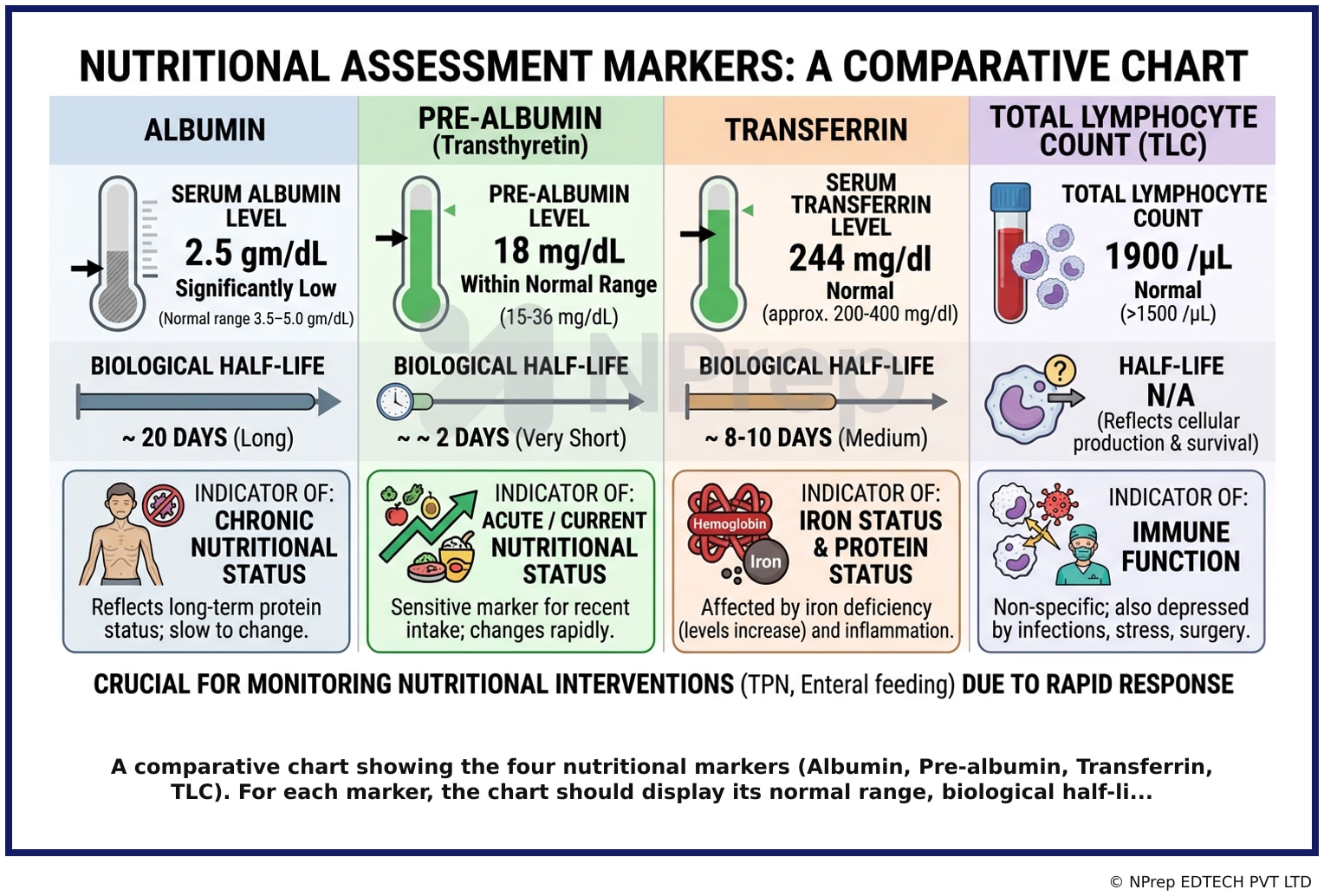
- Pre-albumin is a sensitive protein marker used to assess short-term nutritional status.
- It has a short half-life of approximately 2 days, meaning its levels change quickly in response to changes in protein and calorie intake.
- The provided value of 18 mg/dL is within the normal reference range (typically 15-36 mg/dL), indicating adequate recent nutritional intake.
- This makes it a reliable indicator for monitoring the effectiveness of nutritional support in a clinical setting.
Why Other Options Were Wrong
- Option A: An albumin level of 2.5 gm/dl is significantly low (normal range: 3.5-5.0 gm/dl) and is a clear indicator of chronic malnutrition, not good nutrition.
- Option C: While a transferrin level of 244 mg/dl is within the normal range (approx. 200-400 mg/dl), it is not the best indicator. Transferrin levels are heavily influenced by iron status (they increase in iron deficiency) and can be affected by inflammation, reducing its specificity as a nutritional marker.
- Option D: A total lymphocyte count of 1900/µL is normal (typically >1500/µL). However, it is a very non-specific marker for nutritional status. Lymphocyte counts can be depressed by malnutrition but are also affected by infections, stress, surgery, and various medical conditions.
Related Visual
Clinical Relevance
- Nursing practice connection: Knowing Nutritional Assessment Markers helps nurses interpret findings accurately and avoid errors in routine assessment, medication administration, and patient teaching.
- Nurses frequently monitor these lab values to assess the nutritional status of patients, especially those at risk for malnutrition, such as post-operative, elderly, or critically ill patients.
- Monitoring pre-albumin is crucial for evaluating the effectiveness of nutritional interventions like enteral feeding or total parenteral nutrition (TPN), as its levels respond quickly to therapy.
- A patient's nutritional status directly impacts wound healing, immune response, and overall recovery. Early identification of malnutrition allows for timely intervention, improving patient outcomes.
How to Approach the Question
- First, identify the core question: it asks for an indicator of 'good nutrition'. This implies you are looking for a value that is within a healthy or normal range.
- Next, evaluate each option. Recall or look up the normal laboratory ranges for albumin, pre-albumin, transferrin, and total lymphocytes.
- Analyze each given value against its normal range. Option A (Albumin 2.5) is clearly abnormal and indicates poor nutrition, so it can be eliminated.
- Compare the remaining options (B, C, D), which are all within normal ranges. Consider the specificity and sensitivity of each test as a nutritional marker.
- Recall that pre-albumin has the shortest half-life, making it the most sensitive indicator of current nutritional status. Transferrin is affected by iron levels, and lymphocytes are affected by many non-nutritional factors.
- Conclude that a normal pre-albumin level is the strongest and most direct indicator of good current nutrition among the choices provided.
Concept Tested & Keywords
- Concept Tested: Nutritional Assessment Markers
- Stem keywords: indicator, good nutrition, nurse
- Lead-in keywords: Which of the following
Question ID
QHUUsRXt14j5WrZABXxT7W
Reference Book
E6 Nutrition Monika Sharma 3e p. 301-303
E6 Medicine Harrison 22e Part 2 pp. 521-523, 522-524
Practise the full NCL (MP) Nursing Officer - 2019
Attempt every question from this paper in a timed mock, then review the full solution for each one.
More Nutritional Assessment and Nutrition Education Questions
- The other name of Body Mass Index is:-
- The best measurement done by anthropometric is?
- A special tape used to measure MUAC (Mid Upper Arm Circumference) for fat free mass having colours of tape ?
- On the basis of Body Mass Index (BMI), a person with a height of 150 cm and weight of 70 kg is defined to be:
- A body mass index (BMI) of 25.0 to 29.9 is classified as?
- Formula to calculate BMI is?
- In obesity, BMI is?
- All the food items cause color to the urine EXCEPT?
- What is FFQ in the context of dietary assessment tools?
- Which of these nutritional status assessments is designed to estimate usual eating patterns?
More NCL (MP) Nursing Officer - 2019 Questions
- A nurse is caring for an anemic patient. What finding should suggest to her that it is acute blood loss anemia?
- For what complication should a nurse monitor a patient when an oxytocin infusion is used to induce labor?
- A maternity nurse must be aware that screening for diabetes mellitus in pregnancy is done at?
- A nurse working in an operation theatre must know, the risk of HIV infection with needle stick injury is about?
- A nurse is caring for a patient with 'swine flu' and she has to give the drug of choice for swine flu and it is?
- An infant is born precipitously outside the labor room. What should the nurse do first?
- What is a nurse's primary critical observation when performing an assessment for determining an Apgar score?
- A patient is on enalapril and diuretic therapy for heart failure. The nurse should notify the physician that the therapy is not effective when she fi…
- Heart rate of a healthy alert neonate may range between? (NORCET-2021)
- A nurse is about to insert a Ryle's tube for a patient. Before this act, she must be aware of the distance between the incisor teeth and the gastroes…