
IGNOU PB Bsc Nsg Entrance-2017
Medical & Surgical Nursing
Easy
Which examination is done to confirm TB meningitis?
Appeared in: IGNOU PB Bsc Nsg Entrance-2017
Explanation
- The definitive diagnosis for TB meningitis is established through the analysis of cerebrospinal fluid (CSF).
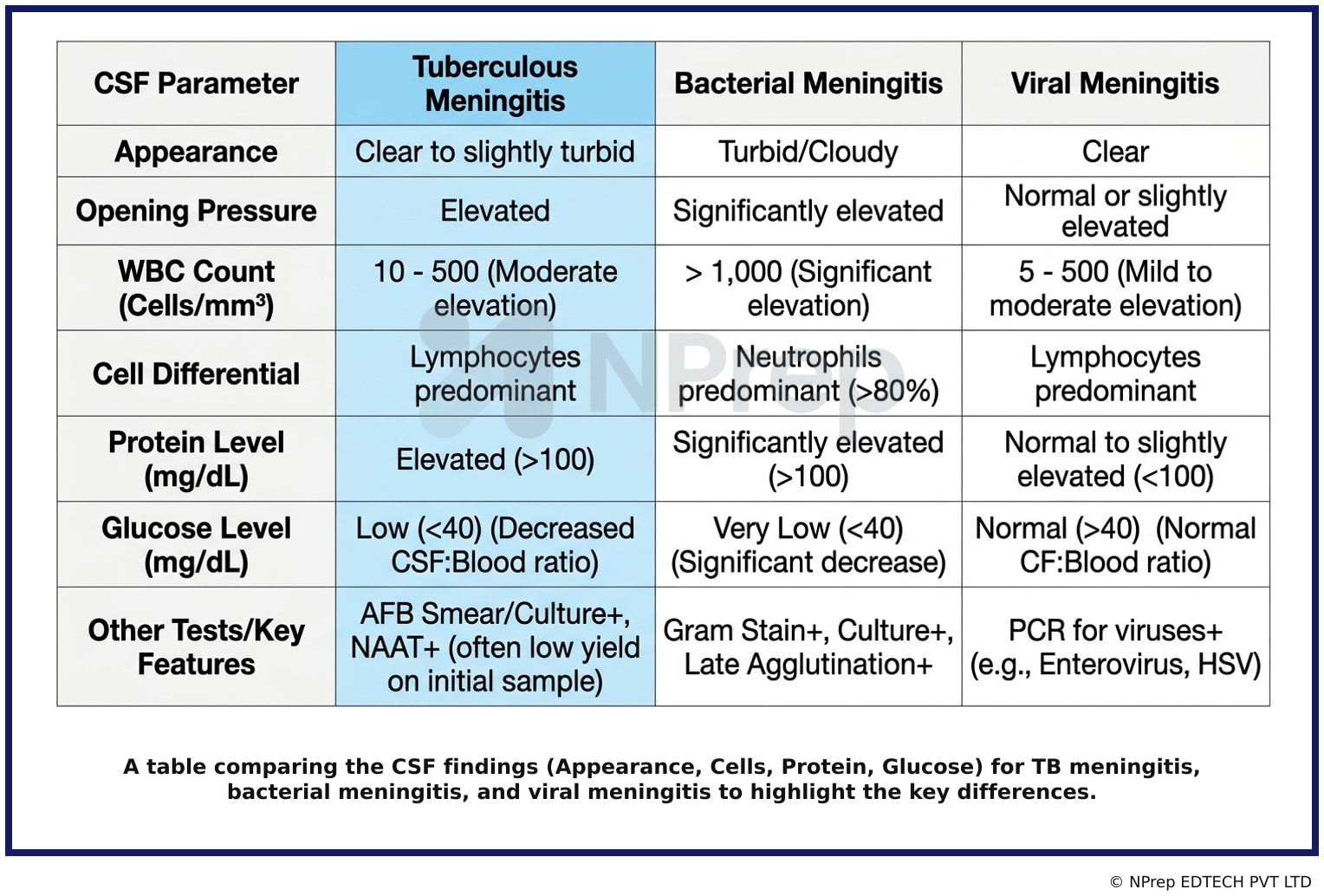
- CSF examination in TB meningitis typically shows a lymphocytic pleocytosis (increased white blood cells, mainly lymphocytes), elevated protein levels, and low glucose levels.
- The presence of Mycobacterium tuberculosis can be confirmed by methods such as Acid-Fast Bacilli (AFB) smear, culture (the gold standard), or nucleic acid amplification tests (NAAT) on the CSF sample.
- The combination of clinical symptoms (headache, fever, stiff neck) and these characteristic CSF findings confirms the diagnosis.
Why Other Options Were Wrong
- Option A: Sputum examination is the primary method for diagnosing pulmonary tuberculosis (TB affecting the lungs), not TB affecting the central nervous system like meningitis.
- Option C: Thoracentesis is a procedure to drain fluid from the pleural space (around the lungs). It has no role in diagnosing meningitis.
- Option D: Lumbar puncture is the procedure used to obtain the cerebrospinal fluid sample. It is a necessary step but is not the examination itself. The question asks for the examination that confirms the diagnosis, which is the analysis of the collected fluid.
Related Visual
Clinical Relevance
- Nursing practice connection: This is primarily an exam-oriented knowledge point with limited direct bedside application, so retain Diagnostic procedures for Tuberculous Meningitis as background academic context rather than a clinical decision trigger.
- Nurses play a critical role in assisting with lumbar punctures, ensuring sterile technique, proper patient positioning (lateral recumbent or sitting), and post-procedure monitoring for complications like headache or bleeding.
- Accurate and timely diagnosis of TB meningitis is crucial as delays can lead to severe neurological sequelae or death. Nurses must recognize the signs and symptoms and ensure diagnostic samples are collected and sent to the lab promptly.
- What if? If a patient has signs of increased intracranial pressure (like papilledema), a lumbar puncture may be contraindicated due to the risk of brain herniation. In such cases, a CT scan of the head is typically performed first to rule out a mass effect.
How to Approach the Question
- First, identify the key terms in the question: 'confirm' and 'TB meningitis'. This indicates you need to find the definitive diagnostic test.
- Analyze the options provided. Think about what each test or procedure is used for.
- Differentiate between a diagnostic 'examination' (the analysis) and a 'procedure' (the method of sample collection).
- Sputum examination is for lung TB. Thoracentesis is for pleural fluid. This leaves CSF examination and Lumbar Puncture.
- Recognize that Lumbar Puncture is the procedure to get the fluid, while CSF examination is the actual analysis of that fluid that confirms the diagnosis. Therefore, CSF examination is the more precise and correct answer to the question asked.
Concept Tested & Keywords
- Concept Tested: Diagnostic procedures for Tuberculous Meningitis
- Stem keywords: TB meningitis, confirm, examination
- Lead-in keywords: Which
Question ID
QUGJ2hlxrMN124zQuW9HNC
Reference Book
E6 Medicine Harrison 22e Part 1 pp. 1168-1170, 1430-1432
E6 Pathology-Vandana Puri & Kavita Gaur Textbook of Pathology and Genetics p. 424-426
Practise the full IGNOU PB Bsc Nsg Entrance-2017
Attempt every question from this paper in a timed mock, then review the full solution for each one.
More Gas Exchange and Respiratory Function Questions
- Which is the most relevant knowledge about oxygen administration to a client with COPD?
- Patient in emergency department diagnosed to have fluid and air present in lung. What is the above-mentioned condition known as?
- Patient is suffering from dyspnea. Which position will you provide for patient to relieve?
- Which of the following is not involved in chest physiotherapy?
- Respiration which is abnormally shallow for two or three breaths followed by irregular period of apnea is termed:
- Identify the following instrument which is used in diagnostic procedures:
- Identify the instrument shown in the following image:
- Identify the tube in the following image:
- A patient suddenly develops respiratory difficulties such as dyspnea, what is the first priority of the nursing officer?
- Which of the following method is used for high flow oxygen administration:
More IGNOU PB Bsc Nsg Entrance-2017 Questions
- In the communication process, the response from the receiver to the sender is called?
- When every study population subject has an equal chance to be selected as a sample for a research study, it is known as?
- If scores of a sample are distributed as 4, 6, 8, 3, 7, 8, 3, 9, 6, the mean is?
- Research in which a researcher makes changes in an independent variable and studies their effects on a dependent variable under controlled conditions…
- In administration, the principle of division of work is essential because?
- Span of control stands for?
- In a general ward, the ratio of nurse and patient should be?
- Job responsibilities of an ANM are all, except?
- The advantages of nursing audits are all, except?
- The importance of human relations in nursing is all, except?