
RRB Staff Nurse Ahmedabad-2015
Community Health Nursing
Easy
Which country was declared by UN as EBOLA free?
Appeared in: RRB Staff Nurse Ahmedabad-2015
Explanation
- Nigeria was officially declared free of Ebola virus transmission by the World Health Organization (WHO) on October 20, 2014.
- This declaration was made after the country passed a 42-day period (twice the maximum 21-day incubation period for the virus) with no new reported cases.
- During the 2014 West African outbreak, Nigeria received imported cases but successfully halted further transmission through a rapid and effective public health response.
- This stood in contrast to the situations in the primary affected countries of Guinea, Liberia, and Sierra Leone, which had weaker health systems.
Why Other Options Were Wrong
- Option A: South Africa was not a primary country involved in the 2014-2016 West African Ebola epidemic and did not have a widespread local outbreak that would necessitate a specific WHO declaration of being 'Ebola-free' at that time.
- Option C: Zimbabwe is located in Southern Africa and was not affected by the 2014-2016 Ebola outbreak, which was concentrated in West Africa.
- Option D: Ethiopia is located in the Horn of Africa (East Africa) and was not part of the 2014-2016 West African Ebola outbreak.
Related Visual
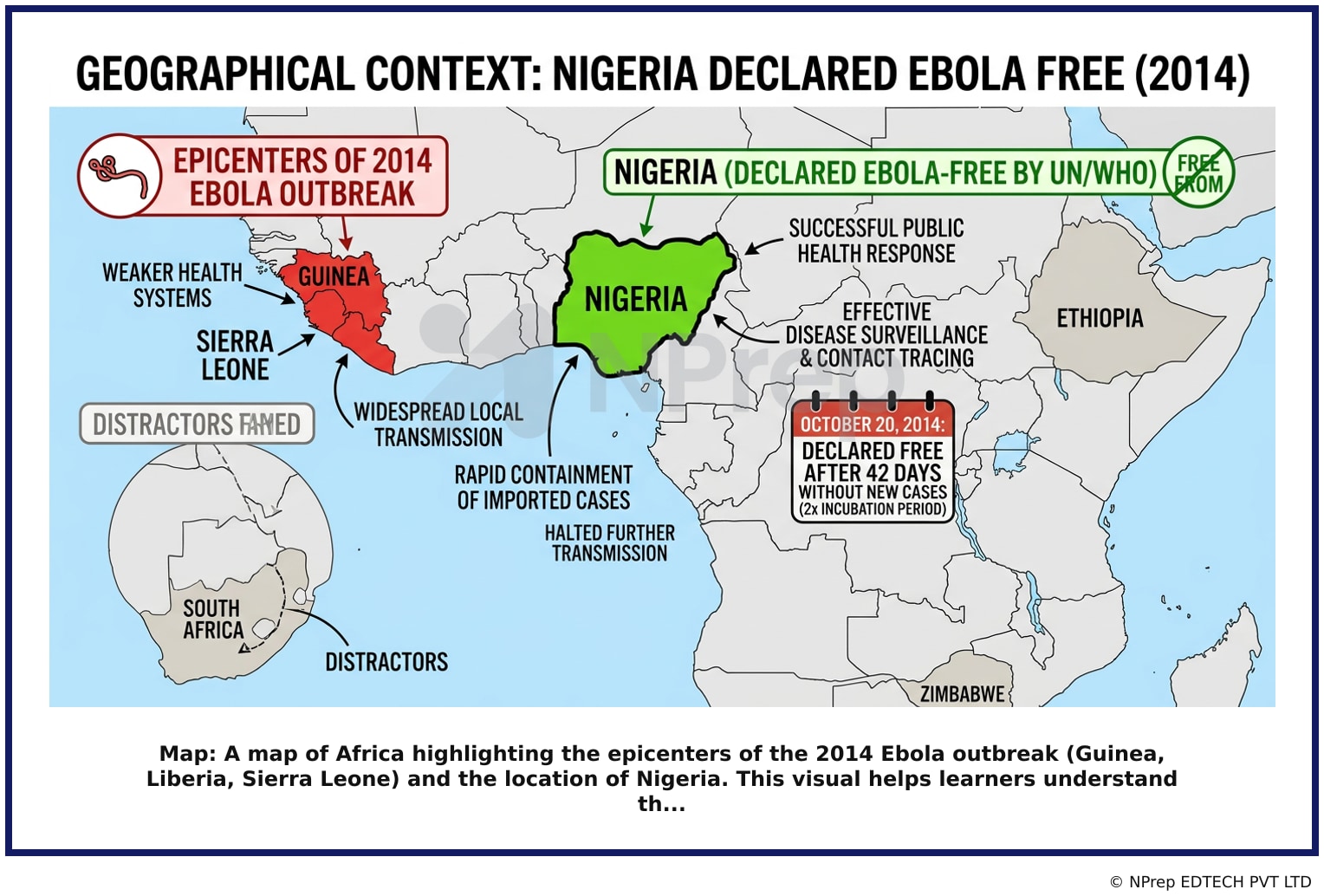
- Visual 1: Map: A map of Africa highlighting the epicenters of the 2014 Ebola outbreak (Guinea, Liberia, Sierra Leone) and the location of Nigeria. This visual helps learners understand the geographical context and appreciate Nigeria's success in containing the imported cases.
- Visual 2: Infographic: A timeline illustrating the key events of Nigeria's successful Ebola response, from the first imported case to the final WHO declaration. This would showcase the effectiveness of rapid public health measures.
Clinical Relevance
- Nursing practice connection: This is primarily an exam-oriented knowledge point with limited direct bedside application, so retain Public Health and Epidemic Control as background academic context rather than a clinical decision trigger.
- This case demonstrates the critical importance of a strong public health infrastructure for effective disease surveillance, rapid contact tracing, and outbreak containment.
- For nurses, this reinforces the vital role of infection prevention and control (IPC) measures, including the correct use of Personal Protective Equipment (PPE) and triage protocols, to prevent nosocomial (hospital-acquired) transmission of highly infectious diseases like Ebola.
- The success of Nigeria highlights how prompt and coordinated action can prevent a limited number of imported cases from escalating into a full-blown epidemic.
How to Approach the Question
- First, identify the key terms in the question: 'UN', 'EBOLA free', and 'country'. This points to a specific official declaration related to an epidemic.
- Recall or infer that the question most likely refers to the major West African Ebola epidemic of 2014-2016, which was a major global health event.
- Analyze the options geographically. South Africa, Zimbabwe, and Ethiopia are not in West Africa, the epicenter of the outbreak. This makes them less likely candidates for this specific declaration.
- Consider Nigeria's role. It is in West Africa and was known to have had imported cases. Its successful and widely reported containment effort makes it the most plausible answer.
- Eliminate the geographically distant and unaffected countries to arrive at the correct answer.
Concept Tested & Keywords
- Concept Tested: Public Health and Epidemic Control
- Stem keywords: UN, EBOLA free, country
- Lead-in keywords: Which
- Negative lead-in flag: false
Question ID
QDp4tw-tzs9MftOclZWDoD
Practise the full RRB Staff Nurse Ahmedabad-2015
Attempt every question from this paper in a timed mock, then review the full solution for each one.
More Epidemiology – Epidemiological Approaches and Processes Questions
- Which test is used to monitor vaccine potency?
- Which vaccine should be stored in the freezer compartment of the refrigerator?
- The two main approaches used in epidemiology are?
- Which of the following is not a observational study design used in epidemiology?
- Which of the following is not a method of epidemiological measurement?
- The comprehensive community health nursing includes? (a) Health Promotion & x20; (b) Disease Prevention & x20; (c) Treatment & x20; (d) Rehabilitatio…
- The constant presence of a disease or infection within a given geographic area is called?
- In the occurrence of SARS and other pandemics, which of the following is the most important role of a nurse in epidemiology?
- A pandemic disease condition which occurs every 5 years. Which trend is reflected here?
- In the following questions, out of four alternatives, select the alternative which is the best substitute of the words/sentences. A disease which att…
More RRB Staff Nurse Ahmedabad-2015 Questions
- The battle of Plassey was fought between
- Lord Dalhousie introduced the first railways in 1853 which ran between
- The normal term of a State Assembly (other than J & K) is
- How long can a presidential ordinance remain in force?
- Black soil is ideal for cultivation of cotton as
- Railways Passenger Coaches are manufactured at
- 'Operation Flood' is related to
- The term "Bull Run" is related to
- Match Col X (Sports trophy) and Col Y (Related sports) | Col X | | Col Y | | | ----- | -------------------- | ----- | --------- | | P. | Durand Cup |…
- Record of highest individual score in One Day International Cricket matches is in the name of