
ISRO 2024
Medical & Surgical Nursing
Hard
Which clinical indicator is the nurse most likely to identify when collecting the history and physical assessment of a patient with complete heart block?
Appeared in: ISRO 2024
Explanation
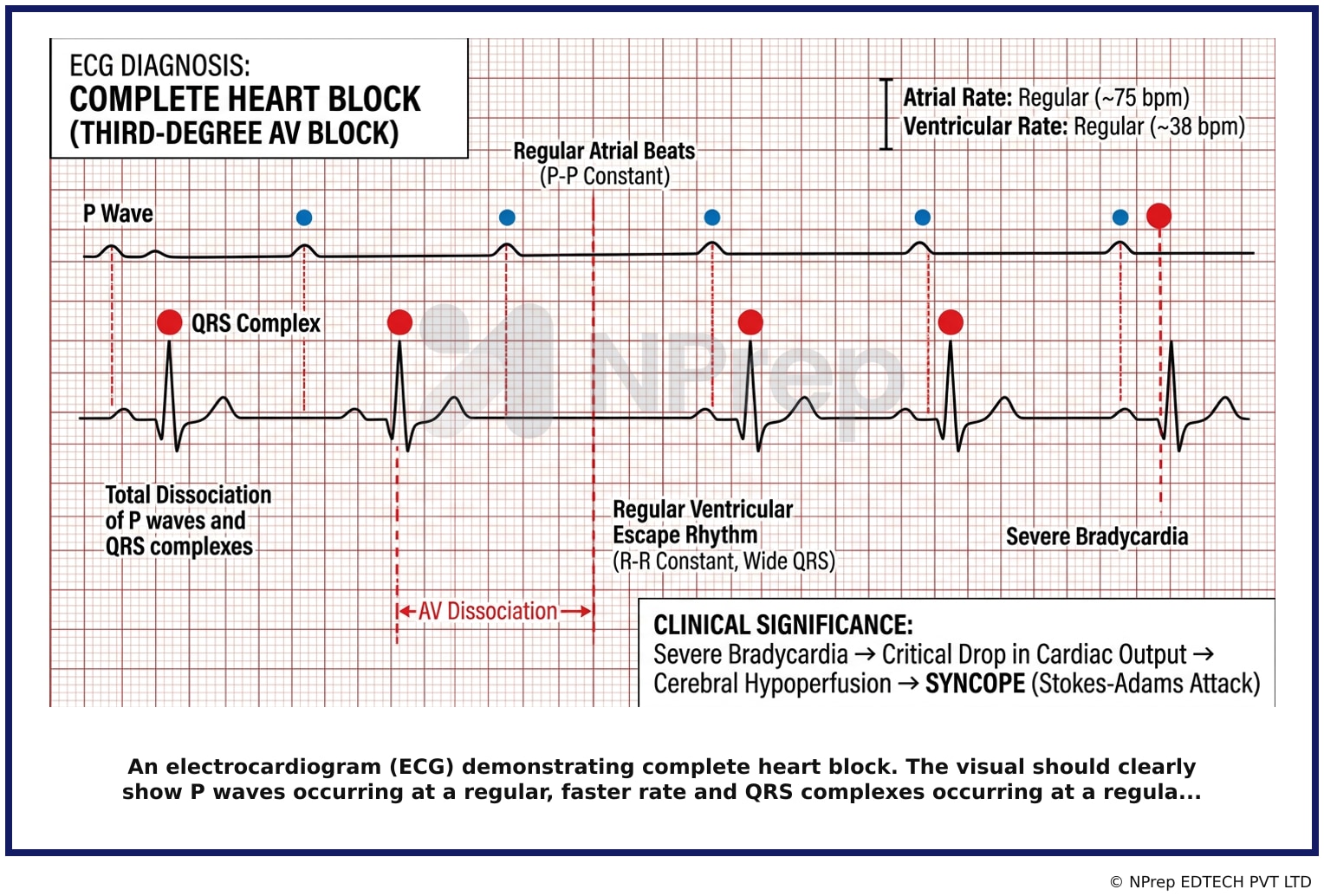
- Complete heart block involves a total dissociation between atrial and ventricular contractions.
- This results in the ventricles beating at a very slow escape rhythm (20-40 bpm), a condition known as severe bradycardia.
- The severe bradycardia drastically reduces cardiac output, leading to decreased blood flow to the brain (cerebral hypoperfusion).
- This lack of adequate brain perfusion causes syncope, which is a transient loss of consciousness.
- These syncopal episodes related to heart block are specifically termed Stokes-Adams attacks.
Why Other Options Were Wrong
- Option B: Headache is a non-specific symptom that can be caused by numerous conditions and is not a primary or hallmark indicator of complete heart block.
- Option C: Tachycardia is a heart rate greater than 100 bpm. Complete heart block is defined by severe bradycardia (a very slow heart rate), making tachycardia the opposite of the expected finding.
- Option D: Hemiparesis (weakness on one side of the body) is a focal neurological deficit. It is a classic sign of a cerebrovascular accident (stroke), not a direct symptom of a cardiac arrhythmia like heart block.
Related Visual
Clinical Relevance
- Nursing practice connection: Use the key finding related to Clinical manifestations of complete heart block (third-degree AV block) to guide bedside assessment, documentation, and the next nursing action.
- Identifying syncope in a patient's history is a critical red flag that should prompt an immediate ECG to rule out life-threatening arrhythmias like complete heart block.
- Complete heart block is a medical emergency because the slow ventricular rate can lead to cardiac arrest. The nurse must be prepared to initiate basic life support and assist with emergency cardiac pacing.
- Patient safety is a top priority. A patient with suspected or confirmed complete heart block is at high risk for falls and injury due to unpredictable syncopal episodes.
How to Approach the Question
- First, identify the core pathophysiology of the condition mentioned in the question: 'complete heart block'.
- Recall that complete heart block means atrial impulses are completely blocked from reaching the ventricles.
- Consider the hemodynamic consequence: the ventricles adopt a very slow 'escape' rhythm, leading to severe bradycardia and a significant drop in cardiac output.
- Think about how a sudden drop in cardiac output affects major organs, especially the brain.
- Evaluate the options based on this understanding. Syncope (fainting) is a direct result of inadequate blood flow to the brain (cerebral hypoperfusion).
- Eliminate the other options: Tachycardia is the opposite of the expected heart rate, while headache and hemiparesis are not direct, primary symptoms of this cardiac condition.
Concept Tested & Keywords
- Concept Tested: Clinical manifestations of complete heart block (third-degree AV block)
- Stem keywords: clinical indicator, history and physical assessment, complete heart block
- Lead-in keywords: most likely
Question ID
QaIrHwGBRHAHOPe4lMH-uy
Reference Book
E6 Physiology Ganong 27e Vol 2 Part 1 p. 76-78
E6 Medicine Macleod Clinical Examination 15e p. 55-57
E6 Nelson Textbook of Pediatrics(2024) — Volume 2 p. 647-649
Practise the full ISRO 2024
Attempt every question from this paper in a timed mock, then review the full solution for each one.
More Cardiovascular, Circulatory, and Hematologic Function Questions
- A patient is undergoing blood transfusion and suddenly shows complaints of transfusion reaction. What will be the priority nursing intervention?
- The following all are blood transfusion complications from; EXCEPT:
- Identify the use of following machine used in pneumatic compression device:
- In iron deficiency anemia, the fingernails become spoon shaped, this condition is referred to as:
- Which gauze cannula is commonly used for blood transfusion?
- If 'P' wave is absent in ECG rhythm, it is an indication of:
- Normal compression to ventilation ratio:
- Trans-illumination procedure is done with:
- A patient in the ward experiences sudden cardiac arrest. What is the most appropriate technique for opening the airway to facilitate endotracheal int…
- A patient experiences complications after a blood transfusion. Which of the following signs and symptoms is indicative of circulatory overload?
More ISRO 2024 Questions
- The corona virus and disease if cause was identified in 2019
- Toilet training is given during which part of life?
- A patient presents with vulval itching, a sore vagina, and a profuse, white curdy discharge with erythema and redness at the introitus. What is the l…
- Which gland is also known as "Master of Orchestra"?
- The aminoglycoside antiseptic that is used as a first-line anti-TB drug is?
- A nurse is leading a discussion on coronary artery disease development in women versus men. When asked to identify the most significant risk factor f…
- In bipolar disorder a major depressive episode alternates with periods of:
- Natural History of disease is studied with?
- "Foot drop" is caused by damage to which of the following nerves?
- As a nurse educating parents on the introduction of solid foods to an infant, during which month should you advise them to start?