
NORCET 7 Prelims -2024
Applied Microbiology & Infection control
Medium
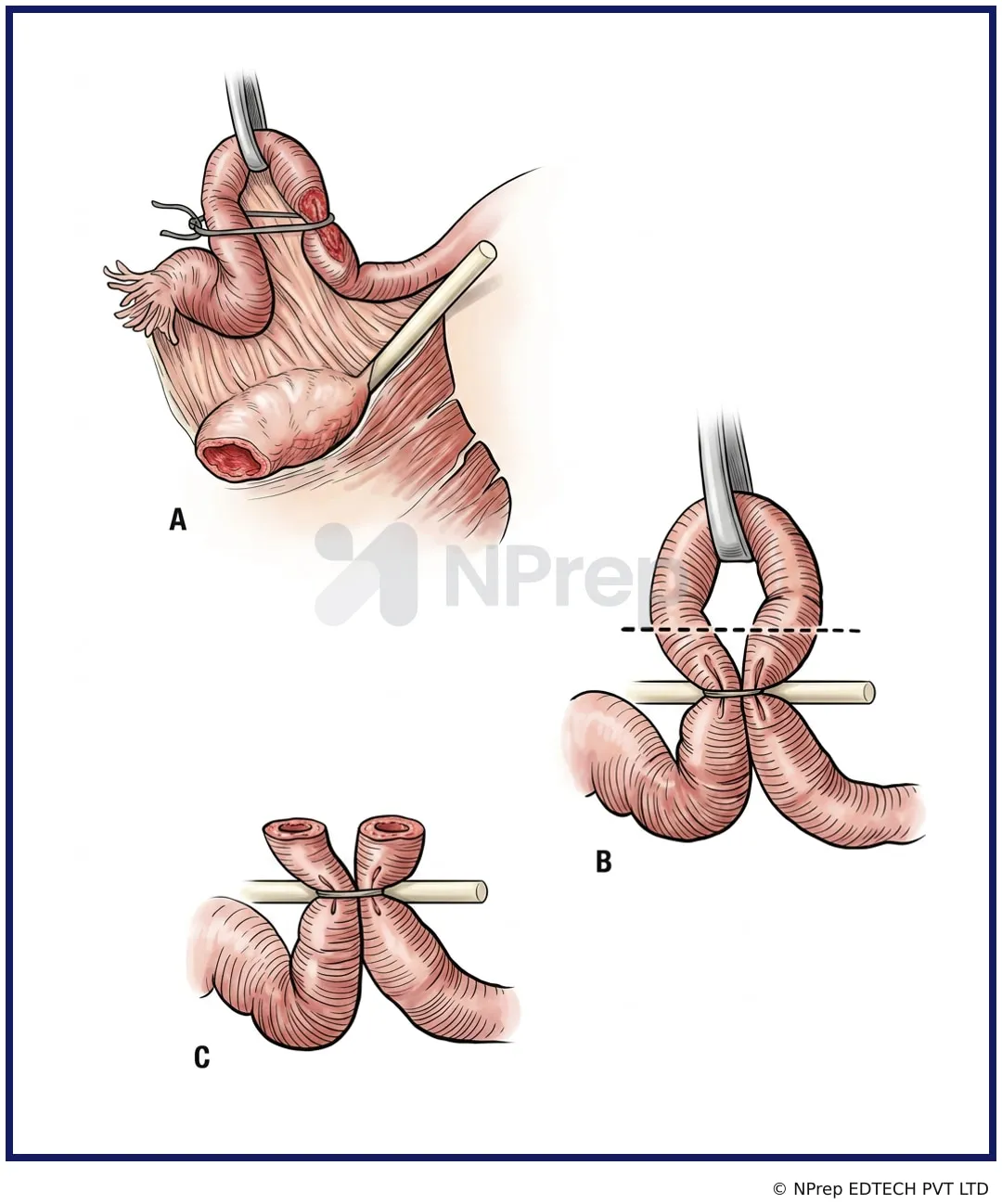
What is the procedure described in the image related to Minilaparotomy?
Appeared in: NORCET 7 Prelims -2024
Explanation
- The image illustrates the Pomeroy method, a common and effective surgical technique for female sterilization (tubal ligation).
- Step A shows a loop of the fallopian tube being elevated, which is the initial step in isolating a segment for ligation.
- Step B demonstrates the ligation of the base of the tubal loop with an absorbable suture, a defining feature of this technique.
- Step C depicts the final stage where the top of the loop is excised, and the subsequent absorption of the suture leads to the separation of the tubal ends, ensuring permanent contraception.
- This procedure is classically performed through a minilaparotomy, a small abdominal incision, particularly in the postpartum period.
Why Other Options Were Wrong
- Option A: Vasectomy is a male sterilization procedure that involves the vas deferens, not the fallopian tubes as shown in the image.
- Option C: Laparoscopic sterilization describes the surgical approach (minimally invasive), not the specific technique of tubal interruption. The image illustrates the technique itself, not the instruments used for the approach.
- Option D: This method uses a mechanical device (a Filshie clip) to clamp the fallopian tube shut. The image clearly shows the use of suture and excision, not a metal clip.
Related Visual

- Visual 1: Diagram - The step-by-step process of the Pomeroy method, highlighting the ligation and excision.
- Visual 2: Diagram - Comparison of different tubal ligation techniques, showing the Pomeroy method alongside the Filshie clip and Falope ring methods to illustrate the visual differences.
- Visual 3: Illustration - A Filshie clip applied to a fallopian tube, providing a clear visual contrast to the Pomeroy method.
Clinical Relevance
- Nursing practice connection: This is primarily an exam-oriented knowledge point with limited direct bedside application, so retain Identification of female sterilization surgical techniques as background academic context rather than a clinical decision trigger.
- Nurses play a crucial role in patient counseling before sterilization, ensuring the patient understands the permanence of the procedure, failure rates, and the availability of long-acting reversible contraceptives (LARCs) as alternatives.
- Post-operative nursing care for a minilaparotomy includes monitoring for signs of infection at the incision site, managing pain, and educating the patient on activity restrictions and when to seek medical attention.
- It is critical to confirm with the patient that sterilization does not protect against sexually transmitted infections (STIs) and to discuss safe sex practices if needed.
How to Approach the Question
- First, carefully analyze the image provided. Break it down into the steps being performed (A, B, C).
- Identify the anatomical structure involved. In this case, it is clearly a fallopian tube.
- Observe the specific actions: a loop of the tube is lifted, the base is tied with a suture, and the top portion is cut away.
- Correlate these visual steps with your knowledge of different surgical sterilization techniques.
- Evaluate each option against the visual evidence. 'Vasectomy' is incorrect as it's a male procedure. 'Filshie clip' is incorrect as no clip is shown. 'Laparoscopic sterilization' describes an approach, not the specific technique depicted.
- Conclude that the procedure shown, involving ligation and excision of a tubal loop, is the Pomeroy method.
Concept Tested & Keywords
- Concept Tested: Identification of female sterilization surgical techniques
- Stem keywords: procedure, image, Minilaparotomy
- Lead-in keywords: What is
Question ID
QIHS2_JGzb-rT6h7N74h98
Practise the full NORCET 7 Prelims -2024
Attempt every question from this paper in a timed mock, then review the full solution for each one.
More Disinfection and Sterilization Questions
- The best and safest method of sterilization is:
- This is a solution used in hospitals. After how many days will you change this solution?
- Which solution is used for management of blood spillage?
- The ratio of mixing bleaching powder and water for acting as a disinfectant is:
- Covid face shield is sterilized by?
- Best method described for the asepsis of any surgical instrument?
- One of the principles of a sterile area?
- Which one of the following methods is commonly used for sterilization of this device?
- Inoculating loops are sterilized by?
- What is the optimum temperature in an autoclave to achieve sterility?
More NORCET 7 Prelims -2024 Questions
- A patient with kidney failure has been found to have 4+ protein in their urine. The nurse recognizes this finding as indicating:
- Which of the following is a true statement regarding breast milk?
- Based on the image showing the placement of ECG electrodes, where should the V1 lead be placed?
- Which type of anemia is characterized by macrocytic RBCs with megaloblastic changes?
- A nurse is caring for a patient with Chronic Obstructive Pulmonary Disease (COPD) and notices that the patient is using a CPAP machine. The nurse und…
- If a tracheostomy tube becomes dislodged, the nurse should:
- A nurse is assessing an endotracheal tube and needs to press the cricoid. This technique is known as:
- Which vaccine is typically given at the 6-week immunization visit?
- A patient is being administered general anesthesia. The nurse should assess the patient for:
- A nurse is using a non-rebreather mask on a patient. The oxygen flow is set at 10–15 L/min, but the reservoir bag is not inflating. What should the n…