
MP CHO -2021 (Shift 1st)
Medical Surgical Nursing
Easy
What is the name of this machine? 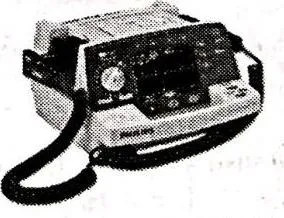
Appeared in: MP CHO -2021 (Shift 1st)
Explanation
- The device in the image is a defibrillator, a crucial piece of equipment in emergency cardiac care.
- Its most recognizable features are the two paddles, which are used to deliver a controlled electrical shock to a patient's chest.
- The purpose of this shock is to terminate a life-threatening cardiac arrhythmia, such as ventricular fibrillation or pulseless ventricular tachycardia, and allow the heart's normal rhythm to resume.
- The console also includes an integrated cardiac monitor to display the patient's ECG, guiding the clinical decision to deliver a shock.
Why Other Options Were Wrong
- Option A: A cardiac monitor is a device used solely for observing a patient's heart rhythm and other vital signs. While this defibrillator has a monitoring function, a standalone cardiac monitor does not have paddles or the capability to deliver an electrical shock.
- Option C: A pulse oximeter is a small, non-invasive device, typically a clip-on probe for a finger or earlobe, used to measure blood oxygen saturation (SpO₂). It is not a large console with paddles.
- Option D: A portable ventilator is a machine that supports or controls a patient's breathing. It involves a breathing circuit, tubing, and a connection to an artificial airway, which are not features of the device shown.
Related Visual

Clinical Relevance
- Nursing practice connection: This is primarily an exam-oriented knowledge point with limited direct bedside application, so retain Identification of emergency medical equipment as background academic context rather than a clinical decision trigger.
- A nurse's primary role during defibrillation is patient and team safety. This includes ensuring no one is in contact with the patient or the bed during the shock by loudly and clearly announcing 'All clear!' before discharge.
- Nurses are also responsible for preparing the patient's chest (e.g., drying, shaving if necessary) to ensure good paddle-to-skin contact and reduce the risk of burns.
- What if? If the patient has an implanted pacemaker or defibrillator (ICD), the nurse must ensure the defibrillator paddles are placed at least one inch (2.5 cm) away from the implanted device to avoid damaging it and to ensure the shock is delivered effectively to the heart muscle.
How to Approach the Question
- First, carefully examine the image provided, paying close attention to its distinct components.
- Identify the key features: a portable console, a screen, control dials, and, most importantly, two paddles connected by a cord.
- Associate these key features with their function. The paddles are specifically designed to deliver an electrical shock.
- Evaluate the given options based on your identification. A 'Cardiac Monitor' only displays data, a 'Pulse Oximeter' is a small probe, and a 'Portable Ventilator' assists with breathing.
- Conclude that the device with paddles for delivering an electrical shock is a 'Defibrillator'.
Concept Tested & Keywords
- Concept Tested: Identification of emergency medical equipment
- Stem keywords: machine, name
- Lead-in keywords: What is
- Clinical cues: The presence of paddles is the most definitive clue for identifying a defibrillator.
Question ID
Q-IF8LaZyKa5GJwTOJyzsC
Reference Book
E6 Nursing Fundamentals Potter Perry 12e Part 5 p. 7-9
E6 Nursing Fundamentals Taylor p. 1078-1080
Practise the full MP CHO -2021 (Shift 1st)
Attempt every question from this paper in a timed mock, then review the full solution for each one.
More Hospital Equipments Questions
More MP CHO -2021 (Shift 1st) Questions
- What does Thrombocytopenia mean?
- What is the function of a Flame cell?
- Which of the following is a Bleeding Disorder?
- Where is the rate of Drug Absorption highest?
- Which of the following bones is called the Collar Bone?
- Which of the following glands is called the Master Gland?
- Which of the following allows air to enter the Lungs?
- Which membrane separates the Middle Ear from the Auditory Canal?
- What is the characteristic of the High Stationary Stage in the demographic cycle?
- Maternal Mortality Rate is expressed per which of the following?