
NIA - 29 January 2023
Pediatric Nursing
Easy
Surveillance of Laryngoscope, AMBU bag, Mask, Oxygen hood and Stethoscope in a pediatric nursery should be done at least?
Appeared in: NIA - 29 January 2023
Explanation
- The equipment listed is critical for airway management and resuscitation, where immediate functionality is life-saving.
- Weekly surveillance is the established minimum standard in healthcare to ensure such equipment is always ready and to prevent catastrophic failures during emergencies.
- This frequency balances thoroughness with practicality, ensuring that issues like battery depletion, material degradation, or missing parts are identified in a timely manner.
- Protocols for pediatric emergency preparedness emphasize regular maintenance schedules and checklists for all resuscitation equipment.
Why Other Options Were Wrong
- Option B: While checking equipment more frequently is never wrong, 'twice a week' is not the universally accepted minimum standard. Weekly checks are considered sufficient for routine surveillance.
- Option C: A monthly interval is dangerously infrequent for life-saving equipment. A critical failure, such as a dead laryngoscope battery or a cracked AMBU bag, could go unnoticed for weeks, posing a significant risk to patient safety.
- Option D: Similar to monthly checks, a twice-a-month schedule is inadequate for ensuring the constant readiness of emergency resuscitation equipment. The risk of undetected malfunction is unacceptably high.
Related Visual
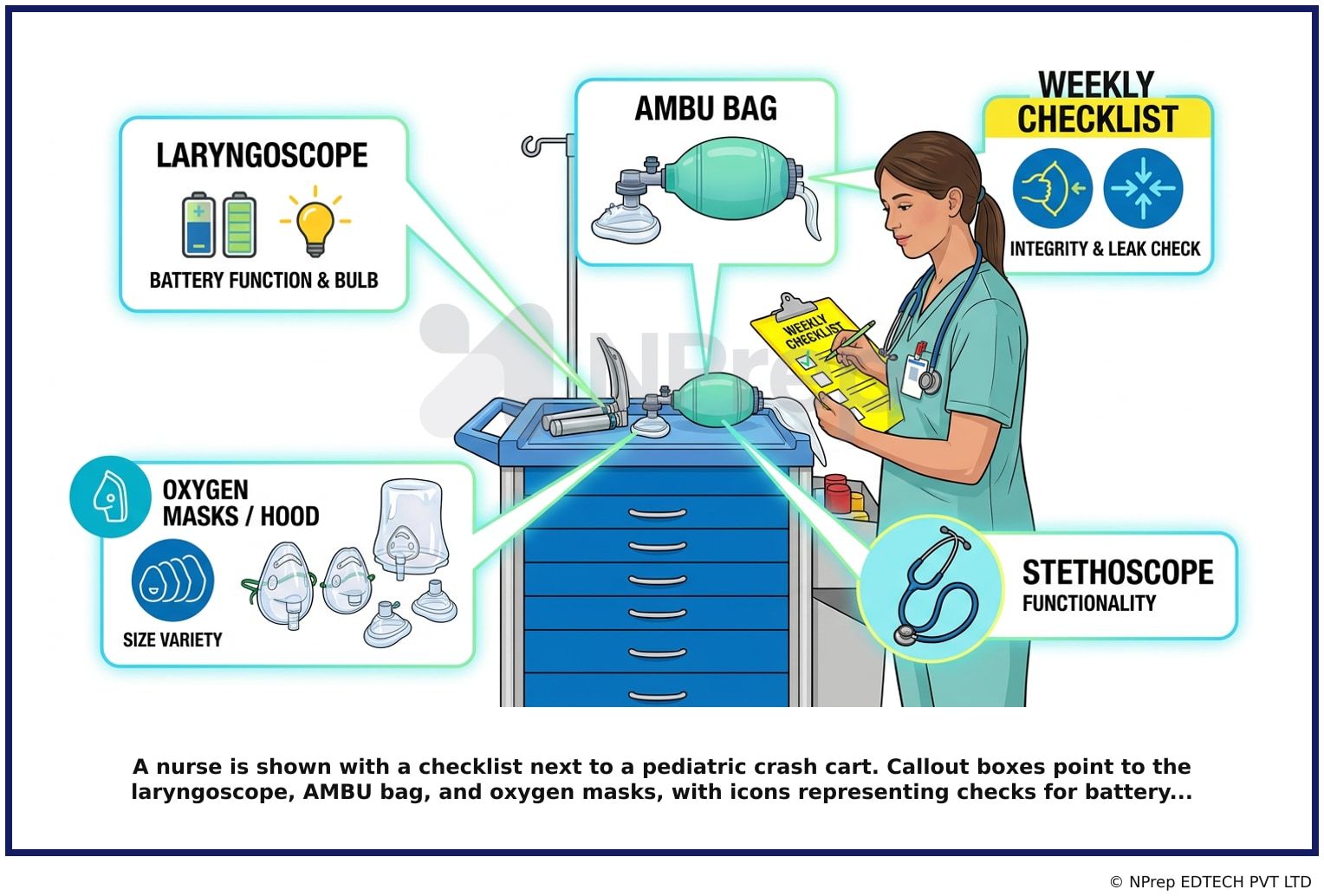
Clinical Relevance
- Nursing practice connection: This is primarily an exam-oriented knowledge point with limited direct bedside application, so retain Equipment readiness and safety protocols in a pediatric setting as background academic context rather than a clinical decision trigger.
- Ensuring equipment readiness is a fundamental professional and ethical responsibility for every nurse. It is a key component of patient safety and emergency preparedness.
- Accurate documentation of these checks provides legal and administrative proof that safety standards are being met.
- What if? A baby suddenly develops severe respiratory distress and requires immediate intubation, but the laryngoscope light does not work. This scenario underscores why weekly checks are a critical, non-negotiable nursing task. The delay in finding a working laryngoscope could lead to irreversible hypoxic brain injury or death.
How to Approach the Question
- First, identify the items listed in the question: Laryngoscope, AMBU bag, etc. Recognize that these are all critical, life-saving pieces of equipment used in emergencies.
- Next, consider the clinical setting: a pediatric nursery. This is a high-risk environment where emergencies can occur rapidly.
- The question asks for the minimum standard frequency for surveillance. This implies a balance between safety and practicality.
- Evaluate the options based on risk. Monthly or semi-monthly checks are too infrequent for equipment that must work perfectly at a moment's notice. The risk of failure is too high.
- Between weekly and twice-weekly, weekly is the most common and widely accepted minimum standard for a thorough check. Therefore, it is the most logical answer.
Concept Tested & Keywords
- Concept Tested: Equipment readiness and safety protocols in a pediatric setting.
- Stem keywords: Surveillance, Laryngoscope, AMBU bag, Mask, Oxygen hood, Stethoscope, pediatric nursery
- Lead-in keywords: at least
- Negative lead-in flag: LEAST changes the reasoning strategy; look for the exception or incorrect statement rather than the true statement.
Question ID
Q6HAHjyo10cYXmeUilXYc8
Reference Book
E6 Nelson Textbook of Pediatrics(2024) — Volume 1 pp. 580-582, 1079-1081
Practise the full NIA - 29 January 2023
Attempt every question from this paper in a timed mock, then review the full solution for each one.
More Hospital Equipments Questions
More NIA - 29 January 2023 Questions
- All are the effective methods of communication EXCEPT?
- In which year, Indian Nursing Council (INC) has published the code of ethics for nurses in India?
- Reason for obtaining an informed consent from preoperative patients is to prevent?
- Urine output less than 100 ml is termed as?
- Optic cranial nerve is a?
- Recommended dose of BCG vaccine is?
- Personnel management identifies the areas EXCEPT?
- Staff development education programme consists of?
- An independent appraisal activity within an organization for the review of accounting, financial and other operations as a basis of services of manag…
- All are the modes of organizing patient care delivery system EXCEPT?