
SGPGI Nursing Officer-2024
Medical & Surgical Nursing
Easy
What is the most common complication of peritoneal dialysis?
Appeared in: SGPGI Nursing Officer-2024
Explanation
- Peritonitis, an inflammation of the peritoneum, is the most common and serious complication of peritoneal dialysis.
- It is typically caused by microorganisms entering the abdominal cavity through the catheter site due to a break in sterile technique during dialysate exchanges.
- The earliest and most reliable sign of peritonitis is cloudy or opaque dialysate effluent, often accompanied by abdominal pain and fever.
Why Other Options Were Wrong
- Option A: Deep Vein Thrombosis is a blood clot in a deep vein and is not a direct complication of the peritoneal dialysis procedure itself.
- Option C: Peritoneal dialysis is a treatment that removes excess fluid and waste, which typically helps to lower and control blood pressure, not cause hypertension.
- Option D: Polyuria is excessive urination. Patients requiring dialysis have end-stage renal disease, characterized by minimal (oliguria) or no (anuria) urine output.
Related Visual
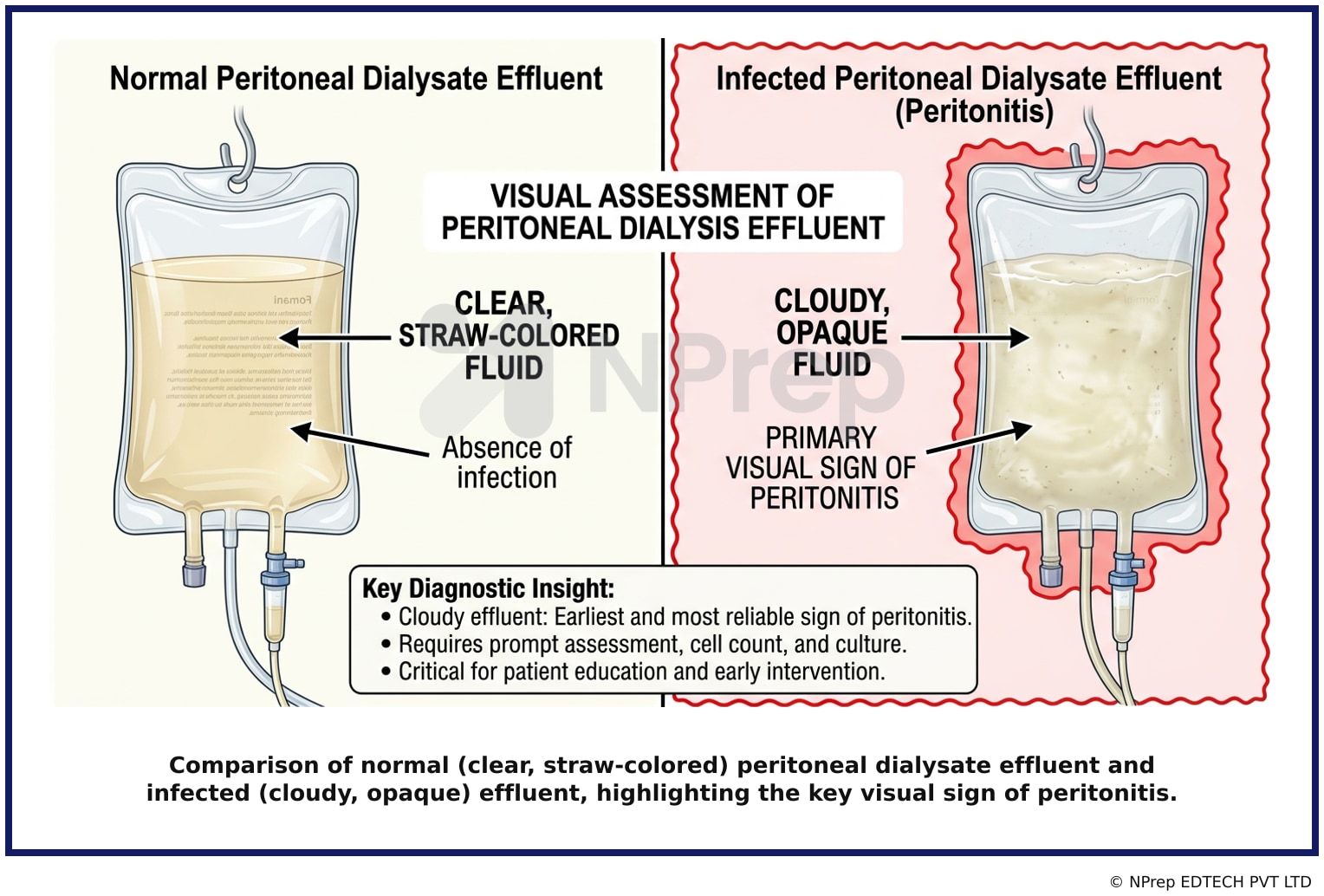
Clinical Relevance
- Nursing practice connection: This is primarily an exam-oriented knowledge point with limited direct bedside application, so retain Complications of Peritoneal Dialysis as background academic context rather than a clinical decision trigger.
- Strict adherence to aseptic technique during all PD exchanges is the most critical nursing intervention to prevent peritonitis.
- Patient and family education on recognizing early signs of peritonitis (cloudy fluid, pain, fever) is vital for prompt treatment and preventing hospitalization or catheter loss.
- What if? If a patient reports abdominal pain but the effluent is clear, the nurse should still assess for other causes like constipation, catheter malposition, or exit-site infection, as these are also common issues in PD patients.
How to Approach the Question
- First, identify the core of the question, which asks for the 'most common complication' of a specific procedure: 'peritoneal dialysis'.
- This is a factual recall question. Access your knowledge about renal replacement therapies.
- Consider the nature of peritoneal dialysis: it involves a permanent catheter into the abdomen and regular fluid exchanges, creating a direct portal for infection.
- Evaluate the options. Peritonitis is an infection of the peritoneum, a direct and well-known risk of this procedure.
- Eliminate the other options. DVT is a clotting issue, hypertension is often treated by dialysis, and polyuria is the opposite of the renal failure state.
- Conclude that peritonitis is the most logical and common complication among the choices.
Concept Tested & Keywords
- Concept Tested: Complications of Peritoneal Dialysis
- Stem keywords: complication, peritoneal dialysis
- Lead-in keywords: most common
Question ID
QtyIG4T8as1c7pdzErc88u
Reference Book
E6 Medicine Harrison 22e Part 2 p. 305-307
Practise the full SGPGI Nursing Officer-2024
Attempt every question from this paper in a timed mock, then review the full solution for each one.
More Urinary Tract Function Questions
- Assessing the laboratory findings which results would the nurse most likely to expect to find in a client with chronic renal failure?
- A nurse is taking care of Chronic renal dysfunction patient. What diet she will advise for this patient?
- A patient is admitted with acute renal kidney injury, and nurse is advised to monitor strict urine output. She notices urine output is less than 100…
- The following are the use of the central line catheter; EXCEPT:
- The involuntary loss of urine through an intact urethra as a result of sudden increase in the intra-abdominal pressure is called:
- Which of the following is the warning sign post renal transplantation?
- What is contraindicated in male patient reporting the symptoms of redness and ecchymosis in the scrotum region?
- A patient with low urine specific gravity will have all the following characteristics; EXCEPT:
- Food contraindicated with CRF and spironolactone:
- When initiating the use of a newly inserted Central Venous Access Device (CVAD), what is the recommended syringe size for the initial flushing proced…
More SGPGI Nursing Officer-2024 Questions
- Choose the one which can be substituted for the given word/sentence. List of the business or subjects to be considered at a meeting.
- Give one word for 'a speech delivered without any previous preparation'?
- Change into passive voice - The girls ate a mango yesterday.
- How is circle different from Ellipse?
- Which country was the first to approve a medical suicide act?
- How many permanent members are there in the UNO?
- The bird wings correspond a man's hands.
- If ROME is written as MORE then DARE is written as:
- The sum of two numbers is 75 and their difference is 25. The product of the two numbers is
- If 30% of a number when added to 50 is equal to the number. Then the number is?